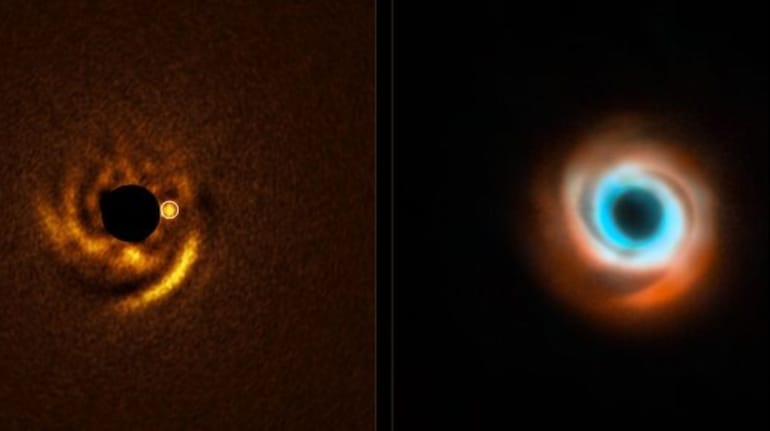
Astronomers believe they’ve seen something quite special—a planet being born before their eyes. Using a powerful telescope in Chile, they’ve spotted clues of a young planet forming 440 light-years away.
Planet Spotted in Cosmic Nursery
A team studying the star HD 135344B has seen a pattern in the gas and dust that hints at something forming deep inside. With the help of ESO’s Very Large Telescope (VLT), they noticed spiral arms in a disc around the star. This shape isn’t just beautiful; it could be a planet’s doing. The suspected planet is likely twice the size of Jupiter and as far from its star as Neptune is from the Sun.
What’s exciting is where the planet sits—right at the start of one of those spirals. That’s exactly where scientists thought a forming planet might be hiding. Until now, no one had seen one in that very spot.
The team used a new tool on the VLT called ERIS. It helped them detect the light from the possible planet itself—not just how it moves dust around. That gives them more confidence that what they’re seeing is real.
Francesco Maio, who led the research from Italy, said this could be the closest thing we’ll ever get to watching a planet like Earth form in real time.
Another Star, Another Surprise
In a separate study, another group looked at a very young star called V960 Mon. Their goal was to find out if planets might be forming there too. They used the same ERIS tool and found what could be a companion near the star. It might be a baby planet or something a bit bigger—a brown dwarf, which isn’t quite a star.
Earlier studies had already shown spiral patterns and breaking materials around V960 Mon. That process, called gravitational instability, happens when chunks of gas and dust start collapsing under their own weight.
Anuroop Dasgupta, who led this second study, says they’ve finally seen one of those chunks turning into something real.
More Clues About Planet Birth
Both studies give scientists better ideas of how planets form. The ERIS tool has made it easier to see inside dusty discs. Now astronomers have more evidence that spiral arms and broken-up gas clouds are signs of baby worlds taking shape.
The discoveries have been published in Astronomy & Astrophysics and The Astrophysical Journal Letters.
Discover the latest Business News, Sensex, and Nifty updates. Obtain Personal Finance insights, tax queries, and expert opinions on Moneycontrol or download the Moneycontrol App to stay updated!
Find the best of Al News in one place, specially curated for you every weekend.
Stay on top of the latest tech trends and biggest startup news.