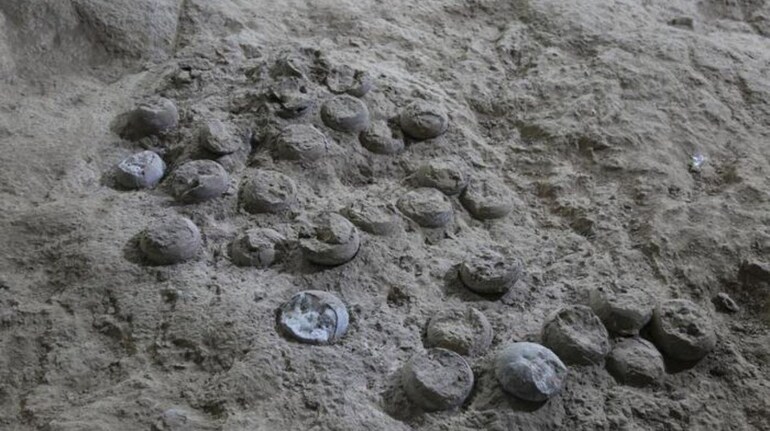
These eggs from this family might have developed special pore patterns to adapt to cooler temperatures. One batch of 28 egg-filled calcite was chosen to research, giving the ideal sample for accurate dating.
How were the eggs dated so precisely?
For the first time, researchers applied carbonate uranium-lead (U-Pb) dating directly to the eggshells. A micro-laser vaporised carbonate minerals into aerosol, which a mass spectrometer analysed. Uranium naturally decays into lead at a fixed rate, acting as an “atomic clock” to calculate the age. The measurements indicated the eggs were laid about 85 million years ago, in the Late Cretaceous, with an error of 1.7 million years. The technique skips conventional indirect dating through volcanic units or nearby rocks, offering the first sound chronological constraints on Qinglongshan dinosaur eggs.
 Dinosaur egg fossil used for geological age dating. (Image: Dr. Bi Zhao)
What do the eggs tell us about past climates?
By the time they were laid, Earth had initiated global cooling after the previous Turonian period. Temperatures had fallen, probably impacting dinosaur diversity and egg-laying behaviour in Qinglongshan. The researchers propose that the very porous shells of Dendroolithid eggs might be an adaptation to such conditions. Placoolithus tumiaolingensis could be an indication of a population that had difficulty surviving in cooler conditions, with an evolutionary dead end. These fossils also offer some hints regarding the evolution of dinosaurs, patterns of extinction, and environmental change in the Late Cretaceous.
Even though few eggshell samples were studied, they were all uniform in age with that of adjoining rocks. Scientists expect to widen the sampling to eggs found in other layers of rocks and in nearby basins to follow migration and construct a regional timeline. This method uses fossils to create a rich history of Earth, enhancing the knowledge of how ancient species coped with climate stresses.
Scientists can investigate questions regarding species, egg morphology, and reproductive specialisations by examining these fossils. The eggs indicate that Dendroolithid dinosaurs laid highly specialised eggs with intricate structures that could have determined how many eggs were laid and survived. Insights into how the eggs worked give a glimpse into the lives of dinosaurs and the environments that existed 85 million years ago.
Discover the latest Business News, Sensex, and Nifty updates. Obtain Personal Finance insights, tax queries, and expert opinions on Moneycontrol or download the Moneycontrol App to stay updated!
Find the best of Al News in one place, specially curated for you every weekend.
Stay on top of the latest tech trends and biggest startup news.