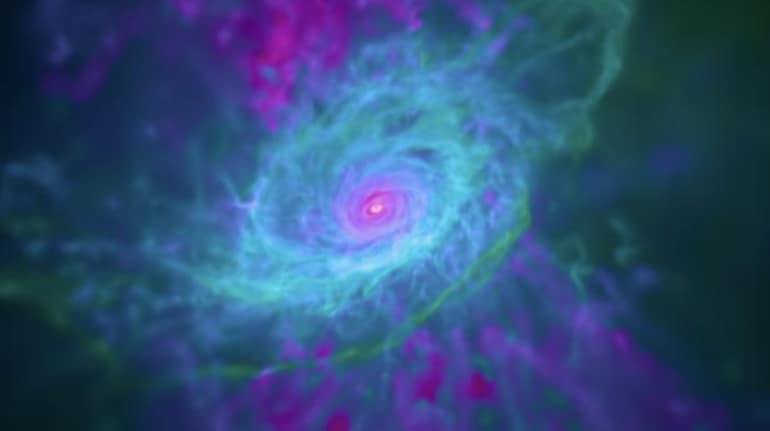
A new study solves a decades-long Milky Way mystery. Nearby stars show two distinct chemical sequences. Scientists now understand how these sequences formed differently. Advanced simulations reveal multiple paths produce similar stellar patterns.
What Has Been Found?
The stars near the Sun split into magnesium-rich and iron-rich groups. This unusual “chemical bimodality” puzzled astronomers for many years. The split is clear in metallicity and element abundance charts. It occurs without major galaxy collisions, contrary to prior assumptions.
Who and Where this Research took place?
Researchers used the Auriga simulations of thirty spiral galaxies. The study was done by researchers working with the Auriga simulations. A team was led by Matthew D. A. Orkney (at the Institute of Cosmos Sciences of the University of Barcelona / IEEC) along with collaborators from CNRS, and other institutions.
The research, published today in Monthly Notices of the Royal Astronomical Society, explores the origins of a puzzling feature in the Milky Way.
What Did Scientists Observe?
Magnesium-rich stars formed early during bursts of star formation. Iron-rich stars emerged later as gas inflows gradually enriched the galaxy. Cold gas from outside the galaxy fueled the second stellar group. Different formation histories led to the Milky Way’s chemical split.
Why This Research Matters?
It shows our galaxy is not a single-path evolutionary case. Other galaxies may develop similar chemical splits differently. The findings challenge merger-centric explanations for star formation histories. Understanding chemical sequences improves knowledge of galactic evolution processes.
What Does Future Hold?
Upcoming telescopes like JWST will test these chemical formation theories. The astronomers can study distant galaxies to compare evolutionary patterns. Simulations may reveal how gas inflow shapes other spiral galaxies. This research guides interpretation of stellar surveys across the universe.
Discover the latest Business News, Sensex, and Nifty updates. Obtain Personal Finance insights, tax queries, and expert opinions on Moneycontrol or download the Moneycontrol App to stay updated!
Find the best of Al News in one place, specially curated for you every weekend.
Stay on top of the latest tech trends and biggest startup news.