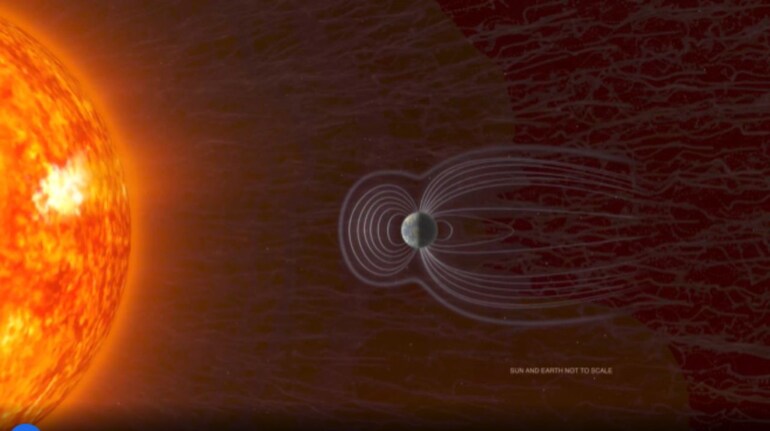
A new solar milestone has just been reached by NASA’s Parker Solar Probe. The spacecraft, currently the closest object to ever study the Sun, has captured detailed new images from within the star’s blazing atmosphere. These visuals and observations are helping scientists decode how solar winds form and affect Earth.
Peering into the Heart of the Sun
On December 24, 2024, Parker Solar Probe swept just 3.8 million miles from the Sun’s surface. Flying through the corona—the Sun’s outer atmosphere—the spacecraft used its Wide-Field Imager, or WISPR, to snap scenes of charged particles and swirling solar winds.
NASA says these images offer a rare chance to watch space weather begin with our own eyes. It’s a vital step to improve predictions that safeguard astronauts, satellites, and ground-based electronics. The corona is where charged outbursts and magnetic currents are launched, which can sometimes disrupt Earth’s power grids and communication networks.
The latest images also reveal the heliospheric current sheet, where the Sun’s magnetic field flips direction. For the first time, scientists saw coronal mass ejections (CMEs) pile up and merge in real time. Understanding how CMEs combine and shift is crucial for predicting their journey and impact.
Zooming into Solar Wind Origins
Decades ago, physicist Eugene Parker proposed the idea of solar wind. Named in his honour, the Parker probe has gone much closer to test those theories. At Earth’s distance, solar wind feels like a steady stream. But closer in, Parker found the wind is erratic, filled with magnetic ‘switchbacks.’ These zig-zagging fields were more common than expected.
In 2021, the spacecraft entered the corona for the first time. It found the edge of the corona was uneven and more complex than earlier models showed. In 2024, Parker’s closer pass helped scientists trace the fast solar wind’s origin to magnetic funnels on the Sun’s surface.
The slower solar wind, however, remains harder to decode. Moving at just 220 miles per second, it’s denser and more unpredictable. Scientists now believe two types exist—Alfvénic and non-Alfvénic—and Parker’s data confirms this. One seems to arise from coronal holes, while the other likely forms near helmet streamers, huge loop structures on the Sun.
More Clues Await with Next Flyby
NASA experts say understanding the solar wind’s path and power is essential. Its mix with fast solar wind can still trigger major storm effects on Earth. Parker’s next journey toward the Sun is scheduled for 15 September 2025, and it may offer more clarity.
“We’re closer than ever to solving this puzzle,” said NASA’s Nour Rawafi. But with every new orbit, Parker continues to reveal how complex and alive our star really is.

Discover the latest Business News, Sensex, and Nifty updates. Obtain Personal Finance insights, tax queries, and expert opinions on Moneycontrol or download the Moneycontrol App to stay updated!
Find the best of Al News in one place, specially curated for you every weekend.
Stay on top of the latest tech trends and biggest startup news.