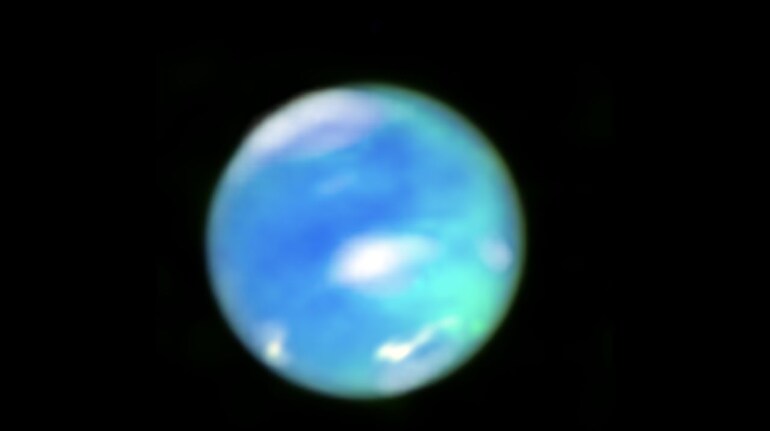
Neptune's auroras have been seen in full view for the first time. They were captured on camera by NASA's James Webb Space Telescope. While there was no hard evidence, astronomers had long suspected their presence. Webb's powerful instruments have now proved it.
A Long-Awaited Finding
When high-energy particles hit a planet's atmosphere, auroras are created. They occur on Earth near the north and south poles. But they occur in unusual mid-latitude regions on Neptune. This is because Neptune's magnetic field is tilted at 47 degrees. This peculiarity was first found by Voyager 2 in 1989.
Astronomers have been hunting for Neptune's auroras for decades. Earlier expeditions detected weak patterns of activity. But good imaging was still out of reach. Lead researcher Henrik Melin of Northumbria University was surprised at Webb's results. "Seeing the auroras so clearly was quite a surprise for us," he said.
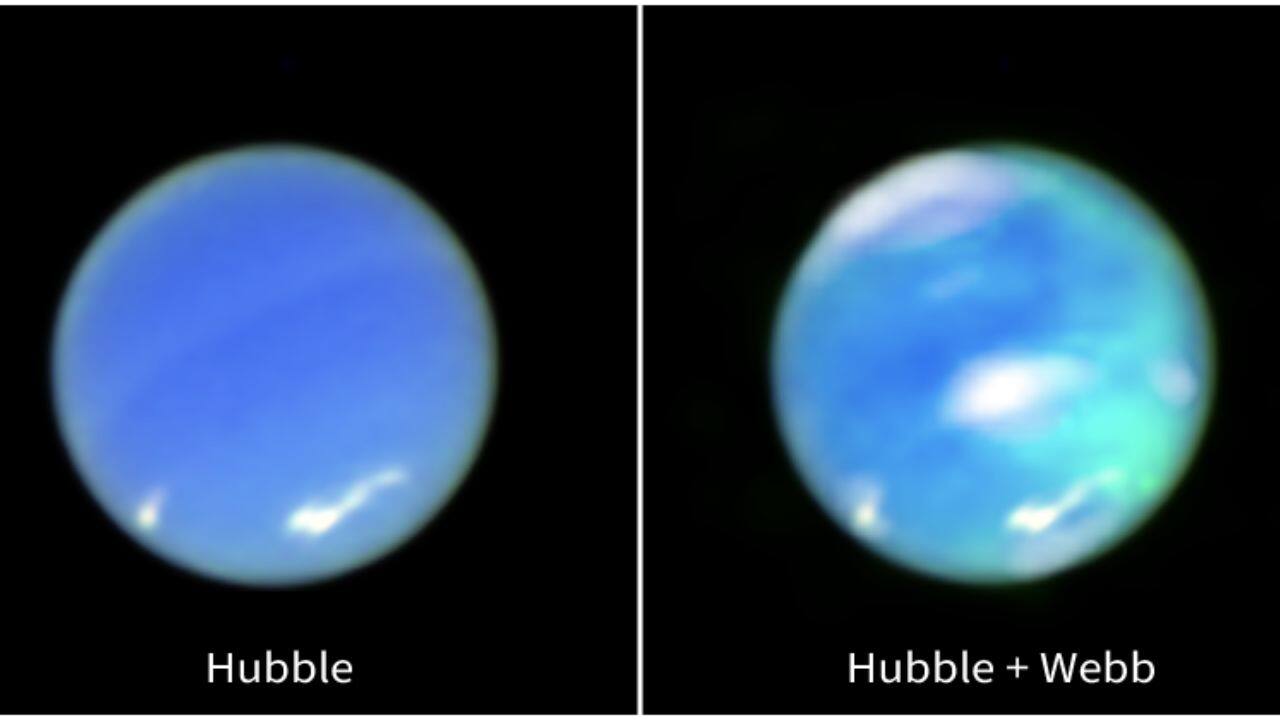 At the left, an enhanced-color image of Neptune from NASA’s Hubble Space Telescope. At the right, that image is combined with data from NASA’s James Webb Space Telescope. The cyan splotches, which represent auroral activity, and white clouds, are data from Webb’s Near-Infrared Spectrograph (NIRSpec), overlayed on top of the full image of the planet from Hubble’s Wide Field Camera 3. (Image: NASA)
Why Neptune's Auroras Were So Hard to See
Webb utilized its Near-Infrared Spectrograph to research Neptune. It took photos and analyzed the composition of the atmosphere. Scientists were given a firm signal for the trihydrogen cation (H3+). This is a chemical responsible for auroras on Saturn, Uranus, and Jupiter. Its identification in Neptune substantiated the expectations of the astronomers.
The cause of these auroras remaining invisible was also revealed by the study. Neptune's upper atmosphere has cooled significantly, as per information. The temperatures have dropped by several hundred degrees from the time Voyager 2 flew by. Auroras become less detectable at lower temperatures, making detection difficult.
Future Studies and Monitoring of Solar Cycles
Researchers now plan to study Neptune over an entire solar cycle. Planetary atmospheres are affected by this 11-year cycle. The magnetic field of Neptune could be explained by studying its auroras.
Leicester University's Leigh Fletcher underscored the importance of Webb. "Future missions to Neptune will have to include infrared instruments," he said. "This telescope has finally enabled us to study its secret ionosphere."
NASA's James Webb Telescope continues to explore the universe. Its latest findings give new insights into the icy giant. The discoveries are a major leap forward in our understanding of Neptune's atmosphere.
Discover the latest Business News, Sensex, and Nifty updates. Obtain Personal Finance insights, tax queries, and expert opinions on Moneycontrol or download the Moneycontrol App to stay updated!
Find the best of Al News in one place, specially curated for you every weekend.
Stay on top of the latest tech trends and biggest startup news.