

Mission Dragonfly is the most valuable and promising step for NASA, and this mission has reached a major milestone. The mission’s rotorcraft lander is designed to fly across Saturn’s largest moon Titan.
Integration and testing phase of rotorcraft has begun at the Johns Hopkins Applied Physics Laboratory in Maryland. This stage will ensure that all systems function flawlessly under the extreme conditions of space travel and Titan’s harsh environment.
Mission Dragonfly on Move
NASA’s ambitious Dragonfly mission is moving forward with a critical milestone. This car-sized rotorcraft is designed to fly across Titan, Saturn’s largest moon, in ways no rover ever could.
The mission aims to explore Titan’s diverse terrains, search for organic molecules and investigate prebiotic chemistry. APL is building the car-sized, nuclear-powered drone for NASA for this mission.
How Is This Rotorcraft Made?
Dragonfly is powered by a radioisotope thermoelectric generator which allow it to operate in Titan’s extremely cold and dark environment. NASA Engineers assemble the craft’s rotors, instruments, sensors and avionics in carefully controlled clean rooms.
Each component undergoes detailed checks to ensure it can withstand both launch stresses and the conditions on Titan.
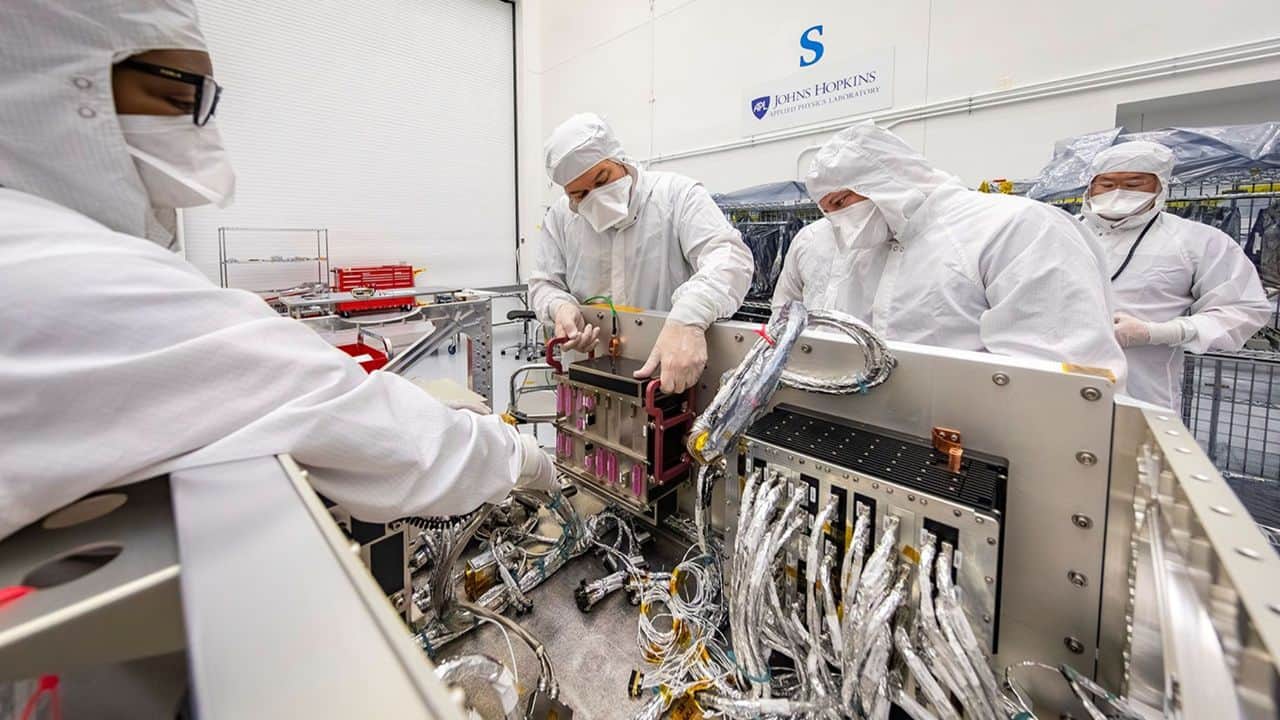 The functional testing on Dragonfly’s Integrated Electronics Module (IEM) has begun. (Image: NASA/Johns Hopkins APL/Ed Whitman)
Integration Testing Phase Has Begun
The rotorcraft has entered the integration and testing phase at the Johns Hopkins Applied Physics Laboratory in Laurel, Maryland.
Engineers are performing rigorous tests that simulate launch vibrations, space travel and Titan-like environmental conditions. These tests ensure that all systems function perfectly before leaving Earth.
2026 Will Be Testing Phase for Dragonfly
Dragonfly integration and testing will continue at APL through this year and into early 2027, when system-level testing is planned at Lockheed Martin. Throughout 2026, Dragonfly will undergo extensive testing of its flight systems, avionics and sensors.
“Starting integration and testing is a huge milestone for the Dragonfly team,” said Annette Dolbow. He is the Dragonfly integration and test lead at APL.
NASA is Preparing for Titan Exploration
Dragonfly is scheduled to launch no earlier than 2028. Once on Titan, it will fly across multiple locations, from dune fields to potential cryovolcanoes. This is due to its mobility that will helps it take samples and investigate chemical processes.
The areas that could not be reached by traditional rovers will also be covered. It will launch in 2028 in spring out of NASA Kennedy Space Center in Florida.
Through geology and organic chemistry by analyzing the atmosphere of Titan, Dragonfly would be able to provide some hints concerning the origin of life outside of Earth.
Discover the latest Business News, Sensex, and Nifty updates. Obtain Personal Finance insights, tax queries, and expert opinions on Moneycontrol or download the Moneycontrol App to stay updated!
Find the best of Al News in one place, specially curated for you every weekend.
Stay on top of the latest tech trends and biggest startup news.