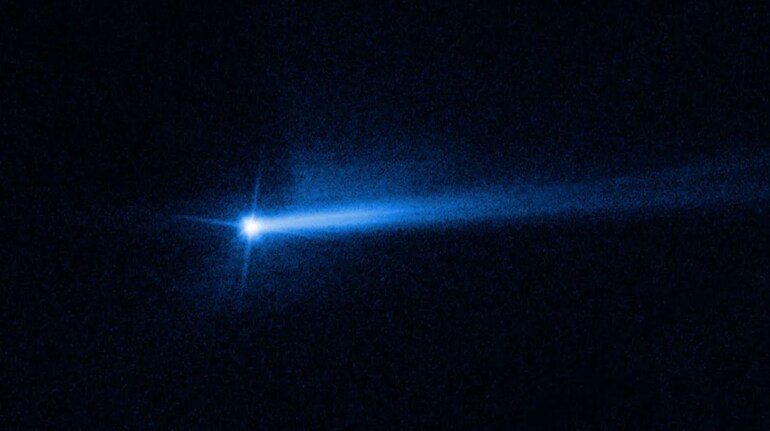

A groundbreaking study has revealed that NASA’s historic asteroid-deflection experiment did more than scientists initially realised. The agency’s Double Asteroid Redirection Test (DART) not only altered the motion of a small asteroid within its system but also slightly changed the orbit of the entire asteroid pair around the Sun.
The finding highlights the powerful potential of spacecraft impacts as a planetary defence strategy to protect Earth from hazardous asteroids.
What the DART mission targeted?
The DART spacecraft was deliberately crashed into Dimorphos, a small asteroid that orbits the larger asteroid Didymos.
Dimorphos measures about 170 metres in diameter, while Didymos is about 805 metres wide. Together they form a binary asteroid system that orbits the Sun.
Notably, the system is not harmful to the Earth making them a perfect natural laboratorium to test the asteroid-deflection technology.
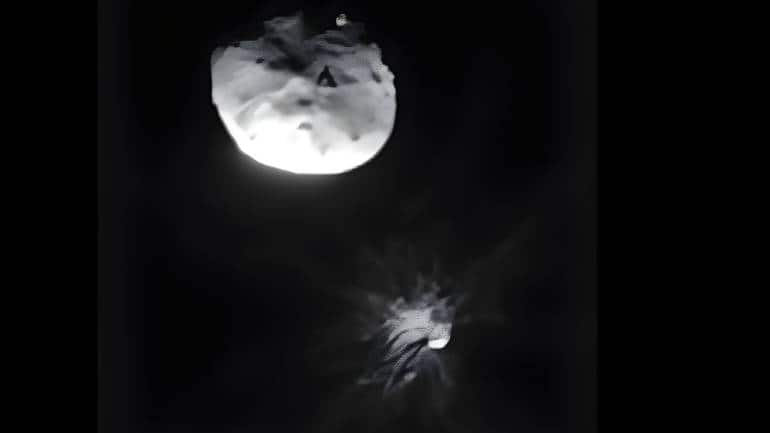 Dimorphos took 11 hours and 55 minutes to orbit Didymos. (Image: NASA/ASI)
A historic collision in space
In September 2022, DART intentionally smashed into Dimorphos at a speed of about 22,500 km per hour. The objective of the mission was to experiment with the method of the kinetic impactor.
This is associated with striking an asteroid with a spacecraft so as to alter its movement. Initial observations soon confirmed that the mission had succeeded.
How the asteroid’s orbit changed?
Before the impact, Dimorphos took 11 hours and 55 minutes to orbit Didymos. Its collision resulted in a period of orbit of 11 hours and 23 minutes, that is, the orbit was reduced by 33 minutes.
This was so much more than was projected by the scientists and proved that the influence had indeed worked to change the movement of the asteroid.
The entire asteroid system shifted
New analysis has now revealed another surprising effect: the collision also slightly altered the orbit of the Didymos system around the Sun. Researchers found that the solar orbital period changed by about 0.15 seconds.
The system’s speed changed by roughly 11.7 microns per second. Although these changes are extremely small, they demonstrate that human-made spacecraft can measurably alter the motion of celestial objects in the solar system.
Debris from the impact amplified the effect
The effect was successful as indicated by scientists. They anticipated since it threw off a massive columnar spray of rocky debris of Dimorphos. This debris was a kind of natural rocket exhaust, which began to push the asteroid even further and increase the momentum passed by the spacecraft. This was called momentum enhancement and greatly augmented the deflection.
Why this discovery matters for Earth?
The results prove that kinetic impact missions could be used to protect Earth from dangerous asteroids. If scientists detect a potentially hazardous asteroid years or decades in advance, even a tiny push from a spacecraft could shift its path enough to make it safely miss Earth.
The DART experiment marks a historic milestone. For the first time, humans have successfully demonstrated the ability to change the motion of an asteroid in space.
Discover the latest Business News, Sensex, and Nifty updates. Obtain Personal Finance insights, tax queries, and expert opinions on Moneycontrol or download the Moneycontrol App to stay updated!
Find the best of Al News in one place, specially curated for you every weekend.
Stay on top of the latest tech trends and biggest startup news.