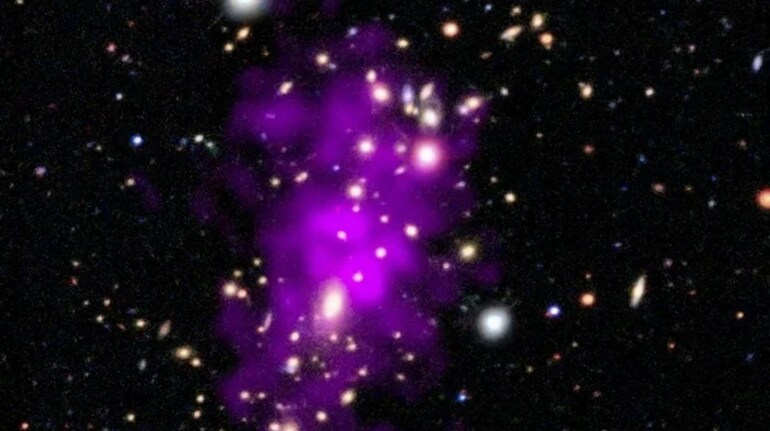

A newly released space image is offering astronomers fresh insight into a dramatic cosmic collision. Observations focus on the Champagne Cluster, a rare merging galaxy cluster studied using NASA’s Chandra X-ray Observatory alongside powerful optical telescopes, revealing clues about dark matter behaviour.
Champagne Cluster Collision Caught in Detail
The Champagne Cluster was discovered on New Year’s Eve 2020. It was identified during surveys searching for distant galaxy clusters. Scientists later noticed its unusual structure and striking appearance. The timing of discovery helped inspire its celebratory nickname. Its official designation, RM J130558.9+263048.4, proved far less memorable.
New composite images show the cluster is not singular. Instead, it consists of two massive galaxy clusters merging. Chandra X-ray data reveals superheated gas glowing brightly. Optical data from the Legacy Surveys adds further detail. These surveys combine observations from telescopes in Arizona and Chile. Together, the datasets provide a layered view of matter.
Unlike typical clusters, the hot gas appears stretched vertically. Normally, such gas forms rounded or oval shapes. This distortion suggests a violent collision occurred. Two dense concentrations of galaxies are also visible. One sits above the image centre, another below. These mark the locations of each merging cluster.
The hot gas within the system outweighs all visible galaxies combined. More than one hundred galaxies inhabit the forming cluster. Beyond this lies even more unseen mass. Astronomers say vast quantities of dark matter dominate. This invisible material shapes how clusters collide and evolve.
Dark Matter Clues from a Rare Merger
The Champagne Cluster belongs to an exclusive cosmic category. It resembles the famous Bullet Cluster studied previously. In such systems, hot gas slows during collisions. Meanwhile, galaxies and dark matter pass through faster. This creates separation between visible gas and mass concentrations.
Such separation allows scientists to test dark matter behaviour. By tracking movement differences, researchers infer interaction properties. Dark matter appears to interact weakly with itself. These observations help refine cosmological models.
Researchers compared real data with advanced computer simulations. Two possible collision histories emerged from this analysis. Each scenario offers different timelines and implications.
Two Possible Histories, One Ongoing Mystery
One theory suggests a collision over two billion years ago. After impact, clusters drifted apart through momentum. Gravity then reversed their outward motion gradually. They are now approaching another potential collision.
The alternative theory proposes a much younger event. In this case, clusters collided around 400 million years ago. They are currently moving away from each other. Both explanations fit certain observed features.
Further observations will help narrow possibilities. Scientists plan additional modelling and deeper X-ray studies. The findings were published in The Astrophysical Journal. Researchers say the Champagne Cluster remains a valuable natural laboratory. It continues offering insight into cosmic collisions and dark matter’s elusive nature.
Discover the latest Business News, Sensex, and Nifty updates. Obtain Personal Finance insights, tax queries, and expert opinions on Moneycontrol or download the Moneycontrol App to stay updated!
Find the best of Al News in one place, specially curated for you every weekend.
Stay on top of the latest tech trends and biggest startup news.