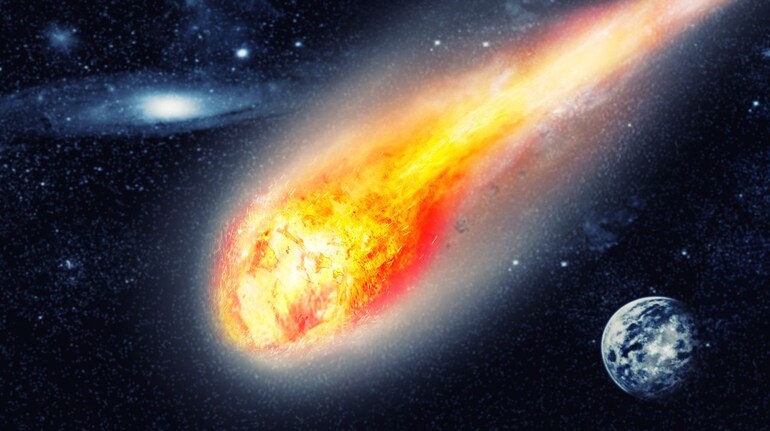
An asteroid named 2011 MW1 is currently speeding towards Earth at a velocity of 28,946 km/h. NASA has raised an alert concerning this Apollo-class asteroid, which is about 380 feet in size. Data from NASA's Center for Near-Earth Object Studies (CNEOS) indicates that the asteroid will make its closest approach to Earth on July 25, coming within approximately 2.4 million miles.
Although 2011 MW1's orbit brings it relatively close to Earth's orbit, it does not pose an imminent threat. The asteroid is classified as a Near-Earth Asteroid (NEA) by NASA’s Jet Propulsion Laboratory due to its distance from our planet but is not categorized as a ‘Potentially Hazardous Asteroid (PHA).’ NASA has identified around 35,000 Near-Earth Objects (NEOs) to date. Despite its skyscraper-like size, NASA assures that 2011 MW1 does not endanger Earth, though its trajectory and movement are being closely monitored.
Asteroids, which are remnants from the formation of the solar system, typically orbit the sun like planets but are much smaller. Many asteroids reside in the main asteroid belt between Jupiter and Mars. As of July 2024, there are 1,385,217 known asteroids or minor planets, according to NASA's JPL Solar System Dynamics website.
Asteroid Watch and Monitoring Efforts
NASA’s Center for Near-Earth Object Studies (CNEOS) is responsible for tracking the orbits of all NEOs and predicting their approaches to Earth and potential impacts. NEOs are asteroids or comets that come within 120 million miles of the Sun and can thus pass close to Earth’s orbital neighborhood, posing possible risks.
NASA employs various observatories dedicated to collecting asteroid tracking information, including PAN-STARRS, the Catalina Sky Survey, NASA’s NEOWISE mission, and the upcoming NEO Surveyor. Additionally, radar initiatives like the Goldstone Solar System Radar Group complement NASA’s NEO Observations Program. Space agencies are also developing technologies to counter potential threats from celestial bodies, such as the DART mission.
Through these extensive monitoring efforts and technological advancements, NASA aims to ensure that any potential threats from asteroids like 2011 MW1 are detected and mitigated well in advance.
Discover the latest Business News, Sensex, and Nifty updates. Obtain Personal Finance insights, tax queries, and expert opinions on Moneycontrol or download the Moneycontrol App to stay updated!
Find the best of Al News in one place, specially curated for you every weekend.
Stay on top of the latest tech trends and biggest startup news.