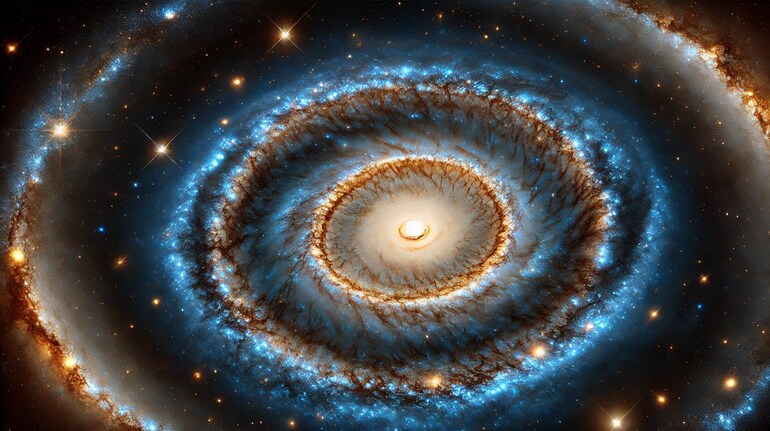
NASA’s Hubble Space Telescope has revealed a galaxy resembling a bullseye, with multiple rings expanding from its centre. This rare sight offers insights into galactic collisions and star formation in deep space.
Rare Galactic Collision Creates Expanding Rings
Researchers identified the galaxy, named LEDA 1313424, around 50 million years after a smaller blue dwarf galaxy passed through its centre. This impact left behind nine distinct rings, a record number in such interactions. The rings, filled with newly formed stars, spread out like ripples in a pond.
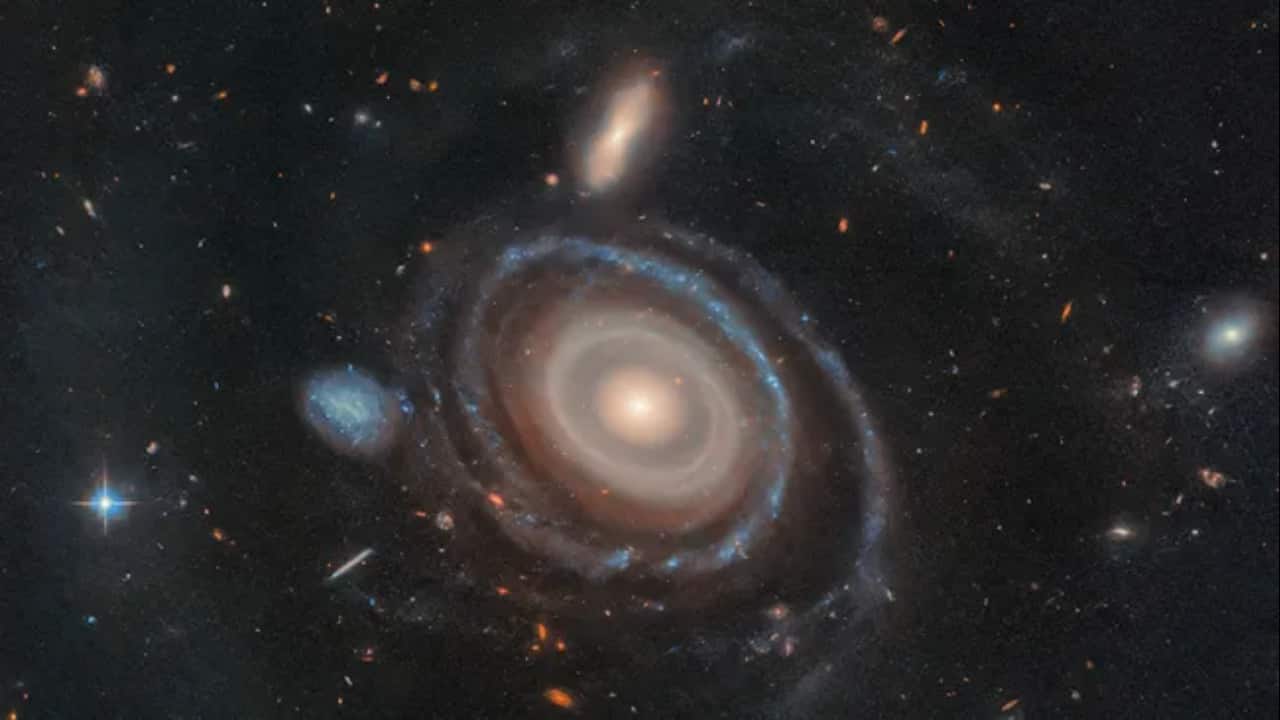 LEDA 1313424, known as the Bullseye, is 2.5 times larger than the Milky Way and has nine rings—six more than any other known galaxy. (Image: NASA)
Hubble’s Role in the Discovery
Lead researcher Imad Pasha, a Yale University doctoral student, first noticed the rings in a ground-based survey. Hubble’s detailed images later confirmed the structure. Previous studies had detected at most three rings in similar collisions, making this observation unique. Scientists suggest a tenth ring might exist beyond the detected ones.
Future Research and Observations
Astronomers believe the rings expand outward over time, aligning with computational models. The upcoming Nancy Grace Roman Space Telescope could reveal more galaxies like this, further enhancing understanding of cosmic collisions.
Discover the latest Business News, Sensex, and Nifty updates. Obtain Personal Finance insights, tax queries, and expert opinions on Moneycontrol or download the Moneycontrol App to stay updated!
Find the best of Al News in one place, specially curated for you every weekend.
Stay on top of the latest tech trends and biggest startup news.