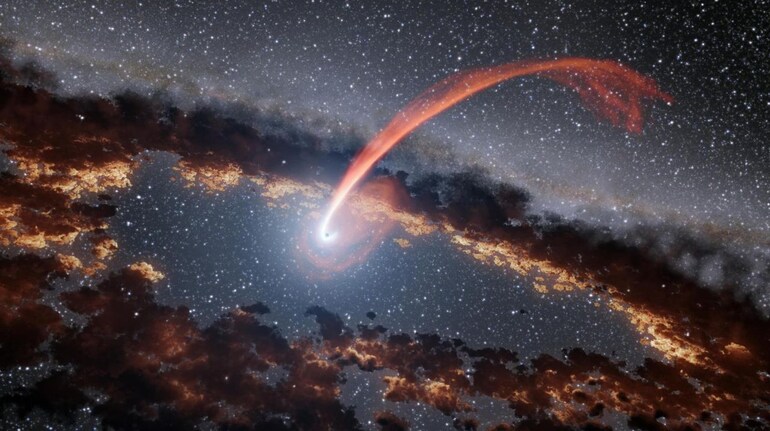
Sometimes, space feels like it’s holding its breath. Quiet, calm, and then—boom—something enormous happens. That’s what scientists are seeing now. Supermassive black holes are waking up to devour giant stars, and the explosions are lighting up the universe.
A New Class of Cosmic Fireworks
A new study highlights three unusual events in deep space. Each involves a quiet black hole suddenly flaring into life. These giants destroyed stars several times heavier than our Sun. Their violent feasts gave off more energy than 100 supernovae combined.
The black holes sit in the centres of faraway galaxies. They stayed dark for years before tearing into massive stars. After the stars were destroyed, the black holes glowed brightly for months.
Scientists call these outbursts “extreme nuclear transients”. They are unlike anything else seen in the universe. Researchers believe studying them could reveal more about black holes that are usually silent.
“These events are rare but powerful,” said Jason Hinkle. He is a graduate student at the University of Hawaii. Hinkle led the new study published in Science Advances. “They help us study quiet black holes in action.”
Tracking Down the Star Eaters
One of the events was first spotted in 2020. It was found by the Zwicky Transient Facility in California. The star-shattering flash was nicknamed “Barbie” for its catalogue tag ZTF20abrbeie.
The other two events came from data gathered by ESA’s Gaia mission. They were spotted in 2016 and 2018. NASA’s Swift Observatory later confirmed all three involved black holes, not stars exploding.
The way light rose and faded was the key clue. Swift watched X-rays, UV, and visible light change over time. The pattern matched known black hole behaviour when destroying a star.
High-energy light from these explosions took over 100 days to peak. It then took more than 150 days to fall to half that level. These changes affected the surroundings and gave off signals that ground-based telescopes could see.
Eyes on the Infrared Universe
NASA’s retired WISE spacecraft also played a key role. It had mapped the sky in infrared from 2009 to 2011. Later renamed NEOWISE, it helped scientists measure dust around the black holes.
The research also used ground telescopes, including Keck Observatory. NASA-supported surveys like ATLAS, Pan-STARRS, and Catalina also added data.
“This study pushes what we know about extreme environments,” said Anna Payne. She is a staff scientist at the Space Telescope Science Institute. She worked on chemical analysis using a University of Hawaii telescope.
The work was funded by a FINESST grant from NASA. It helped Hinkle continue exploring rare black hole flares. “The grant gave him freedom to dig deeper,” said advisor Ben Shappee.
Now, Hinkle is continuing this research at the University of Illinois Urbana-Champaign. He is doing so under the NASA Hubble Fellowship. “We still want to know how black holes grow,” he said.
These results also add to what NASA’s James Webb Space Telescope is finding. While Webb looks at how black holes eat gas in early space, these events show another feeding method.
Only 10% of early black holes eat gas and dust. But when one eats a giant star, it puts on a rare and brilliant show. The light from such an event could be seen across billions of years.
Looking to the Future with Roman
NASA’s upcoming Roman Space Telescope may soon find more. It is designed to see in infrared light, ideal for these events. As space expands, ultraviolet light from black holes stretches into infrared. Roman will be ready to detect it.
Roman’s wide view and strong infrared sensors are perfect for the task. It may even catch events from when the universe was just 1 billion years old. The telescope is set to launch by 2027, or possibly in late 2026.
“These three explosions show us what to look for,” said Payne. “They’re a starting point for future black hole discoveries.”
Discover the latest Business News, Sensex, and Nifty updates. Obtain Personal Finance insights, tax queries, and expert opinions on Moneycontrol or download the Moneycontrol App to stay updated!
Find the best of Al News in one place, specially curated for you every weekend.
Stay on top of the latest tech trends and biggest startup news.