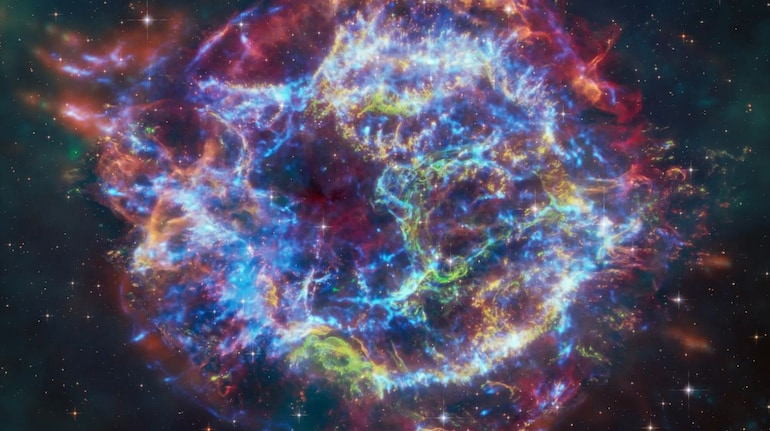
A joint NASA-JAXA mission has revealed rare elements in a supernova. XRISM detected life-essential elements in Cassiopeia A. These discoveries shed new light on how stars create cosmic chemistry.
Rare Elements Spotted in Cassiopeia A
NASA and JAXA’s XRISM mission detected chlorine and potassium. These elements were found in the supernova remnant Cassiopeia A. Cass A lies roughly eleven thousand light-years from Earth. XRISM observed the remnant using high-resolution X-ray spectroscopy techniques.
Elements found in Cassiopeia A
Two elements Potassium and Chlorine were found in the supernova. Potassium is essential for life, including cell and muscle functions. Chlorine and potassium were previously undetected in this star debris.
Their presence confirms that supernovae produce more diverse elements than thought. Findings shed light on how stars enrich the universe chemically.
Advanced Instruments Reveals Hidden Signatures
XRISM’s Resolve instrument measures X-rays with unprecedented precision. Some observations were made in December 2023, revealing clear emission lines. The data showed potassium and chlorine abundances higher than predicted models. This allows scientists to study stellar interiors and explosion dynamics.
Insights into Stellar Explosions
Distribution of these elements inside Cassiopeia A is uneven and patchy. Internal star processes like rotation or shell mixing may explain patterns. These asymmetries suggest complex mechanisms inside massive stars before exploding. Understanding these processes helps refine models of supernova nucleosynthesis.
Implications for Life and Planets
The discovery links massive stellar deaths to planetary chemistry. Essential elements from supernovae likely seeded planets like Earth billions.
“Combining XRISM’s capabilities with those of other missions allows scientists to detect and measure these rare elements that are so critical to the formation of life in the universe", said Brian Williams.
He is the XRISM project scientist at NASA’s Goddard Space Flight Center in Greenbelt, Maryland.
Global Collaboration Advances Space Science
NASA and JAXA’s partnership highlight international cooperation in space research. Joint missions like XRISM push boundaries of astrophysical discovery worldwide. These efforts deepen understanding of how the universe builds elements. The findings inspire ongoing exploration of stars and cosmic chemistry.
Discover the latest Business News, Sensex, and Nifty updates. Obtain Personal Finance insights, tax queries, and expert opinions on Moneycontrol or download the Moneycontrol App to stay updated!
Find the best of Al News in one place, specially curated for you every weekend.
Stay on top of the latest tech trends and biggest startup news.