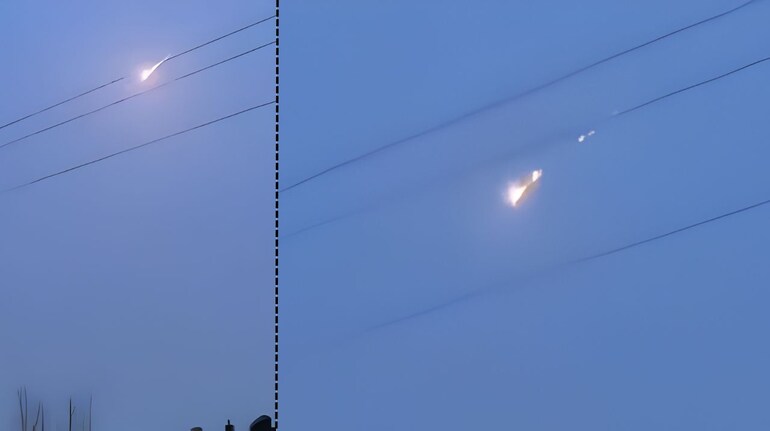

Everyone shocked when a bright fireball lit up the night sky across Europe. This fireball is a space rock that entered Earth’s atmosphere at high speed. This night sky event took place on 8th March.
The intense flash was caused by a meteor burning through Earth’s atmosphere, producing a bright trail of light visible across a wide region. This fireball is so big that now European Space Agency has come forward to investigate this space rock.
Meteor Breaks Apart in the Atmosphere
When the space rock crashed into the earth it broke apart due to the extreme pressures and heat. A small portion of the content burnt, and only some pieces passed the Earth's atmosphere.
These fragments that remained were called meteorites, which later fell at the ground. Scientists believe the original object may have been a few metres wide before entering Earth’s atmosphere.
A brilliant fireball lit up the evening sky over Belgium, glowing for several seconds before breaking apart and leaving a bright trail across the horizon. 🌠 pic.twitter.com/j1r5GPXBJi— AccuWeather (@accuweather) March 10, 2026
Meteorite Hits House in Germany
One of the fragments reportedly struck a house in the Guls district of Koblenz, Germany. The meteorite punched a hole through the roof and landed inside a bedroom.
Fortunately, no one was injured in the incident. The impact caused minor damage to the building but provided scientists with a rare opportunity to examine freshly fallen meteorite material.
European Space Agency started its Investigation
The European Space Agency (ESA) has launched an investigation into the fireball event. Researchers are analysing data collected from meteor camera networks, security footage and videos captured by eyewitnesses.
"The timing and direction of the impact indicate that the object was likely not visible to any of the large-scale telescope sky surveys that scan the night sky for such objects," said ESA.
By studying these observations, scientists believe that they will reconstruct the meteor’s trajectory and determine where other fragments may have landed.
Where was this Fireball Observed?
The fireball was observed in several countries of Europe. This glowed for around 6 seconds just before 7 pm Central European time (18:00 GMT) on Sunday. It was observed by people across Belgium, France, Germany, Luxembourg and the Netherlands.
The fireball occurred just days after the European Space Agency (ESA) announced an update on the asteroid that will pass across Earth.
Why Studying This Fireball Matters?
Fireballs like this provide valuable scientific data. When meteoroids enter the atmosphere and break apart, they reveal information about the composition, structure and behaviour of space rocks.
Recovered meteorites can help researchers understand how materials formed in the early solar system billions of years ago. They also allow scientists to refine models that predict how often such objects approach Earth.
Discover the latest Business News, Sensex, and Nifty updates. Obtain Personal Finance insights, tax queries, and expert opinions on Moneycontrol or download the Moneycontrol App to stay updated!
Find the best of Al News in one place, specially curated for you every weekend.
Stay on top of the latest tech trends and biggest startup news.