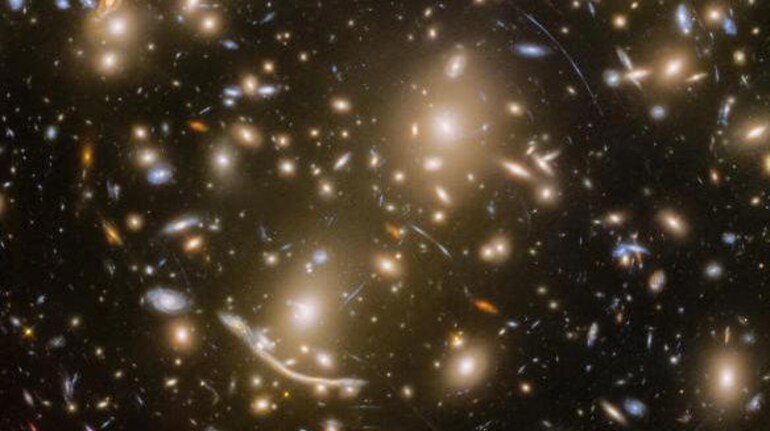
Astronomers have used the James Webb Space Telescope to find dozens of ancient stars in a far-off galaxy. These stars were spotted in the Dragon Arc, a galaxy located 6.5 billion light-years away. The discovery has provided a closer look at a distant part of the universe.
The stars were magnified by a phenomenon known as gravitational lensing. This occurs when massive objects bend light and magnify distant objects. In this case, light from the Dragon Arc was warped by the gravity of a galaxy cluster called Abell 370. The result is a distorted arc of light, revealing stars never seen before.
Unexpected Star Discovery
Astronomers originally aimed to find a distant galaxy behind the cluster. But when they processed the data, they discovered 44 individual stars. This marks the largest group of stars imaged so far outside our galaxy. Until now, the largest groups seen contained just seven stars.
The stars are mostly "red supergiants," some of the largest stars in the universe. The team hopes studying these stars will provide insights into how they evolve. Future research will focus on more stars in the Dragon Arc and other distant galaxies. This will help answer questions about galaxy formation and dark matter.
To study stellar populations further, more stars are needed. Researchers will continue observing distant galaxies to uncover more cosmic secrets.
Read Also: 'Planet parade': Four planets to align each night of January 2025; know best watching tips from NASA
Discover the latest Business News, Sensex, and Nifty updates. Obtain Personal Finance insights, tax queries, and expert opinions on Moneycontrol or download the Moneycontrol App to stay updated!
Find the best of Al News in one place, specially curated for you every weekend.
Stay on top of the latest tech trends and biggest startup news.