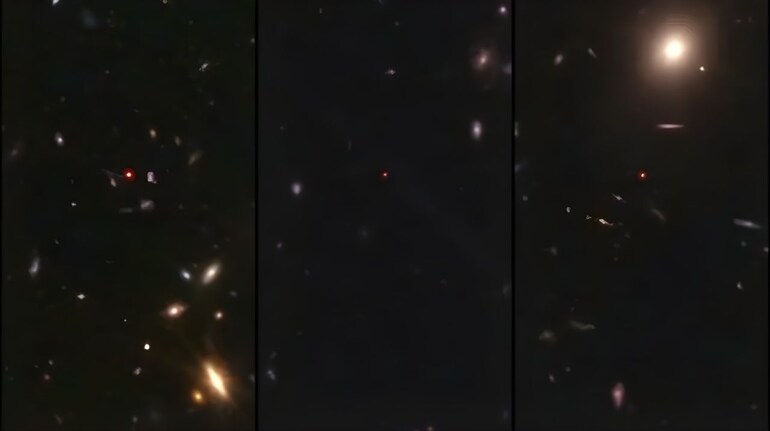

Astronomers using James Webb spotted strange red dots in deep space. These objects appeared in early universe images captured by powerful telescope. They look small, compact and unusually red compared to normal galaxies.
Scientists first believed they were ancient, tiny galaxies filled with stars. However, new research suggests something far more mysterious is happening. These red dots may actually hide growing black holes inside.
Strange Signals from the Early Universe
The objects appear as faint red specks in Webb images. They exist in the distant, early universe after the Big Bang. Their red colour suggests heat, dust or unusual energy sources. They do not match known galaxy shapes or sizes clearly.
Scientists needed new explanations for these strange cosmic objects. Recent studies now offer an unexpected and dramatic answer. Black holes may be hiding inside these mysterious red dots.
Are These Galaxies or Hidden Black Holes?
International astronomers analysed data from the James Webb Space Telescope. The telescope observed deep fields across distant regions of space. Researchers focused on early-universe objects from billions of years ago. They noticed repeating patterns of compact red sources. Experts praised the discovery for its surprising implications. More studies are now planned to confirm these results.
What Webb Images actually show?
Normal galaxies glow mainly because of billions of shining stars. These red dots glow differently, suggesting another energy source. The light may come from hot gas, not starlight. Gas becomes extremely bright when falling into black holes. This process releases powerful energy and infrared radiation. Webb detects this radiation as red light in deep space.
Born Too Early to Exist?
Gas clouds in early space collapsed under strong gravity. Some formed stars, while others fed growing black holes. Heavy dust surrounded these energetic cosmic centres. The dust blocked visible light from escaping outward.
How This Discovery Could Rewrite Cosmic History?
Understanding these objects reveals secrets of cosmic beginnings. They show how black holes may shape early galaxies. These red dots explain how massive black holes formed so quickly. They open new directions for space research. They capture the imagination of curious readers worldwide.
Discover the latest Business News, Sensex, and Nifty updates. Obtain Personal Finance insights, tax queries, and expert opinions on Moneycontrol or download the Moneycontrol App to stay updated!
Find the best of Al News in one place, specially curated for you every weekend.
Stay on top of the latest tech trends and biggest startup news.