






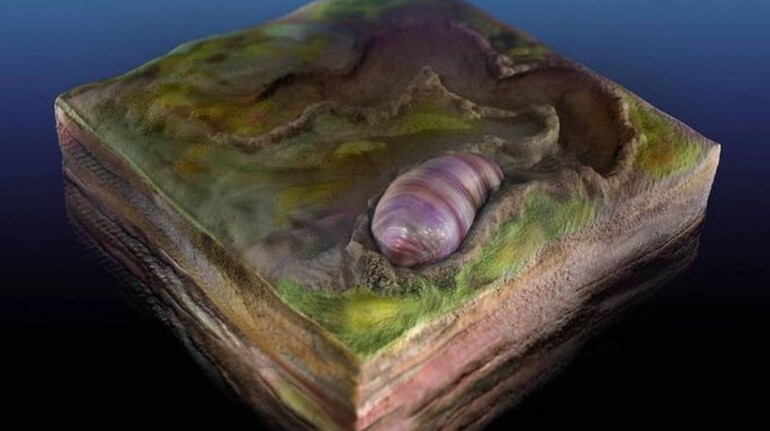
If you’ve ever wondered where the story of animals began, scientists may now have an answer as small as a grain of rice. A team of researchers has found what could be the earliest known bilaterian creature, offering a rare glimpse into life over 555 million years ago.
This small wormlike fossil, Ikaria wariootia, was found in South Australia and reported on in a recent paper released in the Proceedings of the National Academy of Sciences. Though it is small in length — only 2 to 7 millimetres — this ancient creature has enormous evolutionary importance.
Bilateral symmetry encountered in a rice-sized ancestor
Ikaria wariootia existed during the Ediacaran period, a period of time prior to the renowned Cambrian explosion. It is a member of a class known as bilaterians — animals with symmetrical left and right sides, including the presence of a distinguished head and tail. This trait is common among nearly all living animals, including humans.
Scientists have long believed such creatures must have existed then. But as of yet, there was no definite fossil to show it. That came when 3D laser scans uncovered a plain cylindrical body exhibiting bilateral symmetry. The scans also detected traces of muscles, enabling it to be moved.
Dr Scott Evans of the University of California, Riverside, described the instant they understood the significance. "When we had the 3D scans, we knew that we had made a significant find," he said.
Fossil burrows resembled the animal's exact shape
The find also unravels a long-standing mystery that has been confounding palaeontologists for decades. In the same Nilpena rock layers in South Australia, researchers had earlier discovered minuscule fossil burrows. They were called Helminthoidichnites, and scientists had thought these were created by early bilaterians — but never discovered which animal was responsible.
The shape and size of Ikaria are the exact fit for the burrows. Its existence utterly indicates that it was the animal responsible for digging them. Fossil discoveries even indicate V-shaped ridges, which indicate that it crawled as contemporary worms do, employing peristaltic movement. This is a process of contracting muscles along its length — a mark of coordination and sensory perception.
Another member of the research team, Professor Mary Droser, described the fossil as emerging earlier than anything with such complexity. "Burrows of Ikaria wariootia occur lower than anything else," she added.
A new perspective on the family tree of ancient life
This fossil is challenging scientists to reimagine early life's evolution. Although larger Ediacaran animals such as Dickinsonia hogged the limelight earlier, they might have led nowhere. Ikaria, however, might be a real animal kingdom ancestor.
Dickinsonia and other large objects were likely evolutionary dead ends," Professor Droser said. "We realised that we had a lot of little objects too and suspected these could have been the early bilaterians that we were after.
This find aligns fossil data with genetic forecasts. It verifies early bilaterians were simple in body design but exhibited goal-orientated behaviour. They got around and dug by indicating a more organised and conscious animal than previously thought.
To a barely perceptible eye, a fossil, Ikaria wariootia, could contain the secret of how complicated animal existence got started.
Discover the latest Business News, Sensex, and Nifty updates. Obtain Personal Finance insights, tax queries, and expert opinions on Moneycontrol or download the Moneycontrol App to stay updated!
Find the best of Al News in one place, specially curated for you every weekend.
Stay on top of the latest tech trends and biggest startup news.









