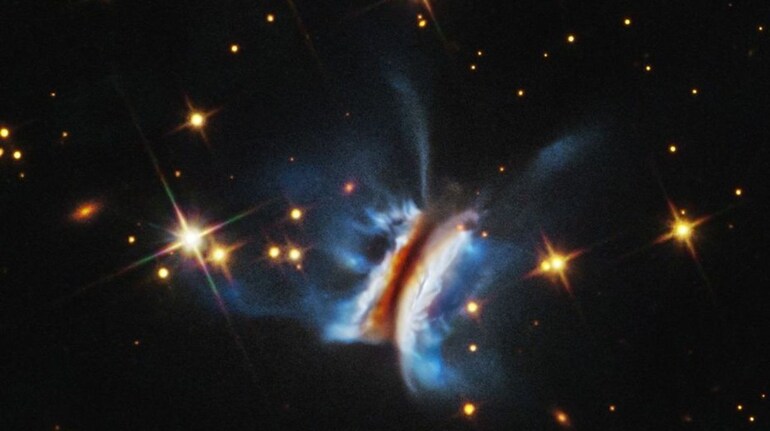
Astronomers on Tuesday revealed striking Hubble images of a vast planet forming disk. The observations, published in The Astrophysical Journal, describe the largest known protoplanetary disk ever seen. NASA’s Hubble Space Telescope captured the structure using visible light for the first time. Scientists say the disk appears unexpectedly chaotic, turbulent, and unusually asymmetric. The findings highlight how extreme environments may influence planetary formation processes.
What Hubble observed around a distant young star
The massive disk surrounds the young stellar system IRAS 23077+6707. Located roughly 1,000 light years from Earth, the object dwarfs known examples. Astronomers estimate the disk stretches nearly 400 billion miles across. That makes it about 40 times wider than our solar system. The disk blocks direct views of the central light source. Researchers believe the hidden object may be a massive star or binary.
Hubble’s images show wisps of dust rising far above the disk. Such vertical extensions exceed heights observed in similar planet forming systems. Scientists were surprised by filament like structures on one side only. The opposite side appears sharply edged, lacking visible extended material. This lopsided appearance suggests active forces shaping the disk’s evolution. Researchers suspect recent infalling gas or environmental interactions caused the imbalance.
Kristina Monsch of the Center for Astrophysics led the study. She said the detail visible in these images is rare. The edge on angle allows scientists to trace substructures clearly. Previous observations by the James Webb Space Telescope hinted similar features elsewhere. However, this system offers an unmatched visible light perspective.
Why “Dracula’s Chivito” stands out
The research team nicknamed the object “Dracula’s Chivito” for cultural reasons. One researcher traces heritage to Transylvania. Another comes from Uruguay, where a chivito is popular. The disk resembles a layered hamburger when viewed edge on. A dark central band lies between glowing dust layers above.
Scientists estimate the disk contains enormous amounts of material. Its mass may equal between 10 and 30 Jupiters. Such mass could support the formation of multiple giant planets. Researchers say the system may resemble an enlarged early solar system.
Joshua Bennett Lovell, a co investigator at the CfA, commented on the findings. He said the asymmetry reveals chaotic processes shaping planetary nurseries. He added many of these processes remain poorly understood.
What the discovery means for planet formation
Planetary systems form from spinning disks of gas and dust. Over time, gas falls inward while planets grow outward. IRAS 23077+6707 offers a rare chance to study extremes. Scientists believe fundamental formation processes remain broadly similar. The images raise new questions about disk evolution. Researchers say future studies may clarify how such systems develop.
Discover the latest Business News, Sensex, and Nifty updates. Obtain Personal Finance insights, tax queries, and expert opinions on Moneycontrol or download the Moneycontrol App to stay updated!
Find the best of Al News in one place, specially curated for you every weekend.
Stay on top of the latest tech trends and biggest startup news.