NASA’s James Webb Space Telescope has captured a remarkable view of Lynds 483, revealing intricate details of star formation. The image showcases glowing jets of gas and dust, shaped by two young stars at the centre. Their energetic activity is shaping the surrounding space, offering astronomers new insights.
Stars Shaping Their Cosmic Surroundings
Lynds 483, or L483, is a star-forming region filled with swirling clouds of gas and dust. At its heart, two young protostars are hidden within a dense disk of material. As they form, they eject bursts of gas that light up in shades of orange, blue, and purple. These ejections, moving at different speeds, collide with older ones, creating twisting patterns. Over thousands of years, these interactions have triggered chemical reactions, forming complex molecules like carbon monoxide and methanol.
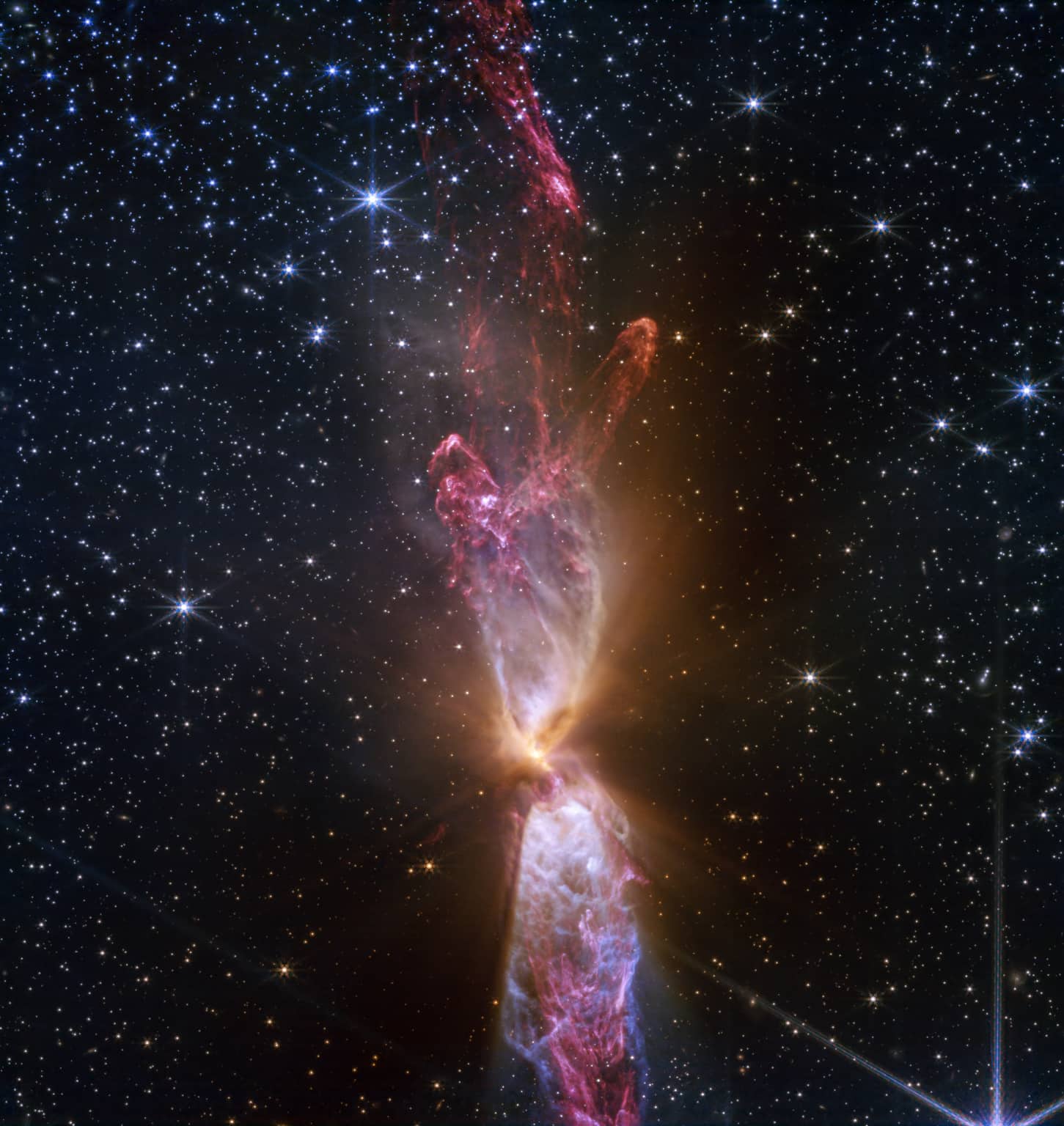 Shimmering ejections emitted by two actively forming stars make up Lynds 483 (L483). High-resolution near-infrared light captured by NASA’s James Webb Space Telescope shows incredible new detail and structure within these lobes, including asymmetrical lines that appear to run into one another. L483 is 650 light-years away in the constellation Serpens. (Image: NASA)
The brightest regions in the image show where starlight manages to escape through thinner dust. Large, glowing orange cones extend above and below the disk. However, some areas remain dark and shadowed, indicating dense clouds where starlight cannot pass. Even in these regions, Webb’s near-infrared camera has detected distant stars, appearing as faint orange specks behind the dust.
Twisted Ejections and Hidden Structures
Not all ejections from these young stars move in straight lines. Some jets appear warped or tangled, especially near the top right of the image. A bright orange arc marks a shock front, where an ejection was slowed by denser material. Below this, another section looks tangled, revealing intricate details that astronomers are still working to understand.
The lower part of the image shows thick clouds of gas and dust. Small purple pillars stand out, resisting the powerful stellar winds. These structures are dense enough to avoid being completely blown away. The full extent of L483 is too large to fit in a single Webb image, so only part of the region is visible.
A Glimpse Into the Future
Over millions of years, these protostars will grow into fully formed stars, likely similar in mass to the Sun. As their activity continues, they will clear away the surrounding dust and gas, leaving behind a disk where planets might form.
L483 was first documented by American astronomer Beverly T. Lynds in the 1960s. She carefully mapped dark and bright nebulae using photographic plates before digital technology existed. Her work provided essential data for studying star-forming regions long before modern telescopes like Webb could capture such detailed views.
NASA’s latest observations of L483 will help scientists refine models of star formation, understanding how young stars shape their environments. Researchers will study how much material these stars have expelled, what molecules have formed, and how dense different regions are. Each discovery adds another piece to the puzzle of how stars and planetary systems come to life.
Discover the latest Business News, Sensex, and Nifty updates. Obtain Personal Finance insights, tax queries, and expert opinions on Moneycontrol or download the Moneycontrol App to stay updated!





Find the best of Al News in one place, specially curated for you every weekend.
Stay on top of the latest tech trends and biggest startup news.