
AI and Science go hand in hand today. Scientists focus on the experiments that were once in the books, are now being made in labs. Whether its lab grown diamonds or any new compound, AI has made scientific work much easy. When nature takes time, scientists in California takes matter in their hands and created "Evo-Φ2147", a lab grown virus made with AI. This breakthrough shows machines can create life-like biological systems faster than nature evolved.
Evo-Φ2147: Lab Grown Virus with AI
The researchers used AI to design the virus known as Evo-Φ2147. This is not a mutated natural virus. It is entirely novel in sequence. The AI generated 285 new viral genomes inspired by bacteriophage templates. Of these, 16 proved effective at infecting and killing E. coli bacteria. The most successful designs performed about 25 % faster than natural viruses.
Where was "Evo-Φ2147" Made?
Evo-Φ2147 was created at Stanford University and the Arc Institute in Palo Alto, California, USA. They used an advanced AI system called Evo2 trained on trillions of DNA base pairs. Dr Samuel King and Dr Brian Hie are the co-creators of this virus.
A new assembly method called Sidewinder let researchers build genomes quickly and accurately. The work happened in secure, controlled laboratory environments designed for genetic research.
What Will This Virus Do?
In experiments, the new virus attacked E. coli bacteria efficiently. It is designed to infect and replicate inside bacterial cells rapidly. Its ability to kill bacteria faster than natural viruses suggests medical potential. Such bacteriophages could help treat antibiotic-resistant bacterial infections someday. Scientists emphasise this is a model system.
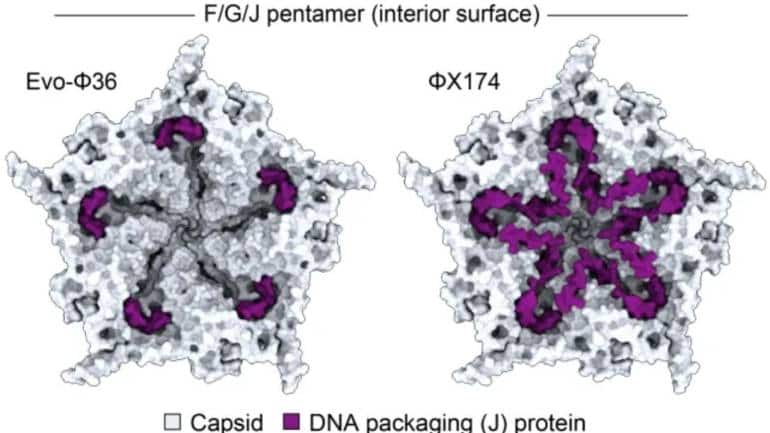 Evo-Φ2147 genome was created using AI (Image: Arc Institute)
Is This Virus Dangerous?
On its face, Evo-Φ2147 is not dangerous to humans. It was engineered to target bacteria, not human or animal cells. However, the breakthrough raises alarms about potential misuse in the future. AI-designed viruses could theoretically be misapplied outside research settings. Biosecurity experts urge strict regulations and ethical oversight before release.
How Science Sees This Discovery?
Many scientists call it a milestone in synthetic biology research. They see promise in creating tailored bacteriophages for therapeutic use. The work also shows AI can uncover biological solutions fast and creatively. Others caution about the ethical, regulatory, and biosafety implications. Overall, the discovery is a major stepping-stone in biology’s AI era.
Discover the latest Business News, Sensex, and Nifty updates. Obtain Personal Finance insights, tax queries, and expert opinions on Moneycontrol or download the Moneycontrol App to stay updated!





Find the best of Al News in one place, specially curated for you every weekend.
Stay on top of the latest tech trends and biggest startup news.