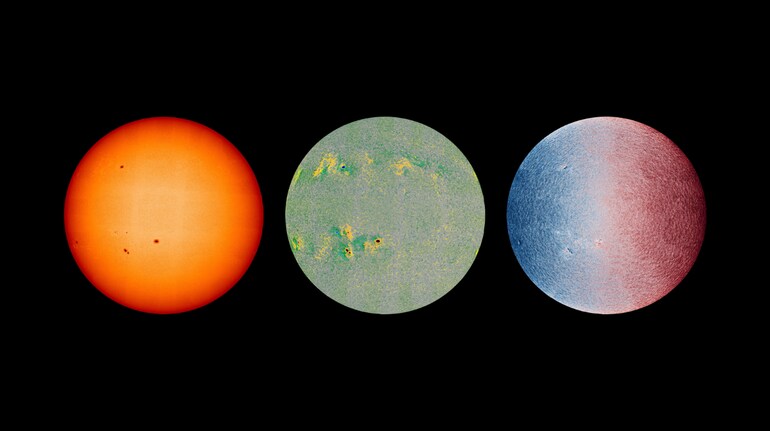
The European Space Agency's (ESA) Solar Orbiter has captured four new high-resolution images of the Sun, taken on March 22, 2023. These images, created using the spacecraft’s PHI (Polarimetric and Helioseismic Imager) and EUI (Extreme Ultraviolet Imager) instruments, showcase the Sun's surface and outer atmosphere like never before.
The PHI images provide the clearest full views of the Sun's visible surface (photosphere) to date, highlighting its complex magnetic field and surface motion. These can be compared to EUI's ultraviolet images of the Sun’s corona, its glowing outer atmosphere. Together, they reveal the Sun’s many layers and dynamic activity.
Daniel Müller, Solar Orbiter’s Project Scientist, explained, "The Sun's magnetic field is key to understanding its dynamic nature. These detailed maps from PHI show the beauty of the Sun's surface magnetic field and flows, while EUI captures the corona’s hot plasma activity."
PHI’s visible light image shows the Sun’s surface as a turbulent sea of glowing plasma, with temperatures between 4500–6000°C. Beneath this layer, plasma churns in the Sun’s convection zone, creating the Sun's grainy surface appearance.
Sunspots, appearing as dark spots in these images, are areas of intense magnetic activity. PHI’s magnetic map reveals these sunspots as regions where the magnetic field is strongest, pointing outward (red) or inward (blue). The powerful magnetic fields disrupt heat transfer, making sunspots cooler and darker.
The velocity map from PHI, or tachogram, shows the plasma’s movement. Blue areas indicate motion toward the spacecraft, while red shows motion away. Around sunspots, plasma appears to be pushed outward.
Above the photosphere, EUI’s images of the corona capture plasma at temperatures of over a million degrees. This plasma follows magnetic field lines, forming loops that connect neighboring sunspots.
The high-resolution images were taken when Solar Orbiter was just 74 million kilometers from the Sun. Since each image only covers a small area, the spacecraft was tilted and rotated to capture different sections. These were then stitched into mosaics, each composed of 25 images taken over four hours.
The Sun’s full-disc mosaics measure nearly 8000 pixels in diameter, revealing extraordinary details. The image processing was a complex task, but future mosaics are expected to be produced more quickly, with the PHI team aiming for two high-resolution mosaics per year.
Solar Orbiter is a collaborative mission between ESA and NASA, designed to study the Sun’s behavior and unlock the secrets of our star’s magnetic field and surface dynamics.
Discover the latest Business News, Sensex, and Nifty updates. Obtain Personal Finance insights, tax queries, and expert opinions on Moneycontrol or download the Moneycontrol App to stay updated!
Find the best of Al News in one place, specially curated for you every weekend.
Stay on top of the latest tech trends and biggest startup news.