






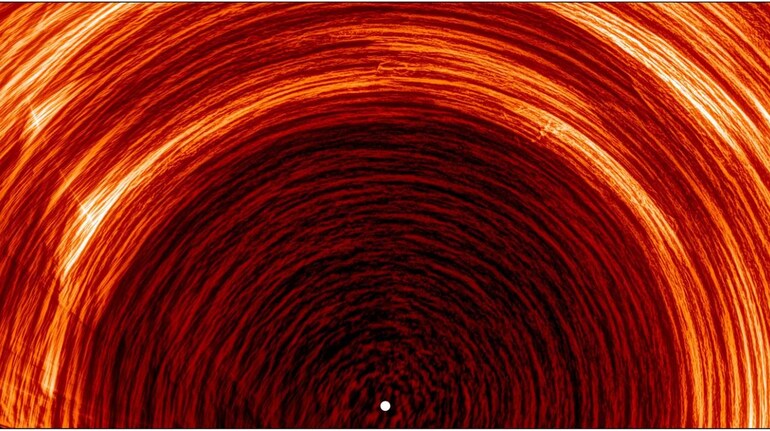
For the first time, humans have gazed directly at the Sun's mysterious poles. The European Space Agency's Solar Orbiter has sent back stunning images from its tilted orbit, giving scientists a completely new perspective on the star that powers life on Earth. These long-awaited observations have indeed revealed surprising details about how the Sun's magnetic field behaves near its poles.
How Did Solar Orbiter Capture the Polar Regions?
The Solar Orbiter was placed in an orbit tilted compared with the Solar System’s plane. This new path allowed it to see what no spacecraft had seen before — the polar regions of the Sun. Until now, researchers only had a side-on, grazing view of these areas. But the Orbiter's vantage point changed that, giving scientists a direct look at the poles for the first time.
What Did Scientists Discover About Solar Activity?
Surprisingly, it became clear that the magnetic field at the poles behaves differently than expected. The magnetic field gives rise to an 11-year cycle of activity on the Sun, and the poles play a key role in that process. Plasma, the hot, charged gas that makes up the Sun, circulates within each hemisphere. It drifts from the equator to the poles on the surface and moves back again deep inside.
The mission tracked “supergranules”, enormous cells of hot plasma two to three times larger than Earth. These supergranules push magnetic field lines to their edges, forming the Sun’s magnetic network. Previous models suggested that this movement was slower at the poles, but the new data showed speeds of 10 to 20 metres per second — almost the same as near the equator.
Why Is This Discovery Important?
“The supergranules at the poles act as a kind of tracer. They make the polar component of the Sun’s global, eleven-year circulation visible for the first time,” explained Lakshmi Pradeep Chitta, research group leader at the Max Planck Institute for Solar System Research (MPS) and lead author of the study.
This new insight may reshape understanding of how the Sun’s magnetic “conveyor belt” operates. While it remains unclear if the magnetic flow truly slows near the poles, the data offer fresh clues about how the Sun’s magnetism evolves on a global scale.
“To understand the Sun’s magnetic cycle, we still lack knowledge of what happens at the Sun’s poles. Solar Orbiter can now provide this missing piece of the puzzle,” said Sami Solanki, MPS Director and co-author of the research.
Where Was the Study Published?
The findings were reported in The Astrophysical Journal Letters, marking a major step in solar research. Though early in the mission’s discoveries, scientists believe Solar Orbiter will continue to unlock the secrets of the Sun’s most hidden regions — the poles that hold the key to understanding its magnetic heartbeat.
Discover the latest Business News, Sensex, and Nifty updates. Obtain Personal Finance insights, tax queries, and expert opinions on Moneycontrol or download the Moneycontrol App to stay updated!
Find the best of Al News in one place, specially curated for you every weekend.
Stay on top of the latest tech trends and biggest startup news.









