A visitor from deep space is drawing wide attention, and many are asking what its latest approach may reveal. The interstellar comet 3I/ATLAS is now heading away from our solar system, yet space agencies are racing to observe it once more before it disappears forever.
New Images Capture Bright, Active 3I/ATLAS
Why is this comet attracting such strong interest? Discovered in late June and confirmed as the third known interstellar object in July, 3I/ATLAS has raced through the inner solar system at roughly 130,000 mph. It made close passes of Mars and the sun in October. Its closest approach to Earth will occur on 19 Dec, when it remains about 170 million miles away.
What have scientists seen so far? NASA and the European Space Agency have shared new images showing the comet brightening after its recent solar encounter. NASA released a Hubble image on 4 Dec that shows a glowing nucleus wrapped in a wide coma of gas and dust. Stars appear as streaks in the background because Hubble tracked the fast-moving comet directly.
 The Hubble Space Telescope’s latest second view of comet 3I/ATLAS. (Image: NASA / Hubble)
Why does the comet appear brighter now? Comets brighten near the sun as internal ice warms and sublimates. The gas forms a long tail pushed by sunlight, while the sun-facing side may release jets of dust. These features appear faintly in Hubble’s recent image.
Spacecraft Collect Data Across the Solar System
How close was Hubble during its latest observation? NASA said Hubble captured the 30 Nov image from about 178 million miles away. Earlier Hubble images from July helped scientists estimate the comet’s size at 1,400 ft to 3.5 miles, making it likely the largest interstellar object ever recorded.
Has more information been released? New details about the coma are still pending. ESA also published an image from its Jupiter Icy Moons Explorer (Juice) mission, taken on 2 Nov during its flight toward Jupiter’s system. Juice observed the comet from only 41 million miles away.
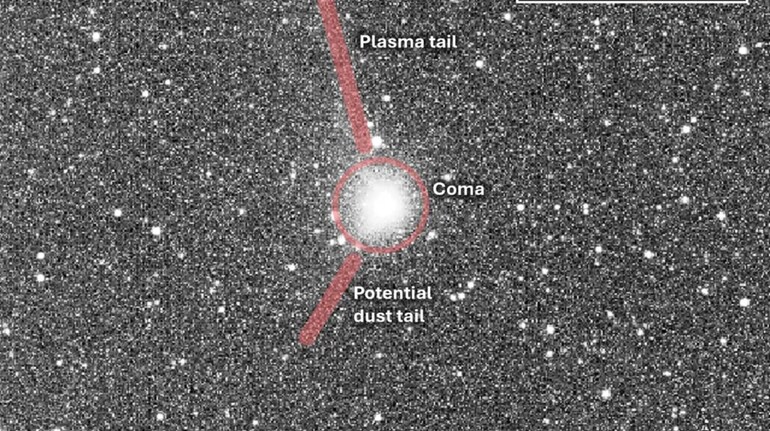
What did Juice detect? ESA said the image shows a clear coma and hints of two tails. A plasma tail appears at the top of the frame, while a faint dust tail extends to the lower left. Juice used five scientific instruments on two separate days, but its full data will not reach Earth until Feb 2026 because its main antenna currently shields it from solar heat.
 A fresh image of comet 3I/ATLAS captured by ESA’s Jupiter Icy Moons Explorer (Juice). (Image: ESA/Juice/NavCam)
More Observations Expected Before Comet Departs
Why are so many missions involved? NASA and ESA noted that more than a dozen spacecraft have tracked 3I/ATLAS, including rovers, solar orbiters and telescopes never built to follow comets. Webb will also observe the comet when it draws closer later this month. Amateur observers and ground-based scientists are preparing to watch it too.
What makes these observations important? With an object arriving from beyond our solar system, every measurement helps answer new questions about its size, behaviour and composition. Scientists hope the final views of 3I/ATLAS will offer clues before it vanishes back into deep space for good.
Discover the latest Business News, Sensex, and Nifty updates. Obtain Personal Finance insights, tax queries, and expert opinions on Moneycontrol or download the Moneycontrol App to stay updated!
Find the best of Al News in one place, specially curated for you every weekend.
Stay on top of the latest tech trends and biggest startup news.