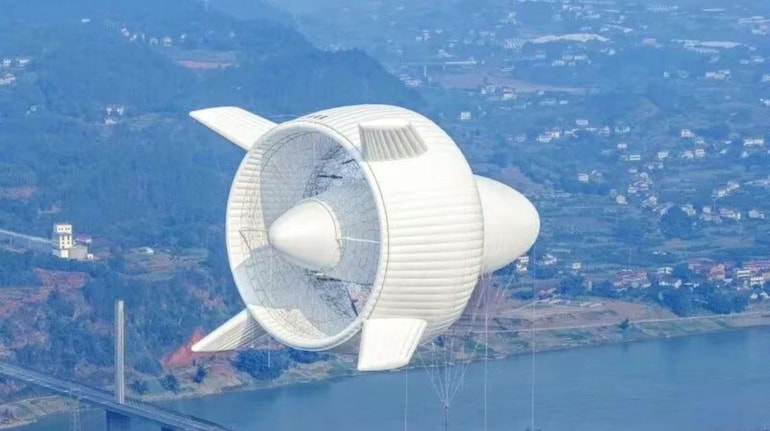

A Chinese energy company has successfully tested a helium filled airborne wind turbine that rises thousands of feet above ground, aiming to capture stronger winds and expand renewable power options.
S2000 Airborne Wind Energy System Takes Flight
The system is called S2000 airborne turbine. It was developed by Beijing Linyi Yunchuan Energy Technology. The craft resembles a large floating blimp. It contains 12 small internal wind turbines. The airship ascends high above cities. It targets stable, faster upper winds. Electricity travels down through tethered cable. Power then feeds directly into grid.
During testing, it flew above Sichuan Province. The altitude reached 6,560 feet. It generated 385 kilowatt hours electricity. That equals about 13.3 days household use. The estimate follows U.S. Energy Information Administration data. The airship measures 197 feet long. It stands 131 feet high and wide. Total rated capacity reaches 3 megawatts. Dimensions were reported by Global Times.
Chief technology officer Weng Hanke explained uses. He spoke to Tide News. Tide News is linked to Zhejiang Daily Press Group. He said remote border outposts benefit. The system could provide stable energy supply. It may also complement ground wind farms. He described this as three dimensional supply.
The world's first MW-class S2000 Stratosphere Airborne Wind Energy System (SAWES) for urban use has successfully completed a test flight in Yibin, southwest China’s Sichuan Province. During the test, the system ascended to an altitude of 2,000 meters, generating and feeding 385… pic.twitter.com/CFynQ6h0b8— People's Daily, China (@PDChina) January 13, 2026
High Altitude Wind Power Density Advantage
Developers say higher altitudes offer benefits. Wind power density increases with height. Offshore turbines capture consistent open water winds. Chinese manufacturer Dongfang Electric built large models. Its DEW 26 MW 310 stands tall. Floating turbines are also expanding rapidly. China Huaneng Group recently unveiled giant unit. Aerospace group Omnidea estimates density growth. Between 100 and 2,500 metres it rises. Wind speeds average 33.5 miles hourly. This highlights possible efficiency gains aloft.
Safety, Regulation and Commercial Viability Questions
However, challenges remain before wider deployment. The tether cable must prove reliability. A 2,000 metre cable poses aviation risk. The UK Civil Aviation Authority sets limits. Balloons above 60 metres need permission. Maintenance could also prove complex.
Standard turbines require regular servicing checks. This craft must descend for repairs. Costs may therefore rise significantly. Further trials are planned before scaling. Developers believe concept suits space limited nations. Countries lacking shallow seabeds may benefit. The test marks early stage progress. Much evaluation remains before commercial rollout.
Discover the latest Business News, Sensex, and Nifty updates. Obtain Personal Finance insights, tax queries, and expert opinions on Moneycontrol or download the Moneycontrol App to stay updated!
Find the best of Al News in one place, specially curated for you every weekend.
Stay on top of the latest tech trends and biggest startup news.