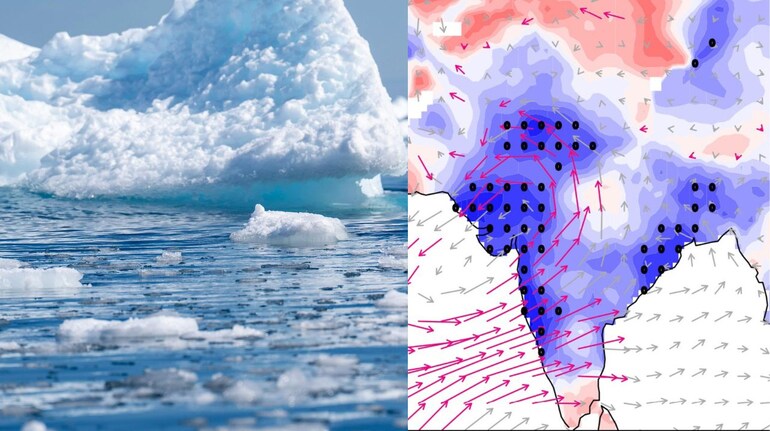

A new climate study has revealed an unexpected and unsettling link. The rapid melting of Arctic sea ice may be reshaping the Indian summer monsoon. Scientists said what happens in the frozen north, does not stay there.
It travels through the atmosphere, all the way to South Asia. For a nation that depends on seasonal rains for agriculture, water security and livelihoods, this discovery could carry serious implications.
What Is This New Research About?
Scientists believe a declining Arctic sea ice influences the behaviour of the Indian summer monsoon. This system is responsible for nearly 80 per cent of India’s annual rainfall. By analysing over four decades of climate data, scientists identified a consistent pattern. The shrinking polar ice appears to influence where India’s heaviest rains fall.
A Striking Connection Between India and the Arctic Sea
At first glance, the Arctic Ocean and India’s monsoon seem worlds apart. One is frozen and the other is tropical. Yet the atmosphere links them.
When Arctic ice melts, darker waters absorb more heat, disturbing pressure patterns and wind circulation. These shifts can move the monsoon trough, altering the path of seasonal rains across South Asia.
Who Analysed This Research?
The study was conducted by scientists from the Indian Institute of Tropical Meteorology, based in Pune, India. The researchers examined satellite data, observational rainfall records. They used advanced climate models covering the period from 1979 to 2022.
“Rising global temperatures, with uneven distribution across the planet, are driving the melting of sea ice,” said Hemantkumar S. Chaudhari, a scientist at IITM.
Can Arctic Ice Really Affect India — And How Badly?
Yes, according to the findings, Arctic ice loss can affect India. Though, not by changing total rainfall drastically, but by altering its distribution.
A westward shift in monsoon rains could increase flood risks in some western regions while leaving central or eastern areas relatively drier. Even subtle changes in timing or intensity can disrupt agriculture, reservoir management and urban planning.
How do Scientists see this as?
Scientists have issued a warning that Arctic sea ice is not the sole driver of monsoon variability. The monsoon is influenced by multiple factors in the Indian and Pacific Oceans. However, the study highlights Arctic melting as a significant emerging influence that must be incorporated into future climate predictions.
The takeaway about climate change is interconnected is clear. The poles and the tropics are linked in ways scientists are only beginning to fully understand.
Discover the latest Business News, Sensex, and Nifty updates. Obtain Personal Finance insights, tax queries, and expert opinions on Moneycontrol or download the Moneycontrol App to stay updated!
Find the best of Al News in one place, specially curated for you every weekend.
Stay on top of the latest tech trends and biggest startup news.