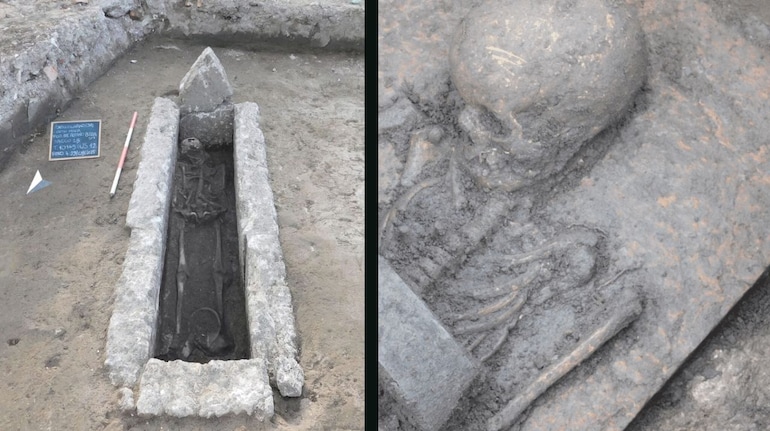

In a remarkable discovery, archaeologists in southern Italy have unearthed two children buried with bronze warrior belts. Traditionally thought to belong only to elite adult fighters.
The findings, from a 2,500‑year‑old cemetery at Pontecagnano near Salerno, open a fascinating window into past. Scientists are figuring out how early Italic cultures viewed status, identity and possibly even youth initiation into adulthood.
What was discovered in Southern Italy?
In excavation of a burying-ground at Pontecagnano, near Salerno, 2 children of about 5-10 years have been found buried with huge bronze belts. The items generally including the elite warriors.
The belts comprised a high-end group of grave furnishings, which were usually exclusive to the male burials of an adult.
These objects found in the graves of children indicate that even social status may be given symbolically at a young age and the warrior identity of the children as well.
How did Scientists discover these buried children?
This was uncovered due to a series of archaeological excavations on the Iron Age Samnite cemetery. Researchers employed careful stratigraphic excavation techniques, documenting grave positions, associated artefacts and skeletal remains.
By analysing the belts, grave layout and age of the children, scientists confirmed that the practice of placing warrior belts in children’s graves was intentional. The belts themselves were well-preserved, revealing the high craftsmanship and symbolic importance of these objects.
Who is behind this study?
The research was carried out by the Superintendency of Archaeology, Fine arts and Landscape of Salerno and Avellino. They examined the Samnite civilisation that was characterized by the warrior cultures and elaborate funeral rituals.
Previously discovered findings, consist of a 12-year-old boy who was buried with a similar bronze belt. This can be attested to the fact that this was not an isolated incidence, but an element of cultural trend.
How this discovery changed science?
This identify contradicts past beliefs of archaeology. This merely embodies on the age, sex or social position of the individual. Rather, it is an indication that in the ancient Samnite society. Scientists assume that the children may be symbolically identified as future warriors.
The ritual of burying a person might have portrayed ancestry or the status or communal principles and not individual processes. This revelation gives a different interpretation of childhood, social identity and ritual in ancient Europe.
Bronze that much old is rare to see?
Yes. The bronze belts were more than 2,500 years old and their intactness in the graves of children is very hard to come by. Artifacts of this date that were made of bronze tend to decay or rust.
These are very valuable in examining the artistry of the ancient world, metallurgy and symbolic culture because well-preserved ones such as these are rare.
Discover the latest Business News, Sensex, and Nifty updates. Obtain Personal Finance insights, tax queries, and expert opinions on Moneycontrol or download the Moneycontrol App to stay updated!
Find the best of Al News in one place, specially curated for you every weekend.
Stay on top of the latest tech trends and biggest startup news.