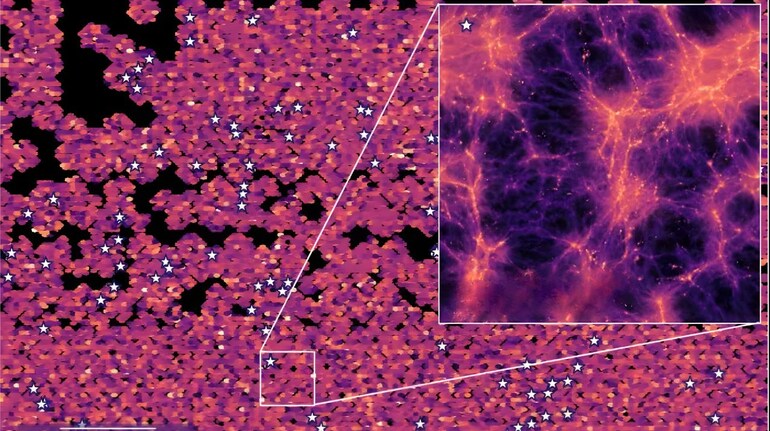

Astronomers have created one of the largest 3D maps of the universe ever produced. It revealed a vast glowing network of matter that existed billions of years ago. The map shows a brilliant “sea of light” spread across the cosmos during a period known as the cosmic dawn. The breakthrough comes from the Hobby‑Eberly Telescope Dark Energy Experiment (HETDEX).
Mapping the Universe Billions of Years Ago
The newly released map reveals the distribution of cosmic matter from around 9 to 11 billion years ago. During this period, star formation in galaxies was at its peak.
Scientists describe the map as showing a glowing cosmic web of light, where galaxies and gas form massive structures stretching across millions of light-years. Instead of simply observing individual galaxies, researchers tracked faint light emitted by hydrogen gas throughout the universe.
The Light That Illuminates the Early Cosmos
The map was built using a special type of radiation known as Lyman‑alpha radiation, which is emitted by hydrogen atoms when they absorb and release energy. Hydrogen is the most abundant element in the universe.
When it glows in this way it creates a faint but detectable signal. By measuring this light across vast regions of space, astronomers were able to reconstruct the large-scale structure of the universe.
A New Way to See the Cosmic Web
To create the map, scientists used data from the Hobby‑Eberly Telescope in Texas. The telescope collected hundreds of millions of spectra. This allows researchers to track hydrogen emission across enormous cosmic distances.
Using a technique called line-intensity mapping, the team combined signals from countless sources to build a detailed 3D picture of how matter is distributed in the universe.
Why This Map Matters for Astronomy?
The new map offers scientists an unprecedented view of the universe during a critical stage of its evolution. Researchers hope the data will help explain how galaxies formed and evolved.
The map also leads towards gathering of matter into large cosmic structures. Mysterious forces such as Dark Energy influence the expansion of the universe. Understanding these processes could reveal why the universe looks the way it does today.
A Glimpse Into the Universe’s Early History
Although the universe is about 13.8 billion years old, much of its early history remains difficult to observe.
The new 3D map provides a rare glimpse into the time when galaxies were rapidly forming and shaping the large-scale structure of the cosmos.
For astronomers, the glowing “sea of light” captured in the map represents a powerful tool to explore how universe evolved.
Discover the latest Business News, Sensex, and Nifty updates. Obtain Personal Finance insights, tax queries, and expert opinions on Moneycontrol or download the Moneycontrol App to stay updated!
Find the best of Al News in one place, specially curated for you every weekend.
Stay on top of the latest tech trends and biggest startup news.