






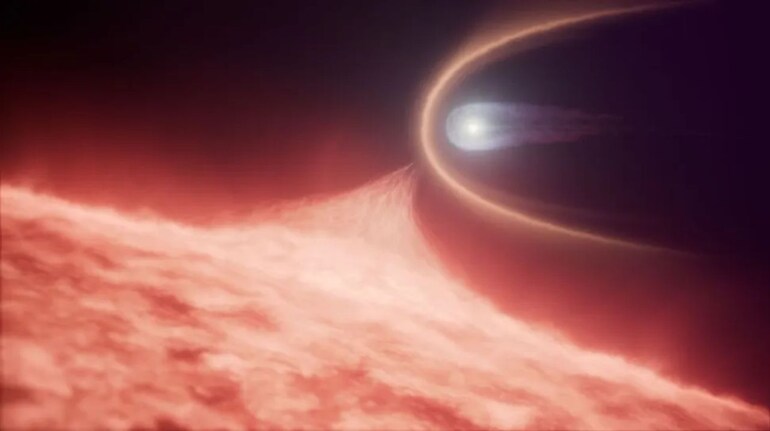
What looked like an ordinary star has revealed a violent past. Astronomers using the Hubble Space Telescope discovered that a white dwarf, once thought normal, is actually the remnant of two colliding stars.
White Dwarf with Unusual Origins
The star, named WD 0525+526, lies about 128 light-years away. At first, it appeared like any other white dwarf seen in visible light. But Hubble’s ultraviolet observations told a different story. Scientists identified anomalous levels of carbon in its atmosphere, an unmistakable indicator of a star merger. Normally, white dwarfs are covered with hydrogen and helium, which mask their carbon-rich interiors. Here, the cataclysmic collision removed the outer layers, revealing carbon.
Astronomers Detect Hidden Carbon Signals
The study, led by Snehalata Sahu and Boris Gaensicke from the University of Warwick, showed WD 0525+526 is hotter and more massive than most merger remnants. Its surface temperature reaches nearly 21,000 Kelvin and its mass is 1.2 times that of the sun. These features set it apart from the small number of similar stars already known.
Clues to Future Stellar Research
Because the star looked normal in visible light, astronomers now suspect that many other white dwarfs may conceal similar origins. The findings suggest that violent mergers could be more common than previously thought. Researchers plan to expand the study to see how many such stars exist and how these mergers may influence future supernovae. The discovery is detailed in the journal Nature Astronomy.
Discover the latest Business News, Sensex, and Nifty updates. Obtain Personal Finance insights, tax queries, and expert opinions on Moneycontrol or download the Moneycontrol App to stay updated!
Find the best of Al News in one place, specially curated for you every weekend.
Stay on top of the latest tech trends and biggest startup news.









