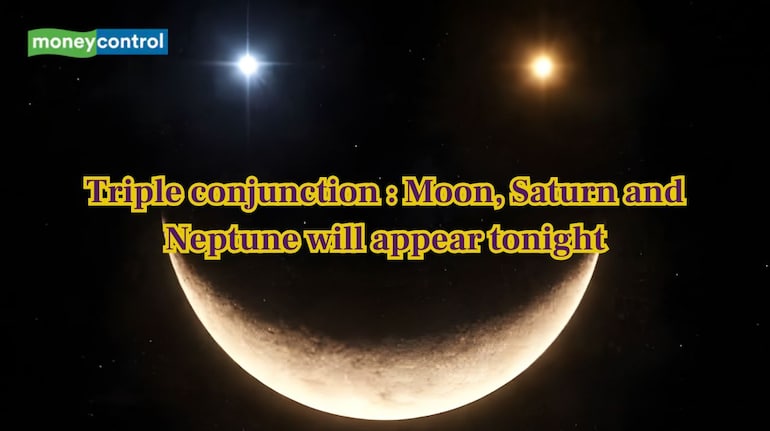

A rare triple conjunction of the Moon, Saturn and Neptune will light up the western night sky on January 23, 2026. After sunset, the thin crescent Moon will be near bright Saturn, and faint Neptune will lie close by forming a compact trio visible to stargazers around the world. The Moon will curve gently beneath Saturn and Neptune, forming a natural “smiley face” high above Earth. This triple conjunction happens when all three celestial bodies appear close together.
What Is Happening?
A triple conjunction occurs when celestial bodies appear near one another in the sky from Earth’s viewpoint, even though they are far apart in space. On the night of 23 January 2026, the Moon, Saturn and Neptune will form a compact group after dusk. Saturn shines steadily, the Moon is bright and Neptune is faint, requiring binoculars or a small telescope.
When to See This Triple Conjunction?
The triple conjunction of the Moon, Saturn and Neptune will occur on 23 January 2026, shortly after sunset and into the early evening. The best time to observe the alignment is approximately 30 to 90 minutes after sunset, before the celestial objects sink below the western horizon.
The Saturn and the Moon will be easiest to see with the naked eye during twilight and early evening. Whereas the Neptune will be much fainter. Best to locate Neptune with binoculars.
Where This Will Be Visible?
The triple conjunction of the Moon, Saturn and Neptune will be visible from most parts of the world. Observers across the Northern Hemisphere, including the United States, Canada, Europe and Asia. It will be able to spot the alignment shortly after sunset. In the Southern Hemisphere, countries such as Australia, New Zealand, South Africa and parts of South America can also view the event.
Why Do Conjunctions Happen?
Conjunctions are apparent alignments. They depend on Earth’s viewpoint. Planets orbit the Sun roughly in the same plane, so occasionally they appear close together in the sky. The Moon and planets are not physically close in space but seem near each other from Earth.
How Rare Is This Event?
The planet conjunctions happen fairly often. A triple conjunction including Neptune is rarer because Neptune is faint and distant. Neptune shines at magnitude ~7.9, invisible to the naked eye under normal conditions. This makes tonight's alignment a special opportunity for stargazers to see three solar system objects together.
How to See This Rare Event?
Go outside shortly after sunset and face the western horizon. Choose a dark spot with minimal light pollution. Moon will be easily visible with the naked eye. Saturn is bright and steady. It will also be visible without equipment. To watch Neptune, use binoculars or a small telescope, near Saturn and the Moon.
Discover the latest Business News, Sensex, and Nifty updates. Obtain Personal Finance insights, tax queries, and expert opinions on Moneycontrol or download the Moneycontrol App to stay updated!
Find the best of Al News in one place, specially curated for you every weekend.
Stay on top of the latest tech trends and biggest startup news.