UK inflation tumbled to the lowest level in two years, bringing relief to consumers and prompting Prime Minister Rishi Sunak to declare victory on his pledge to cut price growth in half.
Consumer prices rose 4.6% from a year earlier in October, down sharply from 6.7% in September and the slowest pace since 2021, the Office for National Statistics said Wednesday. The 2.1-percentage point fall between the two months was the steepest since 1992.
The drop was even sharper than the 4.7% reading economists had anticipated, and will strengthen expectations that the Bank of England is finished raising interest rates. The pound slipped after the report, trading as much as 0.2% weaker at $1.2469.
The figures provide Sunak a boost ahead of a general election widely expected next year after he made halving inflation in 2023 one of his key five pledges. Inflation, which hit 10.7% in the final quarter of last year, remains a little more than double the Bank of England’s 2% target.
“Official figures released this morning confirm we have halved inflation meeting the first of the five priorities I set out at the beginning of this year,” Sunak said in a statement. “While it is welcome news that prices are no longer rising as quickly, we know many people are continuing to struggle, which is why we must stay the course to continue to get inflation all the way back down to 2%.”
This month’s reading marked the biggest drop since 1992, when inflation plunged from 7.1% to 4.7% as a boost to prices a year earlier fell out of the annual comparison. The surge in prices stemmed from then-Chancellor Norman Lamont’s 1991 budget, which included an increase in VAT and numerous duties.
There is similar speculation in the US, where traders on Tuesday erased bets on more rates hikes by the Federal Reserve after figures showing that inflation broadly slowed. After a record tightening spree, the European Central Bank has also probably reached peak rates as price pressures subside.
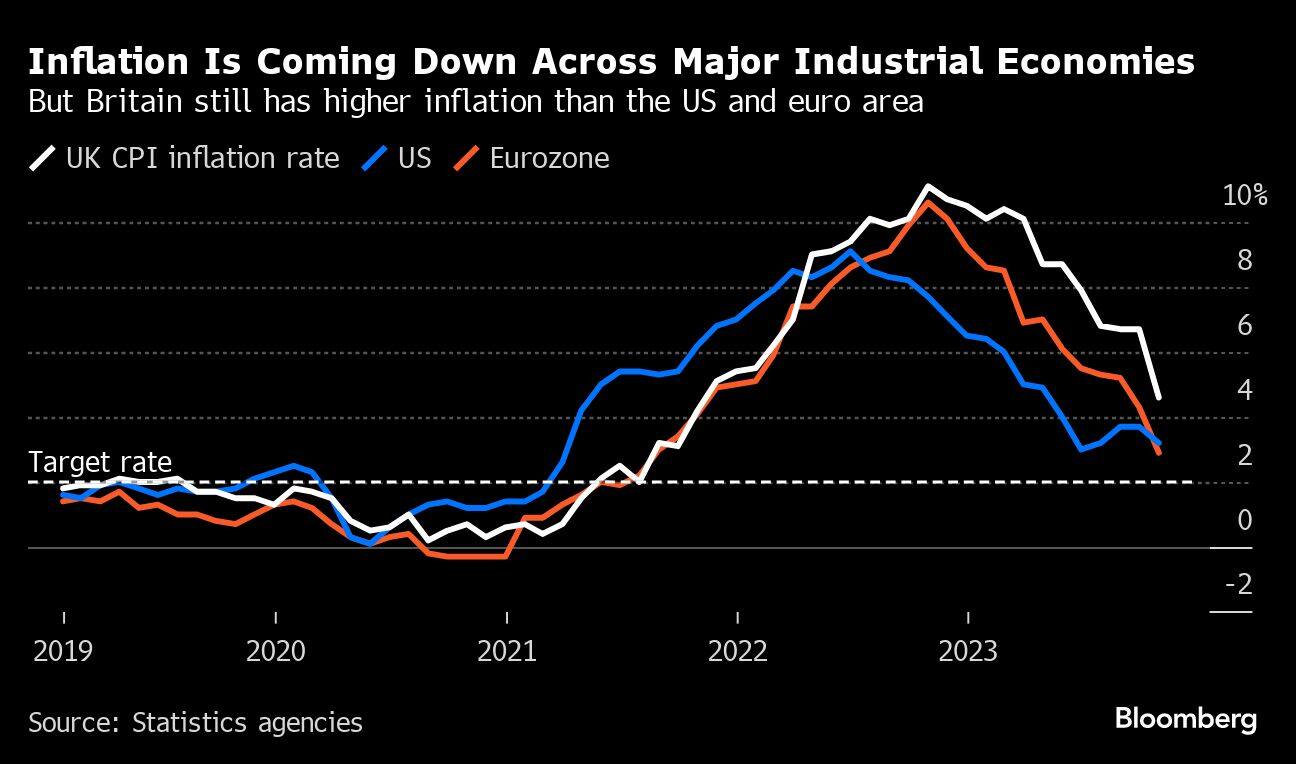
In the UK, both core and services inflation — which are being closely watched by the BOE for signs of underlying inflation — came in weaker than economists had expected. Core inflation, which strips out volatile energy and food prices, slowed to 5.7% from 6.1%. There was no increase in consumer prices between September and October.
“Food prices were little changed on the month, after rising this time last year, while hotel prices fell, both helping to push inflation to its lowest rate for two years” ONS Chief Economist Grant Fitzner said. “The cost of goods leaving factories rose on the month. However, the annual growth was slightly negative, led by petroleum and basic metal products.”
The cost of electricity, natural gas and other domestic fuels fell 7% in October compared with a 24.7% surge a year earlier. Food price inflation slowed to 10.1% from 12.3%., with prices gaining just 0.1% on a month.
The ONS also said that price increases in food and non-alcoholic drinks was one of the largest downward drags on inflation.
The annual rate of inflation for housing and household services, which includes energy bills, was the lowest since 1950, the ONS said.
Discover the latest Business News, Sensex, and Nifty updates. Obtain Personal Finance insights, tax queries, and expert opinions on Moneycontrol or download the Moneycontrol App to stay updated!
Find the best of Al News in one place, specially curated for you every weekend.
Stay on top of the latest tech trends and biggest startup news.