




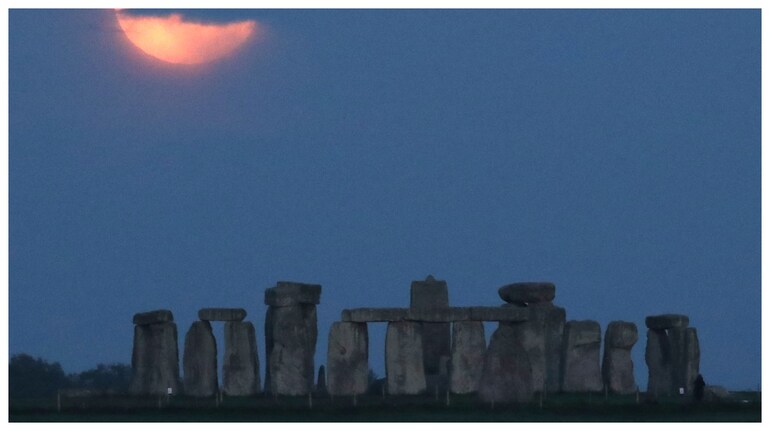
Stonehenge, one of the world's most famous pre-historic wonders, has often left historians as well as archaeologists wondering about the purpose behind its construction. However, as per a new study it has come to light that it was constructed for the purpose of unification in Britain during ancient times.
In a paper published in the journal 'Archaeology International', researchers from University College London and Aberystwyth University have written that the site on Salisbury Plain, about 128 kilometers (80 miles) southwest of London, may have had some unifying purpose for the peoples of Britain.
"It may have served as a monument of unification for the peoples of Britain, celebrating their eternal links with their ancestors and the cosmos," said lead author Professor Mike Parker Pearson from UCL's Institute of Archaeology.
Stonehenge was built on the flat lands of Salisbury Plain in various stages, starting 5,000 years ago, with the unique stone circle erected in the late Neolithic period, about 2,500 BC.
According to the study, people from Scotland and Wales brought local stones as part of their contribution to to assembling the structure and establishing "political unification and shared identity across much or even all of Britain".
"Bringing together these extraordinary and alien rocks ... symbolised and embodied far and distant communities within a complex material," it said.
Pearson also believes that the stone circle may have had a political as well as a religious purpose. "The fact that all of its stones originated from distant regions, making it unique among over 900 stone circles in Britain, suggests that the stone circle may have had a political as well as a religious purpose. It was a monument of unification for the peoples of Britain, celebrating their eternal links with their ancestors and the cosmos," he said.
As per the study, similarities between stone circles in Scotland and Stonehenge, located in Wiltshire on the southern edge of England's Salisbury Plain, add to a growing collection of clues showing there was likely more connectivity between ancient societies in these two distant areas than once thought.
"These new insights have significantly expanded our understanding as to what the original purpose of Stonehenge might have been," Pearson said. "It shows that this site on Sailsbury Plain was important to the people not just living nearby, but across Britain, so much so that they brought massive monoliths across sometimes hundreds of miles to this one location."
Stonehenge is famous for its great sandstone slabs, known as sarsens, which were sourced locally – likely hauled from West Woods in Wiltshire, around 15 miles north. In addition to the tall Sarsen stones that make up Stonehenge's distinctive appearance, the world-famous site is also home to around 80 'bluestones' – smaller stones that have a bluish tinge when freshly broken or when wet.
Some earlier analysis has shown that bluestones, a type of fine-grained sandstone, and larger silicified sandstone blocks called sarsens were used in the monument's construction. The bluestones were brought from 140 miles (225 kilometers) away at the Preseli Hills area in west Wales and are thought to have been the first stones placed at the site. The sarsens, used later, came from the West Woods near Marlborough, located about 15 miles (25 kilometers) away.
Discover the latest Business News, Sensex, and Nifty updates. Obtain Personal Finance insights, tax queries, and expert opinions on Moneycontrol or download the Moneycontrol App to stay updated!
Find the best of Al News in one place, specially curated for you every weekend.
Stay on top of the latest tech trends and biggest startup news.