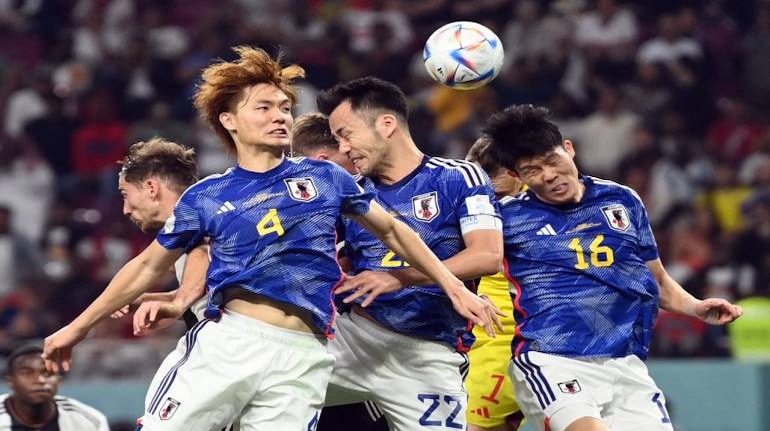
When Japan’s head coach Hajime Moriyasu bowed in front of the nation’s fans to thank them for their support after their penalty shootout defeat against Croatia, it almost felt like it should have been the other way round. In fact, not just Japan, the entire continent of Asia should thank the coach and his players for once again making a continent dream of competing against the best in the world.
 Read more FIFA 2022 stories here
But Moriyasu’s gesture of Japanese etiquette was hardly his team’s approach at the World Cup in Qatar where they hardly bowed down to the likes of Germany, Spain, and even Croatia. Not only did they win games against two of the best teams in the world, they scared the daylights out of last year’s finalists and showed that the Asian nations are not too far from where they should be in world football. It might take a few more World Cups, but the Japanese blueprint has been successful so far.
It is unfortunate that the South Koreans came up against a fantastic Brazil in the other knockout game that ended Asia’s chances, but there is much hope to take from the two sides. Add to that Saudi Arabia’s win against Argentina, and there is enough inspiration to take from the performances for the rest of the countries in the continent. Japan’s football scenario is surely advanced compared to countries like India or China, but it shows that patience in building the sport eventually pays dividends.
But how long does a nation have to wait for a run of results like Japan had at the World Cup? In the case of the Land of the Rising Sun, it took them 30 years of work. There were signs of positivity in those decades, but any drastic change in sporting culture doesn’t happen overnight. Thankfully for Japan, in the time they were setting the building blocks of becoming a formidable football force, they saw results at the world stage that gave them more confidence to continue the good work.
In seven World Cup appearances, they have made the knockouts four times. In the same time (since 1998), they have won three Asian Cups and finished runners-up in the last edition. Some Asian nations set up a vision for the next 10 or 20 years, but when Japan’s football think-tank got together in 1992 to change the footballing landscape, they set up a 100-year vision to win the World Cup.
This vision did not involve only administrative fixes to the league pyramid. While it took time to expand the teams over three tiers to 60, from just 10, Japan set upon adding more to what they already had – speed and agility. Given how the country is obsessed with details and the mechanics of mastering something, they set about adding technique and physicality to their football systems. Tactics don’t matter if you cannot control the ball in tight spaces with European teams hurtling towards you in a modern-day pressing approach. The way Japan played at the World Cup is testament to these additions. Their players wanted the ball, they wanted to attack, they wanted to make things happen. Just look at the numbers of their main man in midfield Daichi Kamada, just from the first half:
Daichi Kamada's first half by numbers vs. Croatia:100% take-ons completed
100% tackle success
31 touches
5/6 duels won
2 x possession won
2 tackles
2 take-ons
1 clearance
1 shotDancing around the middle of the park. #FIFAWorldCup pic.twitter.com/n4hH0sMUSH
— Squawka (@Squawka) December 5, 2022
And all those lessons in technicality were so evident when Japan kept the ball in play by millimetres for their winning goal against Spain. It was evident when attackers like Junya Ito and Kaoru Mitoma ran at defenders at full tilt. It was evident in each and every one of the clearances they made and passes they stitched together. The only limitation the side showed was against Croatia during the penalties – it almost seemed like they had not trained for the situation – relying rather on their abilities to win open play matches than keep their heads in a shootout. Japan’s tactics, spearheaded by coach Moriyasu, were developed from hindsight that it is home-grown coaches who win more World Cups for their countries.
What has also helped Japan is their ability to now export players to European leagues. A higher FIFA ranking allows their players to get work permits in these nations and it was a cruel coincidence that Japan’s 2022 team had more players from the Bundesliga than the J-League when they knocked Germany out of reckoning. Stars like Hidetoshi Nakata and Shinji Kagawa have inspired generations to take up the sport and join the league system. It is a cycle that started early, but it shows other Asian nations that even one player being successful in one of the big leagues can make an entire country sit up and notice. It is similar to Heung-Min Son and his effect on South Korea. The Tottenham Hotspur star is the biggest sports icon in the country and South Korea’s budding footballers have latched onto him as their symbol of the sport.
It is easy to sit back and hope for a goal on the break against two former champions and the 2018 finalists. But Japan’s mentality has grown from an underdog nation to one which can truly compete. They simply do not give up on games, they do not get overawed by European powerhouses and they almost made it to the quarters.
According to Moriyasu, the penalty shootout defeat will teach them more. They went through a heartbreak in 2018 when they lost a two-goal lead against Belgium to lose 3-2. This time, the lesson is different: "We could not break through the round of 16 and could not see a new landscape. We won against Germany and Spain who have been champions. The players showed a new era of Japanese football and they should use this feeling of being upset to try to win next time,” he said.
All it takes is a little spark for a nation’s sporting landscape to change – India’s cricket team winning the 1983 World Cup is a great example. But in a global sport like football, a country’s performance can inspire an entire continent. And there is no better template than Japan’s.
Discover the latest Business News, Sensex, and Nifty updates. Obtain Personal Finance insights, tax queries, and expert opinions on Moneycontrol or download the Moneycontrol App to stay updated!

Find the best of Al News in one place, specially curated for you every weekend.
Stay on top of the latest tech trends and biggest startup news.