Born in India, Lord Meghnad Desai is a world-renowned economist, a member of the British House of Lords and an emeritus professor of economics at the London School of Economics (LSE), where he taught from 1965 to 2003.
In 1992, he established the Centre for the Study of Global Governance at LSE. From 1990 to 1995, he was director and founding member of the LSE’s Development Studies Institute. In 1991, he was made Lord Desai of St Clement Danes; he was awarded the Padma Bhushan, India’s third highest civilian award, in 2008.
In 2014, he established Meghnad Desai Academy of Economics in Mumbai.
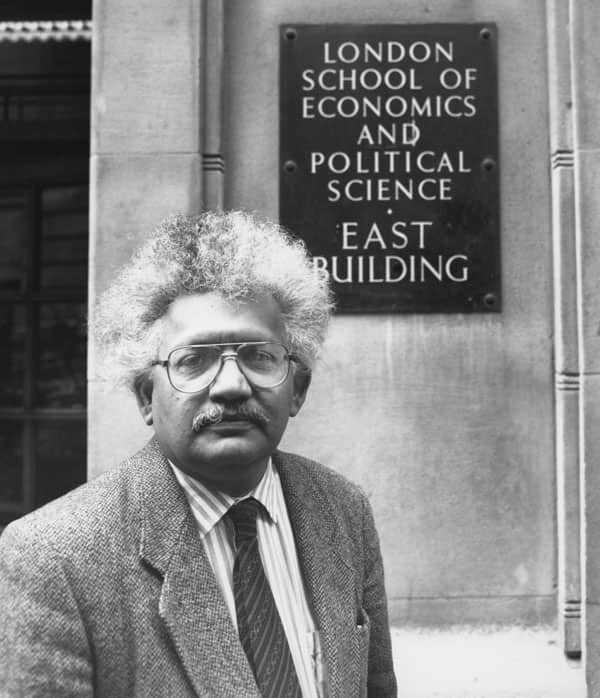 (Image source: LSE Library via Wikimedia Commons)
Author of several books, Lord Desai’s interests range from Marxian economics to postcolonial theory to the films of Dilip Kumar.
Here, Lord Desai talks about what India will look like when it turns 100 in 2047.
In his wordsThere has been a tradition in India (and no doubt in other similar poor nations) of seeking hope in the future as the present does not satisfy. India celebrated 50 years of its independence in 1997. At that time, congratulatory remarks were made about democracy and secularism as embodying the Idea of India. Neither the economy nor military capability had been worth celebrating. India had nuclear weapons and Bangladesh had split Pakistan. But India had lost against China.
Come the 75th anniversary, things were looking up. The quarter-century of solid income growth from 1991-2016 raised India’s total GDP to $2 trillion, taking India in terms of global ranking up to the fifth place. Per capita income was still modest, with India being near 150th in ranking.
These calculations are relatively easy in a nation with ancient mathematical tradition. The compound annual growth rate (CAGR) is magic. If you assume that the economy would grow at such and such CAGR, then hopeful predictions follow. Thus, if you assume a CAGR of 4 percent in total GDP, you can predict it will double in 18 years. If CAGR was 6 percent, GDP will double in 12 years. (Number of years to double = 72/CAGR. Don’t ask me why 72). Much of the future hoping (call it forecasting if you wish) is just such a simple calculation.
The problem is we do not know if the economy will grow at a CAGR of 4 percent or 6 percent. Economies do not normally grow steadily without disruption. The 25 years from 1991 to 2016 were benign for the global economy. India benefited from that as the Narasimha Rao government of 1991-96 had opened up the Indian economy. But more recently since 2008, the global economy has slowed down, and since 2021, there have been the Ukraine-Russia war as well as recovery from the Pandemic. India has benefited from this trading with Russia but there is a high inflation possibility.
This is just to warn against facile mathematical prophecy. Economies do not grow at a given (or wished for) CAGR. So forecasting India at 100 in 2047 is to be done cautiously. The year 2047 is 24 years away. Take the 24 years between 1947 and 1971 - during these years, India did not prosper as much as we had hoped for. Or again take 1971 to 1995, India went through several crises - Emergency, Babri Masjid, etc. - and in 1991 went bankrupt. India had to sell its gold reserves to the International Monetary Fund (IMF) as it had run out of foreign exchange.
So what we predict for 2047, we must bear in mind that life, the economy and global as well as national politics are uncertain. India will be a democracy, it will be the most populous nation in the world (unless China suddenly has a demographic revolution) and better economically than it is now. It may be high up globally in terms of GDP and even per capita income, if things go right. What is more likely is that it will still be united, democratic and tolerant. It will remain an amazingly diverse country with scores of languages and jatis (caste) and many religions and tribes. People’s health will improve, their literacy and education will flourish, and they will be friendly to each other.
Discover the latest Business News, Sensex, and Nifty updates. Obtain Personal Finance insights, tax queries, and expert opinions on Moneycontrol or download the Moneycontrol App to stay updated!
Find the best of Al News in one place, specially curated for you every weekend.
Stay on top of the latest tech trends and biggest startup news.