




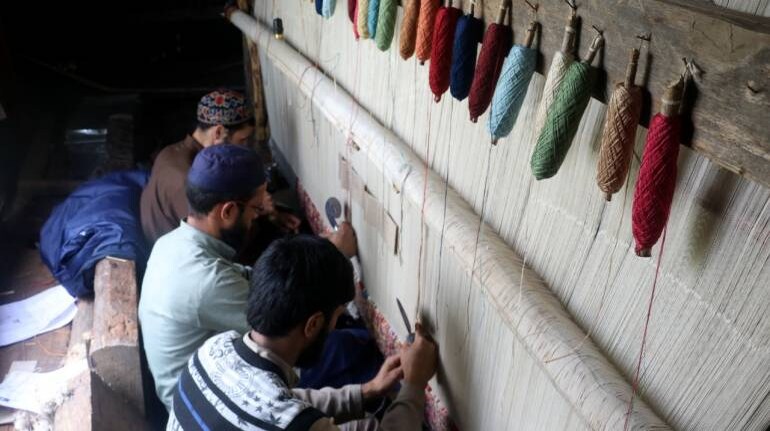
Sitting cross-legged in front of the kaleen waan (carpet-weaving loom), men and women weavers are inching close to completing a tranche of handmade silk carpets.
Around 50 weavers from 12 families associated with the craft, at Khanpora, Shungli Pora and Lassipora hamlets in central Kashmir’s Budgam district, are working day and night to weave traditional silk carpets—one carpet per family—locally called kaleens, for the new Parliament building that is coming up in New Delhi.
At one such loom in the Khanpora hamlet, women sit side by side with men weavers, their eyes and hands move in rhythmic synchronisation. The silk carpets will hang on the walls of the Parliament House.
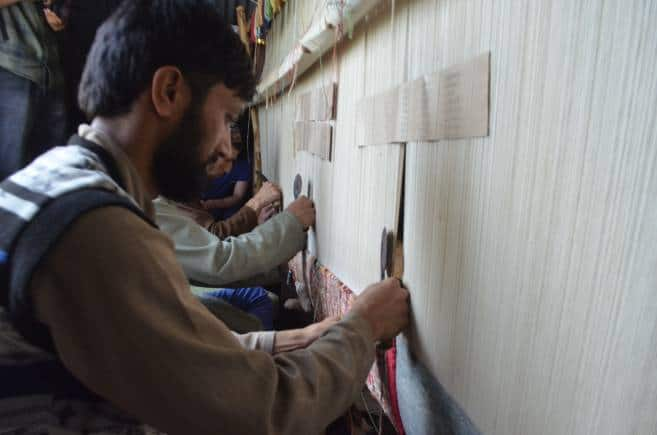 Carpet weavers in Budwan, Kashmir. (Photo by Irfan Amin Malik)
“Nine carpets are ready while work on three is still going on. The carpets are being washed while a few are being given the finishing touches before they are dispatched to New Delhi,” says Qamar Ali Khan, a carpet manufacturer and trader.
In November last year, 28-year-old Khan received the order for 12 carpets from the Central Vista Redevelopment Project that is working on the new Parliament building. “We are so rejoiced that our hand-knotted carpets are going to adorn the halls of the new Parliament building. The weavers are optimistic that it will boost the trade and help them continue their centuries-old craft in the Valley.”
Locally known as Kal Baffi, the hand-knotted carpets of Kashmir are famous the world over for their designs, yarn and weaving quality. “Previously, we had buyers from both within and outside the country, but after the 2014 floods followed by Covid-19, the demand for Kashmiri carpets has dwindled, causing misery to hundreds of artisans,” says Khan, who runs a 35-year-old carpet business in the Valley.
Eight feet broad and 11 feet long, these commissioned carpets will have four different designs, incorporated from the traditional Kashmiri pashmina shawl designs.
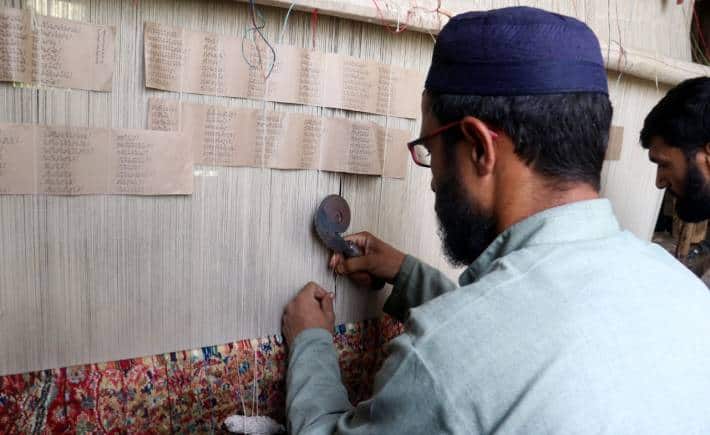 The 12 carpets will have four designs inspired by Kashmiri Pashmina shawls. (Photo by Irfan Amin Malik)
After receiving the order, Khan shortlisted 50 master weavers in Khag tehsil of Budgam for the task. “Since November, the weavers have been working for 10 hours daily. Weavers associated with the carpet weaving would usually get Rs 150-225 a day for their work. However, with this project, the 50 weavers working on it will get about Rs 600-700 a day.”
Master weaver Abdul Rahim Khan of Shungli Pora, a village where around 80 percent of the people are associated with the craft, says he along with five other weavers have worked meticulously to achieve perfection in designing the carpets.
At his carpet-weaving loom, Rahim Khan reads out kaleen taleem or a written code aloud, and the others follow his instructions. “Kaleen taleem is the instruction manual that specifies the number of strands of yarn to be used, the colours, the spacing of the threads to make up the patterns on the carpet being handwoven. We are on the verge of completing one out of the 12 carpets for the Parliament complex,” says the master weaver who has been associated with the craft for more than 22 years.
He added that the majority of his villagers chose this craft as their bread and butter. “Due to snow during winter, our village remains cut off from the rest of the world for around eight months. During this period, we cannot do any other business except carpet-weaving,” he says.
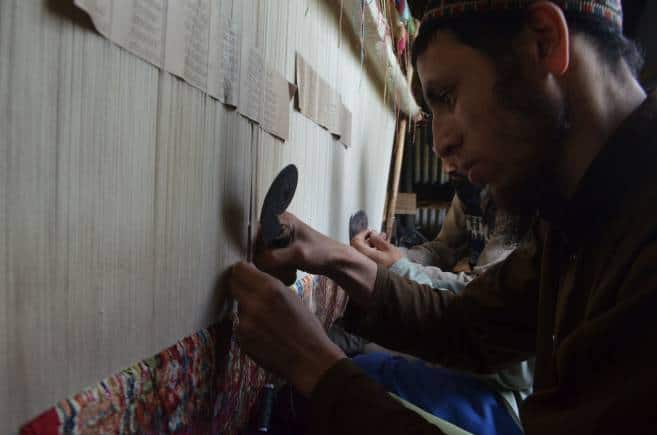 The 50 master weavers have each been working 10 hours a day. (Photo by Irfan Amin Malik)
Similarly, Tariq Ahmad Khan of Khag, along with his sisters Sara Begum and Mubeena, is putting final touches on the carpet that will soon be dispatched. “For the past six months, three-five weavers have worked on it, from dawn to dusk, and within a week, the carpet will be ready. The carpet costs Rs 4,000 per foot and the labour cost on each carpet is around Rs 3.5 lakh,” says Tariq, 26, who began weaving carpets at the age of nine.
While 70 percent of the population in Budgam district is engaged with the carpet industry, other districts that are also engaged in making handmade carpets include Bandipora and Baramulla. The art of weaving carpets was introduced by Sultan Zain Ul Abidin who reigned over Kashmir in the 15th century, carpet makers were brought in from Persia and Central Asia to instruct the locals. Today, around three lakh people in the Valley are associated with handicrafts, including carpet-weaving, according to the handicrafts and handlooms department of Kashmir.

Discover the latest Business News, Sensex, and Nifty updates. Obtain Personal Finance insights, tax queries, and expert opinions on Moneycontrol or download the Moneycontrol App to stay updated!
Find the best of Al News in one place, specially curated for you every weekend.
Stay on top of the latest tech trends and biggest startup news.