





“There's always bigger things. People went to the moon and now to Mars. We are limited (only) by our imagination,” says Nirmaldai ‘Nims’ Purja.
The former soldier, mountaineer was answering a query on future plans, having finished his Bremont Project Possible. Between April and October 2019, Purja attempted—and succeeded—in summitting the world’s 14 highest peaks in a seven-month period. The previous record stood at seven years, 10 months, six days.
The project, now on Netflix as the documentary 14 Peaks: Nothing is Impossible, targeted all the ‘eight-thousanders’ or peaks that are 8,000m above sea level. All of them are located in the Himalayan and Karakorum ranges.
Purja, who spent six years as a Ghurkha and a decade with the UK Special Forces, summitted Annapurna (April 23), Dhaulagiri (May 12), Kanchenjunga (May 15), Everest (May 22), Lhotse (May 22), Makalu (May 24), Nanga Parbat (July 3), Gaherbrum I (July 15), Gasherbrum II (July 18), K2 (July 24), Broad Peak (July 26), Cho Oyu (September 23), Manaslu (September 27) and Shishapangma (October 29) in six months and six days.
He says the main purpose of the mission was literally to show the world that “nothing is impossible,” he says over a Zoom call from the UK. “It does not matter where you come from or what your background is. Nothing is impossible if you put your heart, mind and soul into it.”
His second purpose was to give a boost to Nepalese climbers, whose role in conquering the world’s highest mountains is undervalued and unacknowledged. “One can always do more, right? Feels like there is more to do,” he says.
8,000m is our playgroundThe documentary 14 Peaks made it to the long list for BAFTA (British Academy Film Awards) 2022, but did not make the cut for the final nominations list of five.
“It’s the key for us—the whole thing is about justice. More people need to know the story of Himalayan climbers, the Sherpas. The whole story is about dreaming big. Whatever you do in life—we have our own mountains to climb. So it’s about how you achieve those goals.”
“The 8,000m peaks is our home, playground. A lot of people make a living out of it. If this (the 14 peaks) was done by Western climber, the news would have been 10 times bigger. It’s a fact,” says Purja.
Challenges of shootingShooting the film had its own set of challenges, toughest among them was raising the funds while he was climbing. For him, success was not just getting to the top or getting to the top 14 times. “When someone is at the summit of one mountain, people are like, done. But I have to think not just that I have to go down, but what’s the logistics of the next mountain. Do I have the money? How is team dynamics? Any bureaucracy we have to deal with?”
Purja was born in Dhaulagiri and raised on the flatlands of Chitwan, without any inclination to climb mountains. His ambition was to join the military, a family tradition. There was no television in the house when he was growing up—the children would trot off to a neighbour’s house where they would be shooed away. “I produced one of the biggest mountain films in the world. We are probably first movie ever from Nepal that Netflix has picked up. It shows that there are no excuses. As long as you have vision and work hard,” the 39-year-old says.
 Nims Purja, 39, credits his armed forces training for his fitness to climb the world's highest mountains. (Image via Netflix)
Sometimes, at 7,000m on a mountain terrain, he would be climbing and flying the drone at the same time. As a lead character of the film, he would have to ask someone from his team to get the camera out and film him doing something.
He credits his training in the armed forces for being able to achieve the feat. Even before he got into the Special Forces, Purja says his normal routine would be waking up early in the morning, running 25km carrying 75 pounds (about 35kg) weight, before starting his day job as an engineer. In the evening, he would leave his backpack and run 20km. Then have dinner and go to the gym, cycle 64km, swim 100 laps in a 25m pool. He used to do that 26 days a week for six months.
“I had 10 years in special forces where you have to operate in a stressful environment under extreme circumstances in terms of planning meticulously, making the right decisions. The reason I became successful (in Project Possible) was because the mission was never about me. It was bigger than my own personal goals or interests of my family,” he says.
"Usain Bolt of 8,000m"After summitting five peaks in Pakistan in 23 days, in the film, Purja proclaims: “I am the Usain Bolt of 8000m. No one can beat me.”
There are two bits that stand out in the film shot amidst the majestic, snow-capped Himalayas where climbing is subject to the mercy of the mighty mountains, the weather and other factors beyond human control.
14 Peaks shows a queue of climbers waiting to summit the Everest, a long line of people waiting for the right opportunity to make the final push. Purja says his intention was not to highlight the commercial aspect of climbing Mt Everest.
“Climbing the Everest is tough. Not everybody runs the marathon to beat (Eliud) Kipchoge’s record. People run for the experience, to achieve their new possible. To take something away from that, it’s not cool. Some people have to talk down others to feel better. You cannot talk about it without in-depth knowledge. I was talking about the queue because I was on a different mountain, doing my 14 peaks.”
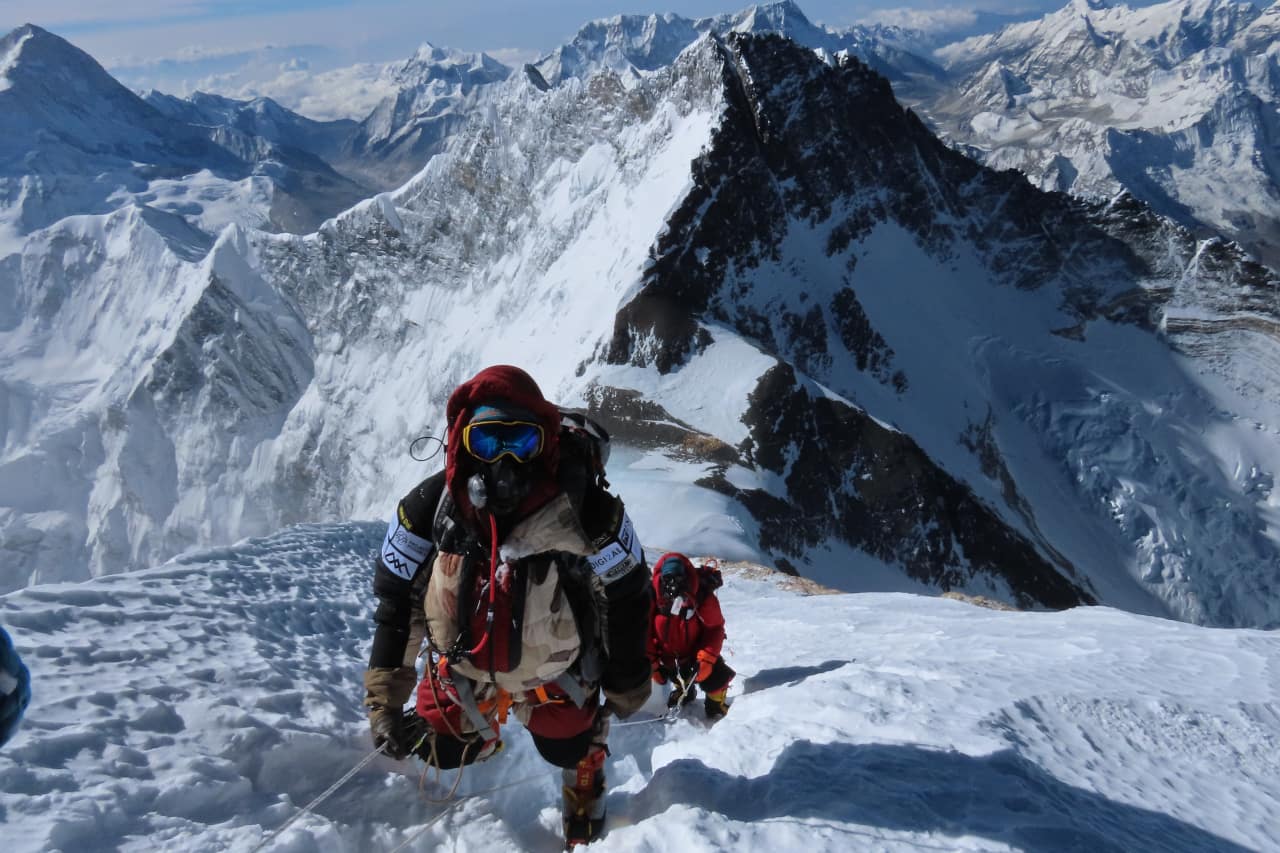 Nims Purja explains oxygen-support can be important for the mountaineers who are leading the climbers and fixing the lines, all while carrying 30kg of load. (Image via Netflix)
The second aspect is climbing with oxygen support, which he did. It’s a practice that gets criticism from the purists. “I can talk for both—I did K2 in winter without oxygen. I have led two expeditions without oxygen. The difference is if you are at the front, trail blazing, fixing the lines, while carrying 30kg of load. With oxygen on 1 litre or 0.5 litre per minute, that is way harder than someone following on the path that has been trailblazed, at the back, with rope that has been fixed.”
He says as long as people call Sherpas by name and admit how they helped, he would be happy. “People climb mountains and make themselves into heroes. They never say I climbed this because of Nims or whoever. Just be honest, don’t be greedy to take credit.”
Discover the latest Business News, Sensex, and Nifty updates. Obtain Personal Finance insights, tax queries, and expert opinions on Moneycontrol or download the Moneycontrol App to stay updated!
Find the best of Al News in one place, specially curated for you every weekend.
Stay on top of the latest tech trends and biggest startup news.




