





When choosing a mutual fund, it's important to consider several factors, including your investment goals, time horizon, risk appetite, the fund manager and fees. But there’s one factor we tend to give a bit more weightage than warranted - past performance.
Any investor would sit up and take notice of 15%, 20% or 25% returns, the higher, the better. You might even use an online mutual fund returns calculator just to see what those returns could look like if you started investing now.
But here’s the thing, these are total returns generated by the fund over specified time periods. It is calculated assuming a lump-sum investment made at the beginning of the period and held throughout.
Apart from the usual disclaimers like ‘past performance is not indicative of future returns’, this is simply not how the typical retail investor behaves. A more important number to consider is the investor returns, which take into account the impact of cash inflows and outflows on the annual returns earned.
To put it simply, investor returns reflect the impact of both how much and when money is invested and withdrawn, giving a more accurate picture of fund performance based on the real experience of investors.
Mind the behaviour gapTypically, investor returns are lower than point-to-point fund returns when markets trend upwards. This gap between the returns that investors actually earn and the returns that they could have earned if they had made optimal investment decisions is known as the behaviour gap. The opposite can be true during long bear markets.
If all this seems a bit abstract, the investment research firm, Morningstar, crunched the numbers to quantify the gap between investor returns and total fund returns in a report titled, ‘Mind the Gap - India’. Total returns across fund categories stood at 10.45%, 8.78% and 12.33% over the last three, five, and 10 years, respectively, till June this year.
At the same time, investors earned about 8.97%, 7.51%, and 9.53% per year on the average rupee they invested in mutual funds across categories over the same periods, respectively. This indicates a gap of 1.48%, 1.28%, and 2.8% over the last three, five, and 10 years, respectively.
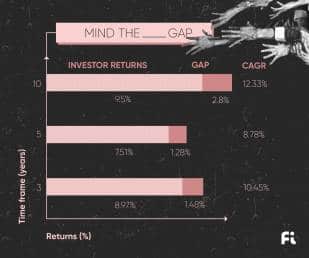
This gap stems from inopportunely timed purchases and sales of funds, which cost investors nearly one-quarter the return they would have earned if they had simply bought and held funds. Along with investment costs and tax efficiency, this shows that timing is one of the most significant factors that can influence investors’ end results.
The issue is that investors may initially buy into funds with a long-term view but tend to panic-sell or book profits in between due to fear or trying to time the market, which breaks the compounding cycle. This is especially true of investors chasing the performance of narrow funds such as thematic or sectoral funds.
Investors often pile onto popular sectors only after they show strong growth and bail out when the market cycle turns. In other words, they buy high and sell low. The investor gap for the technology sector was a massive -24.31% per year over a three-year period.
Keep investments simple, stupidThe behaviour gap is caused by investment decisions based on emotions and biases. Everything from our early investing experiences to the latest market fads impacts our choices. But if investors have to contend with what is essentially human psychology, is there any hope of closing the gap?
“Our study also shines more light on the merits of keeping things simple, favouring broadly diversified funds, and following a disciplined investment approach,” the Morningstar report said.
The four ways investors can capture more of their fund investments’ total returns are:
While advocating a buy-and-hold approach, the report suggests that investors who don’t have a lump sum to invest can follow a rupee-cost-averaging system or SIPs. Money management apps like Fi Money allow investors to go beyond the usual SIPs with innovative AutoInvest rules, including daily and weekly investments. These rules can help investors take maximum advantage of rupee-cost-averaging to close the gap as much as possible.
Moneycontrol Journalists were not involved in the creation of the article.Discover the latest Business News, Sensex, and Nifty updates. Obtain Personal Finance insights, tax queries, and expert opinions on Moneycontrol or download the Moneycontrol App to stay updated!



