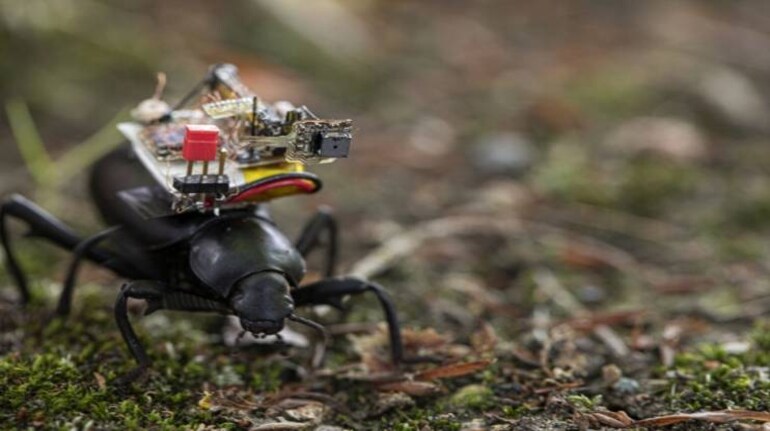
A team of researchers at University of Washington has developed a camera so small in size that it can be mounted on a beetle and can record up to five frames per second in black and white.
The entire camera rig weighs just 250 milligrams, around 1/10th of the weight of a playing card.
The team claims it is the world's "smallest terrestrial, power-autonomous robot with wireless vision," according to a blog post on the Washington University website.
It has the ability to stream to a smartphone and it sits on a mechanical arm that can pivot 60 degrees. It also gives the viewer the ability to capture a high-resolution, panoramic shot or track a moving object while spending little energy, the blogpost said.
According to the blog post, the researchers used a tiny, ultra-low-power black-and-white camera to mimic an animal's vision. This camera has the ability to capturing a sweeping field view, using the mechanical arm. Which can get activated using high voltage.
As opposed to using wheels to move, the robot moves by vibrating and can travel at around three centimeters a second, adding that the researchers are aware of surveillance concerns surrounding the issue.
Shyam Gollakota, one of the researchers involved in the study, spoke about the issue in the blog post, "As researchers, we strongly believe that it's really important to put things in the public domain so people are aware of the risks," Gollakota said, adding that this is done to ensure people can also come up with solutions to start addressing them.
No beetles were harmed during the experiment, with many living up to at least a year after the experiment had ended. The team is hoping to see future versions of this camera feature no batteries and even be solar-powered, according to the blog post.


Discover the latest Business News, Sensex, and Nifty updates. Obtain Personal Finance insights, tax queries, and expert opinions on Moneycontrol or download the Moneycontrol App to stay updated!
Find the best of Al News in one place, specially curated for you every weekend.
Stay on top of the latest tech trends and biggest startup news.