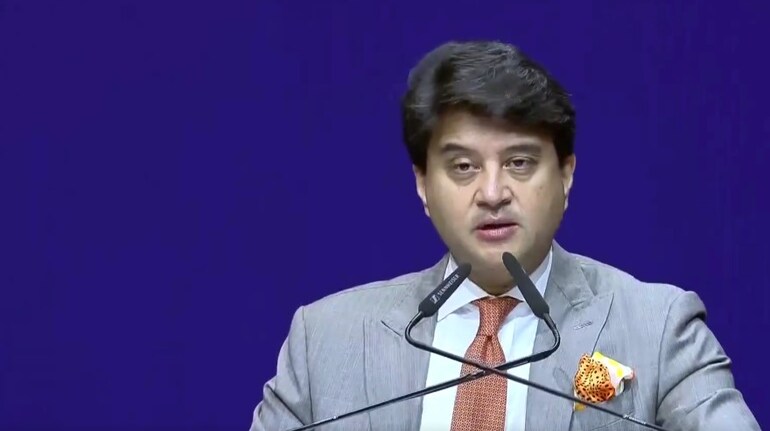

The promise of 6G lies not only in technological sophistication, but also in the democratisation of opportunity—an area where India’s story is set to become globally relevant, telecom minister Jyotiraditya Scindia said on Wednesday.
Speaking at an international workshop on telecom standardisation, Scindia positioned 6G as the next big leap in human civilisation, going beyond faster speeds and lower latency to enable an “intelligent internet of everything” powered by artificial intelligence, immersive technologies and real-time connectivity.
“6G is not just about exponential gains in speed and latency. It represents a transformative shift towards intelligence, immersiveness and limitless possibilities,” he said, adding that the technology has the potential to bridge the digital divide and create opportunities for every citizen globally.
The minister said India is actively positioning itself at the forefront of 6G development, particularly in intellectual property and standard-setting.
“India is leading in 6G IPR. We have ensured that work is progressing across seven dedicated working groups to strengthen India’s participation in global 6G standards,” he said. He added that the government-backed Bharat 6G Alliance is working to ensure India has a seat at the global table as standards evolve.
“India is working steadfastly… to be a partner at the table in setting those standards,” Scindia said.
However, he clarified that key decisions such as spectrum allocation for 6G will follow global consensus.
“In terms of allocation of 6G spectrum, that will be decided by ITU and 3GPP. That is still pending and will likely come after standardisation,” he noted.
The minister highlighted how India’s digital public infrastructure—from UPI to Aadhaar—has already demonstrated the ability of technology to scale and deliver inclusion, connecting 1.4 billion people through what he described as an “invisible digital highway”.
India currently processes nearly 20 billion UPI transactions every month and accounts for over 50% of global digital transactions, he said, adding that falling data costs and rapid expansion of broadband connectivity have created the foundation for the next wave of innovation.
Against this backdrop, 6G could unlock use cases such as remote robotic surgeries, AI-driven agriculture, and holographic education in rural areas, effectively bridging access gaps across sectors.
Scindia also underlined India’s intent to play a larger role in shaping global 6G standards through the Bharat 6G Alliance, with a target of contributing 10% to global standard-setting. “India was not at the table during the evolution of 3G, 4G or even 5G. With 6G, we intend to be a key contributor,” he said.
The minister outlined four pillars to guide the global 6G roadmap—interoperability across networks and devices, common technical standards through bodies such as 3GPP and ITU, accelerated research and innovation, and inclusive growth through open standards.
He also pointed to India’s growing strength in electronics manufacturing, noting that the country now meets 100% of its mobile phone demand domestically while emerging as a major exporter, aided by production-linked incentive (PLI) schemes.
As global conversations on 6G standardisation gather pace, Scindia called for deeper international collaboration, citing the New Delhi Declaration signed at IMC 2025 as a step towards a unified global framework.
“We must build intelligent, inclusive and transformative networks that not only connect devices, but also people, opportunities and possibilities,” he said.

Discover the latest Business News, Sensex, and Nifty updates. Obtain Personal Finance insights, tax queries, and expert opinions on Moneycontrol or download the Moneycontrol App to stay updated!
Find the best of Al News in one place, specially curated for you every weekend.
Stay on top of the latest tech trends and biggest startup news.