-
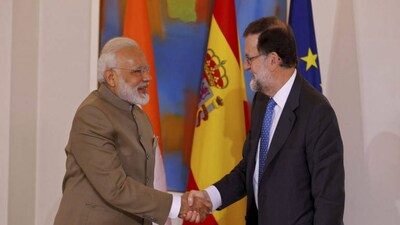
PM Modi for boosting anti-terror cooperation with Spain
Modi met Rajoy at the Moncloa Palace this morning in the first engagement during his stay in the Spanish capital today.
-

After vote, Spain's Rajoy faces arduous task
The ruling conservative Popular Party, led by Rajoy, won the highest number of votes on Sunday but it only obtained 122 seats out of the 350-seat parliament, falling short of the 176 needed for a parliamentary majority.
-
Spain's PM Rajoy punched in face on election walkabout
The prime minister, 60, was unhurt, a People's Party spokesman said, but Rajoy appeared later with a deep red mark on his face.
-
Spain: Once-desperate member of PIIGS comes back
The country, which represents the "S" in "PIIGS," a term coined as a catch-all for Europe's most troubled economies, is growing at its fastest pace in seven years—3.1 percent in the second quarter. Of the other PIIGS—Portugal, Italy, Ireland and Greece—only Ireland is growing faster.
-
At least 77 killed, 131 injured as train derails in Spain
The city's tourism board said all festivities, including the traditional High Mass at the centuries-old cathedral, were cancelled as the city went into mourning following the crash.
-
Pressure mounts on Spanish PM to step down in scandal
Pressure mounted on Spanish Prime Minister Mariano Rajoy on Monday as a once-trusted aide gave more testimony before a judge looking into allegations of illegal financing in the ruling party.
-
Rajoy sees hope for Spain in jobless figures
Unemployment in Spain, the euro zone's fourth-biggest economy, jumped to a record 27.2 percent in April, adding to the European debate over whether to ditch policies focussed on austerity in favour of efforts to spur economic growth.
-
Spain admits recession worse but gets deficit leeway
Spain acknowledged that its economy would shrink more than initially expected in 2013 and its budget deficit would be higher than promised, but the European Union gave it more time to bring the shortfall back down to bloc limits.
-
European shares slide on weak economic outlook
The euro edged higher on Monday as an election victory for Spanish Prime Minister Mariano Rajoy in his home region was seen as clearing one obstacle to Madrid seeking international aid.
-
EU reaches a deal on supervisory body for euro-zone banks
European Union leaders have reached a deal to set up a joint supervisory body for the euro-zone banks next year as the first step towards a banking union in the single currency area.
-
Spain to pass reforms, budget cuts with eye on aid
Spain will announce a series of economic reforms and a tight 2013 budget on Thursday, aiming to avoid the political humiliation of having Brussels impose conditions on a request for an international bailout.
-
Spain's PM expects 'reasonable' terms for any new aid
Spanish Prime Minister Mariano Rajoy said on Monday he expected the European Union to set reasonable conditions for Spain if the country sought a bailout, saying he should not be told exactly where to trim public spending and would not cut pensions.
-
Two months to shape the euro zone's future
After a summer lull, the euro zone faces two months that will go a long way to dictate whether its debt crisis, now into a third year, will spiral out of control or finally be contained.
-
Spain inches closer to seeking sovereign bailout
Spain inched closer to seeking a sovereign bailout on Friday as Prime Minister Mariano Rajoy opened the door to a request, although he said he needed first to know the attached conditions as well as the form the rescue would take.
-
Spain sets out spending cuts to chorus of protest
Spain created an emergency fund to protect regional governments from defaulting and warned that pensions will be overhauled as protesters rallied on Friday against deep spending cuts needed to dodge an international bailout.
-
Spain's new austerity buys some time, not solution
Spain may have won some time with markets and praise from Europe but it has little left in the locker to avoid a state bailout as a new 65-billion-euro austerity programme could deepen the country's economic woes rather than solve them, analysts say.
-
Spain PM announces 65bn euro austerity package
Spain's Prime Minister Mariano Rajoy announced today a 65 billion euro (USD 80 billion) austerity package to avert financial collapse as angry miners rallied against subsidy cuts.
-
Merkel's 'fiscal union' drive faces major hurdles
In the mid-1990s, Helmut Kohl was asked how he ever hoped to convince Germans to give up the deutsche mark for a nebulous new currency that was later dubbed the euro.
-
PM Rajoy says his reforms saved Spain from full rescue
Prime Minister Mariano Rajoy tried on Sunday to deflect withering criticism for his handling of Spain's debt crisis, saying the country had avoided a full rescue for its state debt due to his economic reforms and steps to cut the budget deficit.
-
Spain cries for help: is Berlin listening?
Crisis is the watchword in Madrid. Take your pick - liquidity crisis, debt crisis, banking crisis, economic crisis, confidence crisis, investor crisis, jobless crisis. Spain, the ailing euro zone's latest problem child, has them all.
-
Spain beset by bank crisis, recession, bond pressure
Spain's borrowing costs shot up at a bond auction on Thursday, after economic data confirmed the country is back in recession and reports that nationalised Bankia SA had suffered an outflow of deposits hammered its share price.
-
Spanish borrowing costs to jump, bank buying eyed
Spain's borrowing costs are set to rise by more than a percentage point at an auction of three and five-year bonds on Thursday.
-
Spain: Reform, Grow or Restructure?
With borrowing costs rising for Spain, and S&P last week downgrading the euro zone's fourth-biggest economy by two notches, pressure is growing on Madrid.
-
Euro crisis needs 'mother of all firewalls': OECD
Euro zone finance ministers need to impress finance markets with the size of their rescue fund for indebted countries when they meet later this week, the head of the OECD said on Tuesday, advocating "the mother of all firewalls".
-
The good to follow the bad in eurozone: StanChart Bank
Thomas Costerg, the Europe economist at Standard Chartered Bank says that he expects to see things worsen in the euro zone before they become better.