






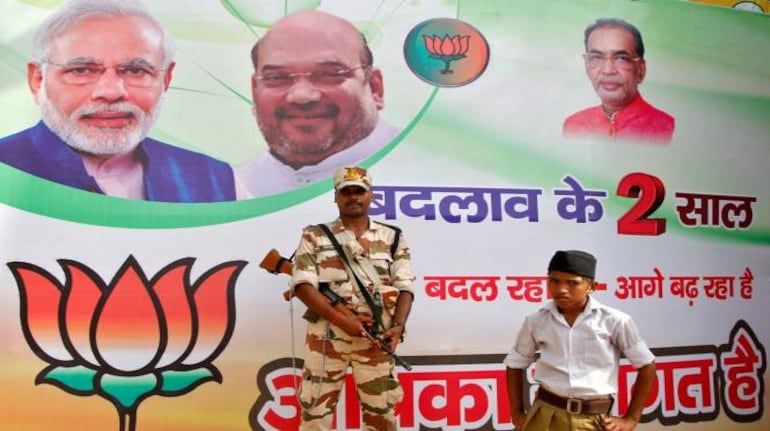
After Nathuram Godse pulled the trigger thrice to assassinate Mahatma Gandhi on January 30, 1948, his alleged links to the Rashtriya Swayamsevak Sangh (RSS) got the organisation banned.
At that point, the RSS was merely an organisation that advocated Hindu values and supremacy and did not wield much political influence. And yet somehow, nearly 70 years later, the top three constitutional posts in the country are currently occupied by products of the RSS.
How did this come to be? How did an organisation which boycotted the Quit India movement and the national flag manage to gain such a vast following in free India?
To answer these questions, we must take a look at RSS’ past, what gave birth to it, and how it has evolved since.
Origin and historyInspired after reading Vinayak Damodar Savarkar’s Hindutva and meeting him in person while incarcerated at Ratnagiri prison, Keshav Baliram Hedgewar founded the RSS in 1925, with an aim to strengthen Hindu society.
Hedgewar believed the only reason for a few Britons managing to hold control India was the lack of unity and valour among Hindus. To remedy this, he recruited young Hindu individuals with a hunger for revolution, gave them a uniform resembling the one British policemen sported, and armed them with lathis.
However, since the RSS isolated itself from the Indian freedom movement, the ideology behind the birth of the RSS has been disputed by scholars and historians.
In fact, when MS Golwalkar became the Sarsanghchalak (supreme leader) of the RSS in 1940, he continued to strengthen this isolation from the freedom movement by saying that the RSS’ aim was to achieve freedom by fighting for religion and culture and not against the British.
Golwalkar went as far as to actually shut down the military department of the RSS when ordered to do so by the British during the Second World War. The British government noted the RSS was not supporting any civil unrest against them at the time, and the Bombay government acknowledged that the organisation stayed away from participating in the Quit India movement, which broke out in August 1942.
Around five years later, a few months before India gained independence, the RSS openly opposed the tricolour and did not recognise it as the national flag. The Organiser, which was the Sangh’s mouthpiece then, demanded the Bhagva Dhwaj (saffron flag) be adopted as the country’s national flag.
“The people who have come to power by the kick of fate may give in our hands the Tricolour but it never be respected and owned by Hindus. The word three is in itself an evil, and a flag having three colours will certainly produce a very bad psychological effect and is injurious to a country,” Golwalkar wrote in an article in the Organiser.
On January 30, 1948, Nathuram Godse, a Hindu supremacist and alleged member of the RSS, walked into the compound of Birla House in New Delhi and shot Mahatma Gandhi thrice in the chest.
Gandhi shortly succumbed to his wounds and several RSS leaders were arrested in connection with the incident in the few days that followed. Five days after the assassination, on February 4, the RSS was banned.
The organisation has since been acquitted of its association with the unfortunate incident and has disowned Godse. However, in a letter to Hindu Mahasabha leader Shyama Prasad Mukherjee, then Deputy Prime Minister Vallabhbhai Patel had said the RSS and the Hindu Mahasabha’s actions were responsible for creating the atmosphere that made Gandhi’s assassination possible.
The ban on the RSS was lifted in 1949, after the organisation vowed to stay away from politics and Golwalkar promised to mention the party’s loyalty to the Constitution of India and the national flag more explicitly in the RSS' constitution.
Rise to prominenceFor a long time after the ban on it was lifted, the RSS did not find any political standing in the country. It was not until 1975 when the Indira Gandhi government proclaimed emergency rule in India that the RSS rose to prominence.
Perceived as being close to leaders from the Opposition, the organisation was among a number of organisations banned by the government. However, the RSS defied the ban and thousands of Sangh members from shakhas around the country took to Satyagraha to express their discontent and protest against the violation of human rights.
When this did not result in any positive outcome as such, RSS members started forming underground movements with an aim to restore democratic governance, and started secretly publishing and distributing literature that was censored in the media.
A substantial amount of funding was raised and leaders both in and out of jail started forming networks of communication to coordinate the movement. The RSS had even said that at the time, it had only one purpose and that was bringing back democracy.
After the Emergency came to an end in 1977, the ban on the RSS was lifted and it quickly immersed itself into mainstream politics. Under the direction of Sarsanghchalak Madhukar Deoras, the RSS merged its political arm the Bharatiya Jan Sangh, created in 1951, into the larger and more diverse Janata Party.
This was the first ever instance of the RSS openly getting involved in electoral politics. The Janata Party defeated the Indian National Congress in the 1977 General Elections and became the ruling party for the next three years.
After losing the 1980 General Elections, the Janata Party split and the Bharatiya Janata Party (BJP) emerged as the Sangh's new avatar. It adopted socialism in order to shield itself from allegations of communalism. However, the BJP won only two seats in Parliament in the 1984 General Elections amid widespread belief that the RSS had withdrawn support to the party and even voted for Congress candidates.
Later that decade, the BJP took notice of the RSS, and the Vishwa Hindu Parishad’s movement to build a Ram temple in Ayodhya was gathering momentum. Seeing this as an opportunity, the party openly embraced Hindutva and thrust itself to the forefront of the movement.
Between September and October 1990, the BJP, along with the RSS and VHP, organised a march called the Ram Rath Yatra. The purpose of the yatra was to support the VHP and RSS’ demand to build a temple to the Hindu deity Rama on the site of the demolished Babri Masjid. Incidentally, a young Narendra Modi, who was then a member of the BJP’s National Election Committee, had a hand in organising the yatra that was led by LK Advani, who would eventually go on to become Deputy Prime Minister.
What followed was a period of communal divisiveness the likes of which India had not seen since Partition. In the eyes of the public, the BJP and the RSS were one and using this momentum, the party came to power in 1996, albeit for just 13 days.
But this was just the beginning. In 1998, the party formed an alliance government, which stayed in power for 13 months, during which it fought a war with Pakistan. In the general elections that followed in 1999, the BJP-led National Democratic Alliance came to power and stayed there for the next five years.
However, it was in these five years that the RSS’ belief that being involved in electoral politics could help build the country based on its own ideologies was put to the test. Prime Minister Atal Bihari Vajpayee, who was a RSS swayamsevak himself, chose to ignore the RSS’ demand for a Ram temple in Ayodhya and instead focused on other issues.
Coming into powerThe RSS had been replacing its old guard with younger members since the late 1990s.
In 2005, when LK Advani visited Mohammad Ali Jinnah’s tomb in Pakistan and praised the leader’s secularist views, the RSS unified against him. Advani was asked to report to the RSS headquarters and tender his resignation from the post of BJP President with immediate effect.
However, Mohan Bhagwat, who was then the general secretary of the RSS, took a softer approach to the whole issue. He suggested that the RSS, as a major organisation of volunteers, should strive to maintain cordial relations with India’s neighbours and that the BJP should hold on to Advani and make him a mentor for the party.
When Bhagwat was appointed Sarsanghchalak of the RSS in 2009, he first focused on repairing the RSS’ relations with the BJP. Unlike his predecessor Sudarshan, who was against going to Advani’s home and discussing the issue with him, Bhagwat believed that given Advani’s age and seniority, he ought to be treated with some respect.
However, despite having gone to Advani’s house and paying him due respect, Bhagwat did not back down from his argument. And therein lies the biggest reason for the RSS coming into real power in the years that followed. Bhagwat not only gained in influence within the RSS and the BJP, he also achieved the unique combination of being both authoritative and accommodative at the same time.
After BJP lost the 2009 General Elections, Bhagwat told Advani he was of the mind to send 500-700 volunteers from the Sangh to strengthen the party at various levels, but left it up to the latter to accept or reject the assistance.
Having lost two general elections in a row, the RSS and the BJP started looking for a prime ministerial candidate for the 2014 elections. Bhagwat had long had Pramod Mahajan in mind, but since Mahajan was shot dead by his brother in 2006, he threw his weight behind Narendra Modi, who had been the Chief Minister of Gujarat since 2002.
Notwithstanding his ability as an organiser and leader, many in the RSS were opposed to the idea of Modi being the BJP’s primary candidate. There were question marks around the outcome of the investigation against him for his alleged involvement in the 2002 Gujarat riots.
However, a year before the election, the RSS and the BJP had to make a choice between a pro-Hindutva candidate and a secular candidate and they largely agreed to go with the former. By June 2013, Modi had already been chosen to head the BJP’s national campaign committee.
The rest, as we know now, is history. Modi’s popularity helped BJP sweep the 2014 General Elections with a single-party majority and ensured the party steamrolled over almost every state assembly election that followed. BJP is now in power in 18 of India’s states and the RSS now has over 50,000 shakhas across the country. With more than 6 million volunteers, RSS says it is the world’s largest voluntary organisation .
A couple of months ago, former Bihar Governor Ram Nath Kovind was voted President of India, and former Union minister Venkaiah Naidu was elected Vice- President. President Kovind, Vice-President Naidu and Prime Minister Modi all trace their roots to the RSS.
Discover the latest Business News, Sensex, and Nifty updates. Obtain Personal Finance insights, tax queries, and expert opinions on Moneycontrol or download the Moneycontrol App to stay updated!
Find the best of Al News in one place, specially curated for you every weekend.
Stay on top of the latest tech trends and biggest startup news.




