




If the energy transition were a product, it would have “Mostly made in China” stamped on the casing. This doesn’t make it an easy sell in the US, so the Department of Energy has just done its part to finesse the pitch.
Long-awaited guidance on eligibility for electric vehicle federal tax credits, as it pertains to country of origin, has arrived. To recap, the expansion of EV credits under the Inflation Reduction Act was conditioned on the sourcing of a rising proportion of battery components from the US and critical minerals from the US or free-trade agreement partners. In addition, inputs from so-called “foreign entities of concern,” or FEOCs, would render such vehicles ineligible for credits, making them less competitive.
Several countries fall under that designation but the one that matters is China. China’s long-standing industrial policy aimed at developing clean-technology manufacturing means it now owns or controls swaths of the value chain, EV batteries very much included.
In a more populist, post-pandemic US, this is intolerable. The IRA doesn’t want just green tech; it has to also be star-spangled. Yet the inescapable fact is that absent the cost deflation wrought by Chinese factories, we wouldn’t even be having a credible conversation about decarbonisation at this point.
The new guidance attempts to deal with this via the sort of ambiguities that keep lawyers paid. While the headline requirement excluding any entity with at least 25 percent FEOC control hews toward the more restrictive end of things, there are potential gray areas.
The obvious one is licensing. Ford Motor Co has come under political fire for a planned battery factory to be built in Michigan that would license technology from Contemporary Amperex Technology Co, or CATL. CATL is the largest battery maker in the world and also completely dominates a particular type of battery chemistry, lithium-iron-phosphate, or LFP, that Ford wants to make cheaper electric trucks. Ford has little choice but to tap into CATL’s knowhow, and the new guidance implicitly blesses this. While the language concedes that licensing agreements can be structured to cede effective control to a FEOC, “many contractual and licensing arrangements do not raise these concerns.” Evaluation on a case-by-case basis provides room for maneuver.
In addition, the 25 percent control threshold is perhaps less restrictive than it appears. ClearView Energy Partners, a Washington-based analytics firm, writes in a new report that the language leaves room for dilution of effective control through multiple layers of ownership. In other words, if a FEOC parent owns 25 percent of a subsidiary but that subsidiary in turn owns less than 50 percent of a further subsidiary, then the third entity wouldn’t be deemed to be under the parent’s control, at least from an equity accounting standpoint.
This should mean facilities outside of China that ultimately trace back to a Chinese parent but which can demonstrate enough degrees of separation to avoid the appearance of effective control can provide components and minerals that qualify for tax credits. Virtually an invitation to Escher-like organigrams, this will incense the likes of Senator Joe Manchin, the key vote for the IRA, largely responsible for its domestic content provisions, and somewhat prone to being incensed about the whole thing.
Such tensions are unavoidable, though. Without casting aspersions on the formidable capabilities of American capitalism, you can’t simultaneously unravel decades of emissions and globalisation overnight. Demanding the electrification of the passenger vehicle fleet and the scaling up of domestic manufacturing within a few years to do it is a recipe for failure.
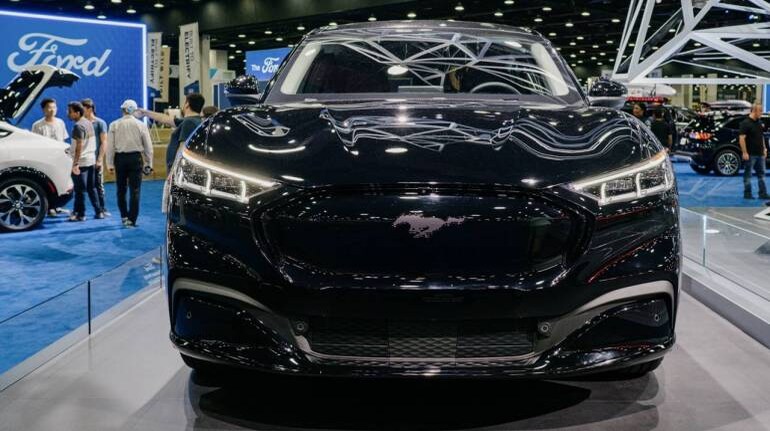
Even with such ambiguities in the FEOC rules, and even assuming they survive court challenges or future election outcomes, they will create obstacles at a time when the growth in demand for EVs, while still above 50 percent, year over year, has slowed from the rapid pace of the past few years and manufacturers’ profit margins have come under pressure. Cheaper Tesla Inc. models using LFP batteries from CATL would lose some of their tax credit and Ford says its Mustang Mach-E, as currently configured, will lose eligibility.
There are other, less obvious ramifications, too. For example, Chinese lithium processors have been financing the development of some mines in Australia. Absent a reduction in their control of those operations, such
lithium would render an EV ineligible for at least some of its tax credit, despite Australia having a free-trade agreement with the US. Conversely, the FEOC language offers an unambiguous boost to nascent US critical minerals projects.
Lurking here is a need for something that, in Washington, is a rare commodity indeed: Humility. As Jane Nakano, a senior fellow at the Center for Strategic and International Studies, points out, unlike the manufacture of solar panels, the US has never really had a domestic EV battery industry: “I don’t see the battery issue as reshoring. It’s onshoring.” Unpalatable as it may be in Congress, this is a sector where the US has much to learn from China. Recognising that, and harnessing it, is necessary if US hopes of a homegrown industry are to succeed.
Liam Denning is a Bloomberg Opinion columnist. Views do not represent the stand of this publication.
Credit: Bloomberg


Discover the latest Business News, Sensex, and Nifty updates. Obtain Personal Finance insights, tax queries, and expert opinions on Moneycontrol or download the Moneycontrol App to stay updated!
Find the best of Al News in one place, specially curated for you every weekend.
Stay on top of the latest tech trends and biggest startup news.