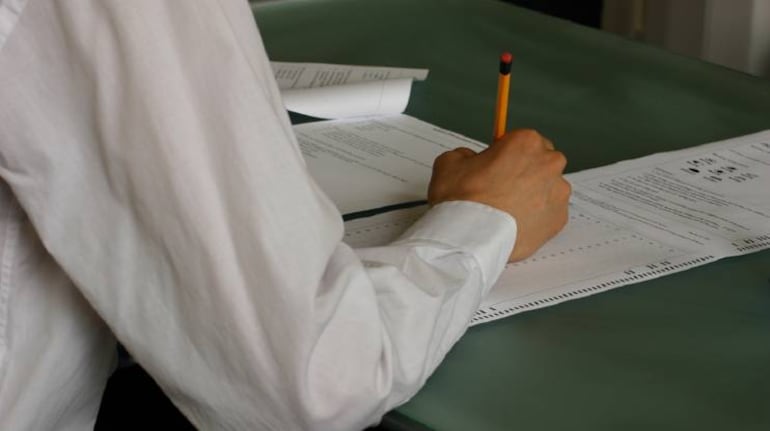
It is that time of the year when millions of young Indian boys and girls, as well as their anxious parents and families, spend sleepless days and weeks worrying about the future. I am talking about the annual pandemic otherwise known as the great Indian Board Exam and college admission jamboree.
With more than 1.5 million schools and more than 250 million students, India is home to the largest school system in the world. Much has been written about the quality of education on offer in this gargantuan, if creaky structure, but the fact is that a significant number do make it all the way through the entire school system to tackle the final barrier — the Class XII exams, conducted by national boards of education like the Central Board of Secondary Education (CBSE) and the Council of Indian School Certification Examination (ISC), as well as various state boards of education.
While numbers for CBSE (about 1.6 million students appeared for the 12th Board exam this year) and ISC (around 100,000) are easier to come by, those for the various State boards are not easily available. However, various estimates put the total number of students appearing for the 12th class board exams at over 14 million. This means that millions of Indians — because in India, as in large parts of Asia, the ‘make or break’ 12th exams involve the entire family, not just the hapless students) — have already undergone months and even years of trauma, tension and anxiety.
The 12th exam results have just come out and a remarkably high percentage (over 90 percent) have actually cleared the hurdle. Unfortunately, this is just the beginning of a long and even more tense journey before these millions of young men and women, all statistically already part of India’s so-called ‘demographic dividend’, having reached the UN Population Fund’s working age classification of 15-64 years, actually become productive, employed and earning members of society.
That is because getting past the 12th class board exam is only the first hurdle. There are many more barriers to pass before they get a scarce seat in a college and an even tougher battle after that to get a post graduate or professional degree and even tougher scramble after that to actually land a job.
India’s gross enrolment ratio — defined as the percentage of population in the eligible age group (18-23 in this case) enrolled in tertiary education — is a little over 27 percent, according to last available estimates. A bunch of researchers, including the vice chairman of India’s apex regulatory body for higher education, the University Grants Commission, have argued in a recent paper that the Eligible Enrolment Ratio (EER), defined as the percentage of eligible students — those who have qualified in the 12th class examination — enrolled in tertiary education as a more suitable measure. According to the study, India’s EER in 2017-18 was almost 65 per cent, comparable to the European and advanced economy averages.
But that still means that 35 percent missed out — many due to economic compulsions as they simply cannot afford to defer earning any longer, but also owing to the fact that there are more students seeking admission to college than there are seats available.
India is home to the world’s third largest tertiary education system, with more than 1,000 universities and nearly 35 million students enrolled in undergraduate, graduate and professional programmes. But the difference between having the second largest school system and the third largest university system is much more than what the one spot difference in rankings suggests. Competition for college seats is intense. With marks inflation in the board exams — more than 135,000 students scored over 90 per cent in this year’s CBSE 12th exam alone — school leaving marks are becoming increasingly irrelevant.
There is now a perfect alphabet soup of entrance exams that students have to clear to join college, the latest being the newly revamped Central University Entrance Test (CUET) mandatory to get into one of India’s 45 Central universities. Much has been written about NEET (the National Eligibility cum Entrance Test) for admissions to medical and dental degree programmes, which saw 1.87 million students vie for a little over 91,000 MBBS and nearly 27,000 BDS (dental) seats but the admission test for engineering is equally brutal JEE (Joint Entrance Examination) for top tier engineering colleges like IITs and NITs saw more than 875,000 aspirants at the first stage (there is a second, advanced test for getting into IITs proper!).
But these are the biggies. There are six other admission tests besides JEE by various groupings of engineering colleges. There are 10 different entrance exams besides NEET for medical. There are eight different entrance tests for management courses. Even hotel management has as many as nine different sets of entrance exams for admission!
Clearly, the education system is broken. The multiplicity of entrance exams point to the increasing failure of the Senior Secondary Certificate qualifying the holder for even admission to a college, leave alone landing a job. The millions of students appearing for competitive exams for jobs points to the failure of a bulk of the tertiary education system to produce employment-ready degree holders.
Worse, the years spent in the pursuit of largely worthless degrees (a famous NASSCOM survey found that only around 7 per cent of engineering graduates were employment-ready) means that India loses a sizeable chunk of working age population during the tertiary phase — a period when they are at their physical and mental productivity peak.
What can be done? For starters, India Inc must give up insisting on pointless qualifications for giving jobs. A 12th certificate, along with a year of focussed skill development training should be enough to meet the entry level requirement in most general admin, sales and marketing jobs. Likewise, an engineering degree is not required for basic shop floor jobs. Ditto for coding.
Since Indians have a transactional attitude to education — degrees are sought not for learning but to help land a job — once the path to a job is eased, the pressure on the tertiary system will ease. This means more resources can be focused on fewer people to enhance quality for higher order skills, while employers can quickly find talent with basic skills for other jobs. This will help solve India Inc’s talent shortage, improve our skills quotient and hopefully reduce trauma for students and parents.
Views are personal and do not represent the stand of this publication.
Discover the latest Business News, Sensex, and Nifty updates. Obtain Personal Finance insights, tax queries, and expert opinions on Moneycontrol or download the Moneycontrol App to stay updated!
Find the best of Al News in one place, specially curated for you every weekend.
Stay on top of the latest tech trends and biggest startup news.