





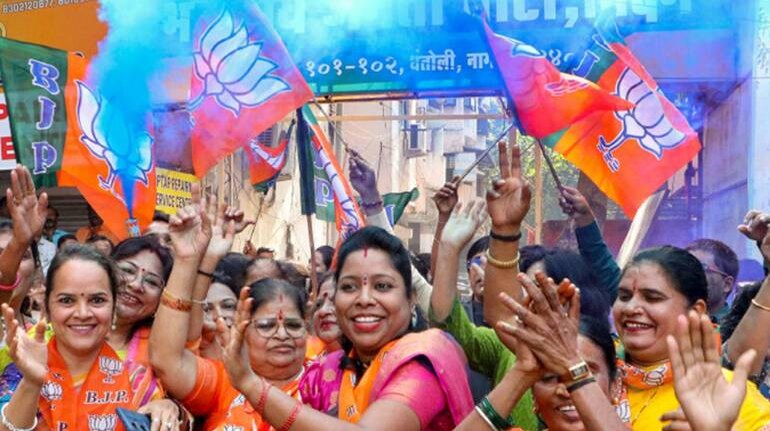
What does the BJP’s sweep of three Northern Indian states (Rajasthan, Chhattisgarh, Madhya Pradesh) mean for the Lok Sabha election less than six months away? One might conceive of the answer in terms of two alternate big picture conclusions?
An expansive conclusion might be that 2024 appears now close to a done deal, barring a near miraculous opposition upsurge. After all, it is the clearest indication yet that BJP still retains its glaring structural advantages (ideological appeal and charismatic national leadership) over the Congress in Hindi belt states.
A Third Consecutive BJP Sweep Likely
In the 2019 election, BJP won 171 out of the 186 seats where it directly faced Congress, much of it in these Central and Northern states. A third consecutive BJP sweep of the Hindi belt in national elections appears likely, which might insulate BJP’s parliamentary majority from minor setbacks in states like Maharashtra and Karnataka.
A modest conclusion might be that the Congress rout represents a setback, but not a fatal blow to the prospects of the Congress, or indeed the INDIA alliance. One might point to the 2003 state elections, where the BJP won all three states, only to lose the 2004 ‘India Shining’ national election. State politics and national elections, one might argue, revolve around distinct political orbits, citing also the previous round (2018 elections) where Congress had triumphed in all three states only to lose nationally six months later.
This is a rare case where the expansive conclusion might represent the more valid conclusion.
The 2003 case is a flawed analogy. For one, the BJP did in fact sweep the same three Northern states in 2004 national elections also, just that they suffered massive setbacks in other states. Thus, the 2003 results were not altogether a false guide to the future. But the more important reason is that the BJP of that period was fundamentally different to the BJP of today.
In the book Congress After Indira (2012), the political scientist Zoya Hasan highlighted certain crucial differences between the Congress under Nehru and Indira Gandhi. Under Nehru, the government and party wings of the Congress were distinct and the state Congress party enjoyed considerable autonomy to follow its political agenda. Under Indira Gandhi, government and party wings were fused, and state units were bent more towards following a centralised agenda.
The analogy might be that the Vajpayee-Advani BJP was like the Nehru Congress in both these respects, whereas the Modi-Shah BJP is like the Indira Gandhi Congress. Therefore, on principle, the relationship between BJP’s performance in state and national elections during the Vajpayee era represents a flawed guide for interpreting elections under the Modi-Shah era.
Consider the number of hats Amit Shah dons. The Home Minister can lead party campaigning, say on the “religious conversion” agenda in Chhattisgarh (aimed at the Hindu Tribal/Christian Tribal divide) but also exercise intricate control over the organisational machinery in the state. In effect, the BJP’s national party leadership, and centralised ideological agenda/organisational machinery had been put here to a popular referendum. Given the massive popular approval at evidence even in the state elections, there is much reason to believe that a similar strategy might work similarly well in the national elections.
Hindutva Agenda’s Popularity
Consider how the state elections of Rajasthan and Chhattisgarh witnessed an unprecedented degree of heightened communal polarisation as well as the primacy of a national agenda. This national agenda (such as G20 and space missions, Ram Temple and Kashmir) was anchored to the leadership of PM Modi, who fronted both these challenger campaigns of the BJP.
The PM also helmed, in many respects, a Hindutva-focussed BJP political messaging in Rajasthan (a departure from the Bhairon Singh Shekhawat-Vasundhara Raje era). The point of the PM repeatedly bringing up the Kanhaiya Lal murder in Udaipur as evidence of Congress’s Muslim appeasement was not to highlight administrative inaction. Of course, everyone knew the murderers had been arrested almost immediately and charged under stringent laws. The point the PM was making was that the (Muslim) killers had acted “without fear” and “proudly made the video viral”. This was the “paap” (sacred crime), the PM held the Gehlot government to have been complicit in the “land of Rajasthan which has lived the tradition of not attacking even the enemy by deceit”.
The “Hindu” messaging of the BJP is an important plank and certainly helped the BJP claw back political support. One can see this immediately in certain regions where the BJP had been wiped out in the previous elections, which have remained “communally sensitive” zones during the campaign period, and where BJP has now boomeranged into the dominant electoral force.
These include the Mewar region of Rajasthan under which Udaipur falls, the Malwa Nimar which contains Khargone (noted recently for the Khargone riots and ‘bulldozer action’), and the Bastar region of Chhattisgarh (which saw clashes between Hindu tribals and Christian tribals in recent times). All of these are also zones containing a considerable tribal population.
Congress had won these belts with a high level of tribal support the last time around. In these elections, both the strident Hindutva agenda of the BJP and the relinquishing of a substantive tribal centric agenda by the Congress state leadership have resulted in the stark reversal of fortunes.
In Bastar, the Congress came under attack not just from the RSS affiliates but also influential tribal forces Chhattisgarh Sarva Adivasi Samaj which backed certain third parties. The Bharatiya Adivasi Party (BAP), meanwhile, won three seats from the Mewar region, capitalising on Congress’s weaknesses. Thus, these regions demonstrated the confident political imagination of the BJP in instituting a Hindutva agenda at the grassroots as well as the abject failure of the Congress to imagine and institute a more inclusive ideological agenda in response to the BJP’s Hindutva.
The so-called soft Hindutva (the device of choice for incumbent Congress CMs) might work at most at the level of everyday tactics, but it certainly does not represent any viable or coherent strategic response.
Telangana Lessons For Congress’s Deadwood
As the Telangana triumph shows, a bad electoral result should not prompt us to entirely write off the Congress in these states. Yet, the leadership of these states must harken to the inclusive model presented by the Telangana victory (following the Karnataka success). The three planks of social mobilisation (yearlong mobilisation of Dalits and tribals addressing specific grievances), economic mobilisation (subsidies targeted at key groups of landless workers and tenant farmers), and electoral mobilisation (youthful and collective leadership launching movements to activate the latent anti-incumbency of the regime).
In contrast, the old guard of the Congress in charge of Madhya Pradesh (perfectly exemplified by Kamal Nath) spent its time guarding their turf from rival Congress factions and indulging in various soft Hindutva gestures, perhaps hoping the BJP would implode on its own due to its high anti-incumbency.
This old guard of Northern states is now perhaps a decade past its expiry date. They have been enabled by a weakened High Command and prevent the emergence of a younger leadership bringing forth new energies and ideas. For the Congress to have any hope of revival, it needs to ruthlessly sideline this deadwood. It might not be enough to prevent another BJP wave of Northern India in 2024 but at least provide the party with desperately needed political resilience and a sense of future direction.
Asim Ali is a political researcher. Views are personal, and do not represent the stand of this publication.
Discover the latest Business News, Sensex, and Nifty updates. Obtain Personal Finance insights, tax queries, and expert opinions on Moneycontrol or download the Moneycontrol App to stay updated!

Find the best of Al News in one place, specially curated for you every weekend.
Stay on top of the latest tech trends and biggest startup news.




