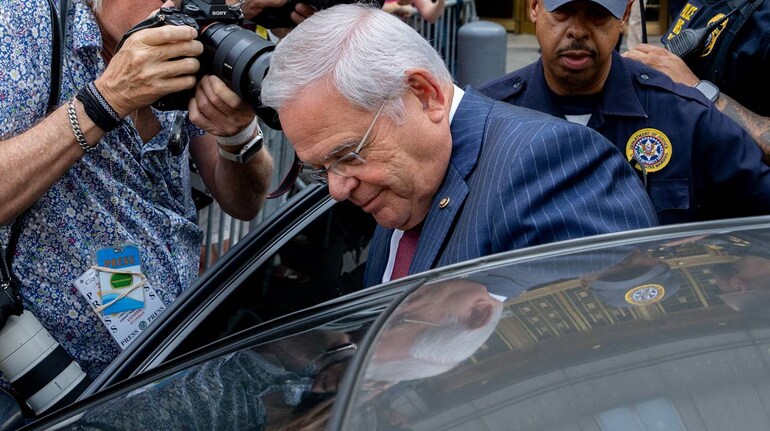
Tuesday’s conviction of Senator Robert Menendez shows that, despite recent trends at the US Supreme Court, some avenues remain open for prosecutors to hold public officials accountable for crimes.
The New Jersey Democrat was convicted in federal court in Manhattan on all 16 counts in an indictment charging him with bribery, extortion, fraud, obstruction of justice and acting as an agent of a foreign government. Menendez has maintained his innocence and has said he will appeal.
In recent years, the Supreme Court has cut back on the application of federal statutes to the conduct of public officials. As a former federal prosecutor, I find this trend concerning — particularly in a time when public confidence in government is particularly low. The Menendez conviction sends an important message that criminal prosecution remains a risk for officials who breach their duty of trust to the people they were elected to serve.
Beginning in 1987, the court has issued several decisions curtailing the application of federal statutes to official misconduct. In McNally v. United States, the court gutted the concept of honest services fraud, a theory that when a government official performs an act on the job for a corrupt purpose, members of the public suffer even if they suffer no monetary loss.
That case involved a state official in Kentucky named Gray (McNally was his co-defendant) who engaged in self-dealing by steering a government contract to an insurance agency that shared its commissions with another agency in which Gray had an undisclosed financial interest. Gray was convicted of fraud for depriving citizens of the right to have their affairs conducted honestly, despite the absence of evidence that the state had paid a higher rate for the insurance. The court reversed the convictions, finding that the mail fraud statute could not be violated based on the loss of intangible honest services. In the future, prosecutors would be required to show that the public lost money or property.
Congress responded with a legislative fix, enacting a new statute making it a crime to engage in a “scheme or artifice to deprive another of the intangible right of honest services.” But that remedy did not last long.
In 2010, the Supreme Court rejected an honest services theory in the Enron case. The court reversed the conviction of CEO Jeffrey Skilling, who was charged with deceiving investors by falsifying financial reports to enrich himself. The court held that honest services fraud could be used only in bribery or kickback schemes, and not in cases like Skilling’s, in which the defendant had engaged in “undisclosed self-dealing by taking action that furthered his own undisclosed financial interests while purporting to act in the interests of those to whom he owed a fiduciary duty.” Because Skilling did not accept bribes or kickbacks, the court reasoned, his conduct did not constitute honest services fraud. Although the Skilling case involved a private business executive, the decision was broad enough to extend to public officials.
As for public officials, another blow to accountability came in 2016, when the court overturned the conviction of former Virginia Governor Bob McDonnell. A jury found that McDonnell and his wife had accepted gifts from the promoter of a dietary supplement. Although the McDonnells accepted $170,000 in gifts in exchange for setting up meetings and hosting a marketing event for the promoter at the governor’s mansion, the Supreme Court found that these acts were not “official acts” because they did not involve the formal exercise of government power. “To qualify as an ‘official act,’” the majority wrote, “the public official must make a decision or take an action on In 2020, the justices carved away more criminal exposure for public officials, when it overturned the convictions in the scandal known as “Bridgegate,” involving aides to former New Jersey Governor Chris Christie. A jury had found that the aides had closed lanes from Fort Lee, New Jersey, into Manhattan on the George Washington Bridge during rush hour, falsely claiming that they were performing a traffic study. In fact, the shutdown was political payback for the mayor of Fort Lee, who had declined to endorse Christie in his re-election campaign. The shutdown caused massive traffic jams. Even though the court found that the conduct constituted “deception, corruption” and “abuse of power,” it did not violate the federal statute because no financial loss occurred. Abusing power to solely to inflict revenge, the court found, was not a crime. And just last month, the court’s conservative majority held in United States v. Snyder that state and local officials cannot be convicted under the federal bribery statute for accepting gratuities, that is, a payment that occurs after the performance of a corrupt official act. In that case, the mayor of Portage, Indiana, had received $13,000 from a trucking company after helping award the company a $1.1 million contract. As Justice Ketanji Brown Jackson noted in her dissent, this “absurd and atextual reading of the statute is one only today’s Court could love.” That track record makes Tuesday’s conviction a refreshing reminder that public officials may still be held accountable for corrupt conduct — at least when the charges are as clear as those facing Menendez. The jury found that the senator engaged in old-fashioned quid-pro-quo bribery. That is, he accepted money and other things of value, such as gold bars and a Mercedes-Benz, in exchange for performing official acts. The jury also agreed that Menendez used his position as chair of the Senate Foreign Relations Committee to help businessmen and the governments of Egypt and Qatar obtain favorable treatment by the government, an egregious abuse of power. The case was certainly made all the more compelling when the FBI found more than $500,000 in cash and gold in Menendez’s home during an FBI search, some of it stuffed in envelopes and clothing . Menendez also made the path to conviction easier by obstructing justice , always a gift to prosecutors. Menendez was found guilty of conspiring to use his influence to scuttle state and federal criminal investigations of some of the bribe payers, a crime that requires no exchange of money. In addition, he was convicted of conspiring with co-defendants to lie to investigators about the nature of the bribe payments by calling them “loans,” and causing his lawyer to misrepresent facts about the case to federal prosecutors. After several decades in which public corruption laws have been weakened by the Supreme Court, his conviction case marks a significant victory for the public. We all deserve the honest services of the officials we elect to serve us in government. Let’s hope the Menendez case is a powerful deterrent to any public officials who need reminding that corruption is a serious crime. Credit: Bloomberg Discover the latest Business News, Sensex, and Nifty updates. Obtain Personal Finance insights, tax queries, and expert opinions on Moneycontrol or download the Moneycontrol App to stay updated!
question, matter, cause, suit, proceeding or controversy’ or agree to do so.” In other words, the conduct may have been “tawdry,” but it did not constitute bribery.
Find the best of Al News in one place, specially curated for you every weekend.
Stay on top of the latest tech trends and biggest startup news.