




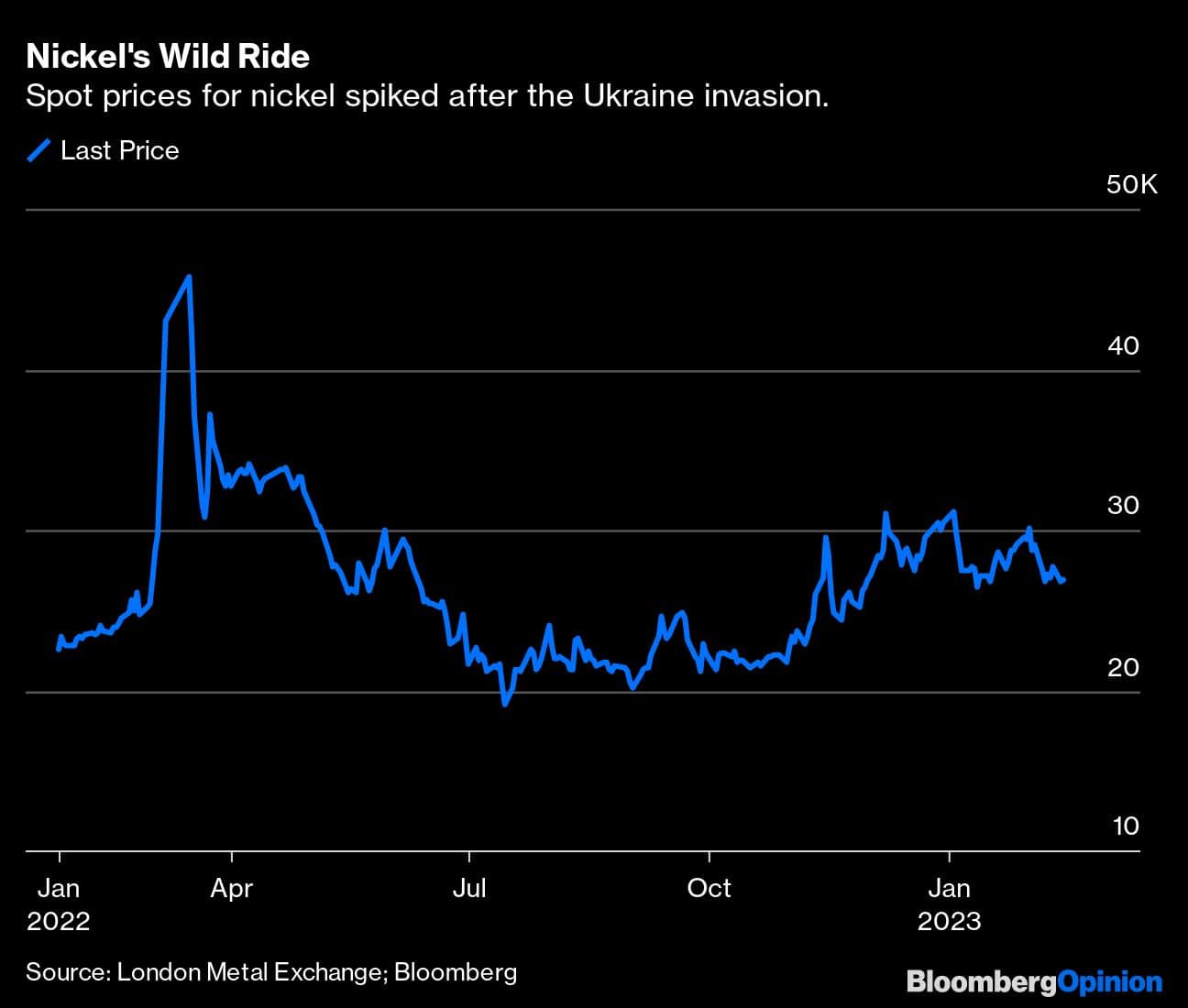
When Russia invaded Ukraine last year, the world got a glimpse of what awaits supply chains in the future. Sudden supply constraints meant that the prices of many commodities, including metals and rare earths, spiked. Nickel prices, for example, rose by 90 percent in the first weeks after the invasion.
Many of these materials have specific roles to play in a low-carbon future: The International Energy Agency has predicted that, if the green transition takes hold, demand for nickel might increase 20 times. Most national governments have woken up to this reality and have started to look for ways to secure their supplies of critical materials. Yet, as we have just learned from commodity trader Trafigura Group’s loss of $577 million to possible fraud, the private sector is relatively unprepared for what the future may hold.
It is easy to look at some of these demand projections, do a quick back-of-the-envelope calculation, and predict easy profits. That would be a mistake. When demand in a sector grows by an order of magnitude and its total value increases manifold — rare earths alone will quintuple in value in the coming decades, according to the IEA — then the sector must take a closer look at how it organizes and governs itself.
Trafigura seems to have lost more than half a billion dollars mainly because it failed to check what was in the shipments against which it was lending money to companies associated with Indian metals trader Prateek Gupta. Internally, many questions will be asked: For example, why did the company keep doing business with Gupta even after he became the subject of a fraud investigation in India? Why did it agree to be paid for lending money against nickel shipments in yet more nickel?
Yet the questions for policy makers, corporations and commodity traders go deeper than this particular case. They have to ask themselves if the existing architecture — which empowers trading companies such as Gupta’s — is fit for a sector that is about to experience explosive growth and become a center of geopolitical competition. The Trafigura scandal is only the latest in a series of losses to traders, in each of which it turns out shipments or stockpiles existed only on paper.
Many of the materials critical for the green transition are currently produced in far fewer areas than oil and gas are. Nevertheless, supply chains for them are frequently very complex. The temptation might be to maintain this complexity, as it could allow trading across geopolitical divides. Yet this case — Gupta has claimed he wanted to ship nickel alloy rather than nickel in “an effort to avoid a ban on shipping nickel of Russian origin” — shows how that effort might create new risks.
In planning for the future, Western governments and companies have three options. The first is to continue business as usual, financing more and more shipments as demand grows. The second is to let China slowly take over the sector. This, given current geopolitical tensions, would seem the least preferred option.
The third is for Western companies to invest in exploration, mining and transportation of these materials themselves, creating extensive but transparent supply chains that meet proper governance standards. Fewer trading houses would be required, and more all-in-one equivalents of the great integrated oil companies that oversaw everything from exploration to distribution.
Transforming the sector will, naturally, cost money. And it will require the West to get its hands dirty. Rather than relying on dematerialized finance, you would need boots on the ground in the areas — many of them conflict-ridden and governance-poor — where these materials are to be found.
Local partners would need to be identified with far greater due diligence than Trafigura appears to have exhibited in this case. And, in a world that is far more democratic than that of the 1900s, you would need to invest money and time in the countries and communities where the materials are mined.
In the long run, however, this may well turn out to be the cheaper option. The Gupta episode has shown that, as values in the sector increase, it will become harder and harder to depend upon middlemen to do the work. The next scandal could be even bigger — and might potentially freeze financing across entire commodities. Countries, not just companies such as Trafigura, cannot afford such risks.
Mihir Sharma is a Bloomberg Opinion columnist. A senior fellow at the Observer Research Foundation in New Delhi, he is author of “Restart: The Last Chance for the Indian Economy.”
Credit: Bloomberg
Discover the latest Business News, Sensex, and Nifty updates. Obtain Personal Finance insights, tax queries, and expert opinions on Moneycontrol or download the Moneycontrol App to stay updated!
Find the best of Al News in one place, specially curated for you every weekend.
Stay on top of the latest tech trends and biggest startup news.