Vinayak Dalmia
Secrecy is the freedom tyrants dream of - Bill Moyers, former White House press secretary.
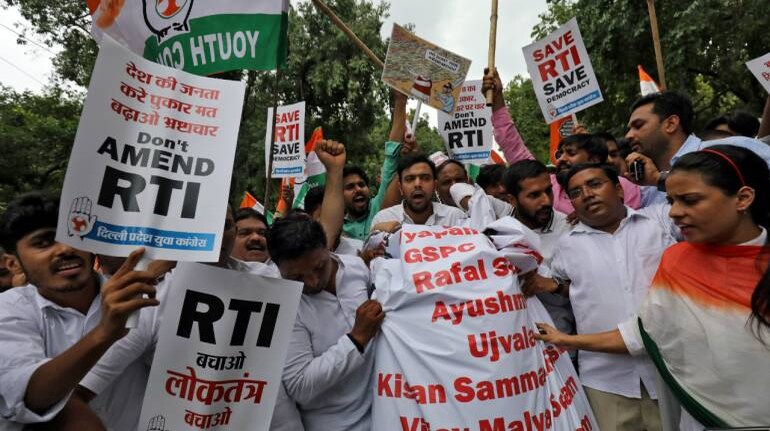
On July 22, Lok Sabha amended the Right To Information (RTI) Act allowing the Centre to determine the term of office, salaries, allowances and other terms of the information commissioners (ICs) who were originally deemed to be on a par with the election commissioners (ECs).
It is easy to fall into a common trap of nostalgia, but 2019 does seem like a far cry from 2005 when the RTI Act was first passed. It opened the black-box of governance and policy-making and allowed the average Indian to ask difficult questions to those in power. Some governments paid a price for this transparency and it made them queasy and uncomfortable. It was a price worth paying and it remains so till this day. Baring some exceptions (such as affairs of national security et. al) secrecy is a lazy and dodgy tool used by those in power. It allows governments to hide their inefficiency, incompetence and worse still their ulterior designs.
Why is RTI important?
Over the years many inconvenient questions have been asked off the government. The RTI allows to pierce the veils of governance ranging from substantial national issues to more granular municipal ones. The RTI covers it all — electoral funding, spectrum allotments and defence deals. Its power is immense and its reach far and wide. Only those who want to hide and keep the truth hidden will have any grouse with such a tool.
The Bharatiya Janata Party (BJP) and others have been past beneficiaries of the RTI, be it the Commonwealth Games or the 2G Spectrum allocation. It is a different story that wrong and false aspersions were made in both cases and it did not stand in the court of law. Political parties and its leaders tend to change rather dramatically when they make the transition from Opposition to government.
A statutory body
Prima facie the government of the day wants to set right the anomaly of statutory bodies (the information commissions) being treated on a par with a constitutional body (the election commission).
If one scrapes beneath the technical facade multiple flaws come to surface. First, there is no legal provision preventing information commissions from being treated on a par with the EC. Moreover this provision was originally passed unanimously by Parliament on suggestions of a standing committee. Second, there is precedent of statutory bodies (the CVC and Lokpal) being treated equivalently to constitutional ones. Third, a constitutional stature insures greater autonomy and independent functioning of institutions and posts.
It is ironic that this government is putting the EC (a constitutional body) on a hallowed higher altar at a time when it is being accused of systematically diluting the ECs independence and autonomy, especially leading up to the general elections.
Ad-hoc, arbitrary and subjective
In 2005, the parliamentary standing committee reviewing the RTI Bill said that the terms of appointment was the “essence of the Bill". It went onto state that “it is necessary to elevate their status to that of the Election Commission of India”.
Now, the first step has been to dilute the stature of the ICs by rendering them non-constitutional and doing so very explicitly. The second was to curb the independence of the commissioners in their terms of service.
Prior to the recent amendment the RTI Act allowed a five-year term or until the age of 65, whichever is earlier. The amendment proposes that the appointment will be "for such term as may be prescribed by the central government”. This will lead to subjective and ad-hoc terms of appointment. Not to say of the job insecurity that it will percolate.
Originally, the salaries were fixed on a par with EC officers — after the amendment, the Centre will fix the salaries.
How does one expect the information commissioners to act with freedom and be fair when the government has the powers to fix the tenure, status, salaries, terms and conditions! All orders and decisions by the commissioner will be made while looking over her shoulder. It will neither be impartial nor seen to be impartial.
In addition to this damage, the amendment threatens to further damage the federal structure of our polity. The Centre now has the power to decide the tenure and compensation of even the state information commissioners.
Majority or majoritarisnism?
Majority in Parliament should not mean majoritarianism in law making. It’s a telling sign that there has been no public consultation, nor was the Bill sent to a select or standing committee in violation of the law ministry’s ‘pre-legislative consultative policy’. Parliamentary democracy is meant to be a dialogue, a discussion, not a heavy-handed approach where it is ‘my way or the highway’.
Conclusion
Many countries, including the United States and the United Kingdom have recognised the right to information as an essential right and freedom, and have enacted laws to that end. The US adopted the Freedom of Information Act in 1966, and President Lyndon Johnson said that he signed the Bill “with a deep sense of pride that the United States is an open society in which the people's right to know is cherished and guarded”. In 2016 his then Press Secretary Bill Moyers said “we had to fight for it then, and we have to keep fighting for it 50 years later”. India it seems has decided to give up on the fight for now.
Far from reducing pendency to protecting whistle blowers there are several reforms that are needed to further strengthen the RTI. Instead of moving in that direction the government is taking a U-turn. Given this, it’s baffling that while addressing the annual convention of information commissioners in 2015, Prime Minister Narendra Modi said: “More openness in government will help citizens. In this day and age, there is no need for secrecy”.
Vinayak Dalmia is a lawyer and writer. Views are personal.

Discover the latest Business News, Sensex, and Nifty updates. Obtain Personal Finance insights, tax queries, and expert opinions on Moneycontrol or download the Moneycontrol App to stay updated!
Find the best of Al News in one place, specially curated for you every weekend.
Stay on top of the latest tech trends and biggest startup news.