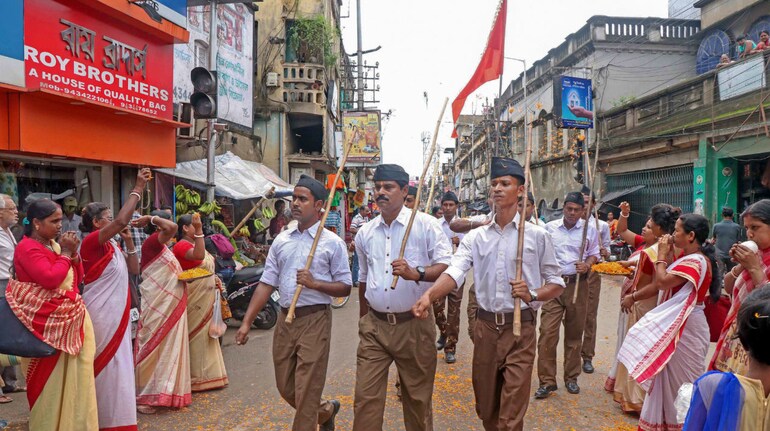
Rashtriya Swayamsevak Sangh (RSS) has been often portrayed as anti-minorities by its detractors. But contrary to the perception built through several decades of fear mongering, the RSS has never been anti-minorities. In fact, the RSS doesn’t believe in the binary of majority and minority. It believes that citizens of India might be following different religions but their ‘Dharma’ is one and that is ‘Hindu Dharma’. For the RSS, the word ‘Dharma’ represents a set of civilisational values that are eternal to the Bharatiya way of life. It doesn’t have anything to do with different ways of worshipping. So an Indian going to the Church or to a Mosque is as much a Hindu as the one who goes to the temple.
Manmohan Vaidya, a senior Pracharak and an ideologue of the RSS, summed this up in an article he penned for Indian Express newspaper in 2019 “…Being Hindu or ‘Hindutva’ has become the identity of all Bharatiyas. The founder of RSS, KB Hedgewar, made this Hindutva the tool to awaken the sense of unity among all Bharatiyas — connecting them with each other irrespective of their caste, region, religion and language. He started organising the entire society by binding them together with this thread of Hindutva.”
Vaidya lucidly explained the Sangh’s perspective on minorities in an interview in 2017 (RSS Interviews, Vichar Vinimay Prakashan, April 2017, p.25).
“In Bharat, traditionally, we believe that all religions lead to the same destination and hence are equal…Ninety-nine per cent of Muslims and Christians in India are converted, having origin in Bharat. Then how can a mere change of faith make them qualify as minorities?”
A look at the history of the RSS shows that it has consistently engaged with the minorities. The second Sarsanghchalak of RSS MS Golwalkar had an interesting exchange of letters with several Muslim intellectuals and luminaries (Shri Guruji Samagra, Volume 7, Prabhat Prakashan, P.154-158).
Golwalkar popularly known as ‘Guruji’ discussed the issue of minorities in several interviews and speeches as well as Q&A sessions with people from various walks of society (Shri Guruji Samagra, Volume 9) that being Muslim or Christian doesn’t come in the way of being part of ‘Hindu Rashtra’.
Sunil Ambekar, Akhil Bharatiya Prachar Pramukh (head of the media/
publicity wing of the RSS), talked about this issue in detail in his book, The RSS Roadmaps 21st Century.
Ambekar noted, “The forefathers of Muslim and Christian populations in India, too, lived by following the Hindu way of life. In our country, many forms of worship developed over several millennia, and so there was no discrimination on the basis of faith or the form and manner of worship.”
He added, “To be born an Indian means to be a descendant of Indian culture; it is not just the physical act of being born, it is being mindful of a cultural ethos laid down by our progenitors…. The motherland is not a territorial map; she is a great spiritual being.”
Dwelling upon this issue further, he emphasised, “Hindu Rashtra is not anti-Muslim. It never was. India’s socio-political kernel is that of ‘Hindu Rashtra’, hence different sects of Islam, Christianity and other religions still practise their faith and rituals openly and freely in India… Therefore, it is absolutely wrong to present Hindutva as a narrow idea to our future generations.”
J Nandakumar, an RSS Pracharak (full-time worker) who is also the national convenor of Prajna Pravah, an organisation of intellectuals, quoted an interesting comment of Guruji, who was Sarsanghchalak from 1940 to 1973, in his book Hindutva for the changing times.
Nandakumar wrote, “In an interview to Dr Saifuddin Jilani, Guruji (the second Sarsanghchalak) says: Indianisation does not mean converting all people to Hinduism. Let us all realise that we are the children of this soil and we must have allegiance to this land. We belong to the same society and our ancestors are common. Understanding this is Indianisation in the real sense. Indianisation does not mean that one should be asked to quit his religious system. We neither said this, nor we are going to say so. Rather we believe that a single religious system for the entire human society is not suitable.”
Also read: PM Modi to arrive in Srinagar on 2-day visit
Conclusion
The RSS doesn’t look at Indians from a binary of majority and minority; it considers all Bharatiyas to be Hindus who consider this nation to be their motherland and want to live and die for it. They might be practising any religion or following any particular way of worship, but for Sangh they are all Hindus. Hindu and Bharatiya are interchangeable words for the RSS. Those critics who often tend to misinterpret the RSS’ stand on minorities get it wrong, as their conceptual framework is based on a binary of majority religion and minority religion. They have built a stereotype image of the RSS that it represents majority, i.e. Hindus in India, and it is anti-minorities (broadly Islam and Christianity). Once these critiques stop thinking and interpreting in binaries, they would be able to understand the consistency of the RSS’ stand on minorities.
Earlier RSSFACTS columns can be read here.
Discover the latest Business News, Sensex, and Nifty updates. Obtain Personal Finance insights, tax queries, and expert opinions on Moneycontrol or download the Moneycontrol App to stay updated!
Find the best of Al News in one place, specially curated for you every weekend.
Stay on top of the latest tech trends and biggest startup news.