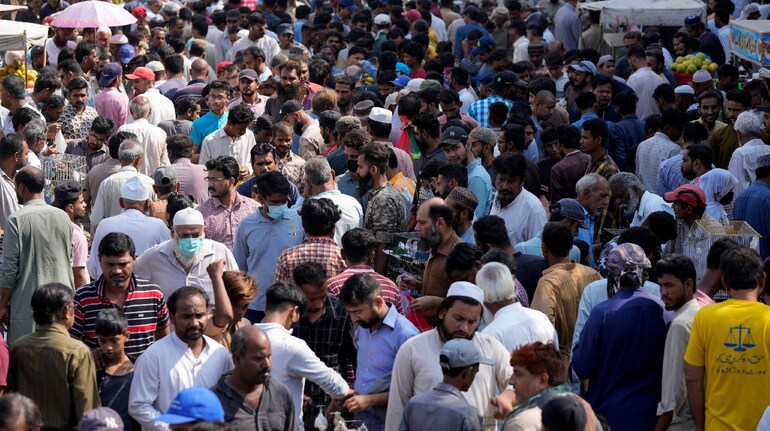
A recent comment by Mohan Bhagwat, the Sarsanghchalak of the Rashtriya Swayamsevak Sangh (RSS) that called for Hindus to have more children has kicked off a new round of debate on the issue of religious demography of India.
Changes in India’s religious demography
The last census of India conducted in 2011 revealed some interesting facts. At the national level, the religion data of the 2011 census shows an increase in the share of Muslims in the population of India from 13.43 percent in 2001 to 14.23 percent. They have thus added 0.8 percentage points to their share in the population.
This was the third decade in a row when the share of Muslims had increased by or above 0.8 percentage points pointing towards a significant change in religious demography in the long run. Incidentally, the share of Muslims in the Indian population has been rising every decade since Independence and Partition.
According to JK Bajaj from Centre for Policy Studies, another way to assess the increase in the share of Muslims is to look at the normalized gap in the decadal growth rates of Muslims and others, especially the Indian Religionists (IRs), among whom we include the Hindus, Sikhs, Jains and those in the Census category of “Other Religions and Persuasions (ORPs)”.
The gap between the growth rates of Muslims and IRs, normalized to the absolute growth of IRs, widened to as much as 49 percent during 1981-91; it became marginally narrower in 1991-2001 and has widened again in the last decade. The commentators, who have been pointing out the decline of the Muslim growth rate from 29.69 to 24.65 percent as an indication of the halting of the religious imbalance, are wrong; because, the normalized gap between the growth rates of Muslims and IRs has only widened, adds Bajaj.
It is clear from the Census data that for three decades in a row, the Muslims in India have grown by nearly 50 percent. Such a wide difference in the growth rates of one community compared to others is not sustainable in any society, says Bajaj.
India to have largest Muslim population in the World
According to the CPS study, Muslim population in India has grown to 17.22 crore in 2011 compared to 3.77 crores in 1951. This implies a multiplication factor of 4.6. The population of Indian Religionists in the same period has multiplied only 3.2 times. According to 2011 data, India hosted the second largest Muslim population in the world. Indonesia had 19.1 crore Muslims in its population of 24 crores at that time. This way, India is even ahead of Pakistan, which had 16.7 crore Muslims in its total population of 17.4 crores in 2010. Given the trends, most demographers would agree that within two- or three-decades India shall be home to the largest Muslim population in the world.
Implications of change in religious demography
Countries which have undergone significant change in religious demography with a rise in Muslim population have been witnessing severe bloody conflicts. Significant sections of Muslims are insistent on implementing Sharia and not following the constitutions of their respective countries. The religious riots in Europe, street fights by Muslim radicals in the streets of Britain and a civil war in several countries of Africa and middle east where Islamic militia are playing a dominant role are globally acknowledged facts.
Lebanon is a classic case study where till 1970’s Christians were in majority and the country was flourishing. With Muslims becoming the majority, the country was thrown into a 15 year long civil war that wrecked the country. This war has erupted again now leaving an endless trail of death and destruction.
Lebanon was the only Christian dominated democracy in the middle east after the second world war. It was compared to Switzerland due to its picturesque geography and its capital Beirut was considered to be no less attractive than Paris. Today Lebanon is a wrecked state and has become a sanctuary for terrorist organisations like Hezbollah.
In an interesting study, Pierre Rostan and Alexandra Rostan projected in 2019 that 13 European countries will have Muslim population as a majority over the next two centuries. These countries are Cyprus, Sweden, France, Greece, Belgium, Bulgaria, Italy, Luxembourg, UK, Slovenia, Switzerland, Ireland and Lithuania.
However, given the rapid increase in immigration of Muslims to Europe and their high fertility rate, this might happen much earlier.
“The greater the proportion of Muslims in a country, the faster the change will be in the society: construction of mosques, prayer calls from loudspeakers, open air worships, halal products available in supermarkets and produced locally, compatible workload and adjustable working hours with Ramadan constraints are examples of such changes in Europe,” said this study.
Religious Demography and RSS
The issue of religious demography has been discussed within the RSS since its inception. Until 2005, this discussion was more focused on the threat posed by the religious conversions of Hindus in India into Islam and Christianity. Then the Chennai-based Centre for Policy Studies (CPS) published a report Religious Demography of India in 2005. The study projected that India's religious demography was undergoing a rapid change that could have huge implications. This brought the growth rate of Muslim population under scanner and the RSS has been discussing this issue more vocally since then. According to the CPS, going by the current trends of high Muslim growth rate in India and annihilation of Hindus in Pakistan and Bangladesh, Indian religionists will become a minority in the Indian subcontinent in another five to six decades. And this definitely bothers the RSS.
Earlier RSSFACTS columns can be read here.
Discover the latest Business News, Sensex, and Nifty updates. Obtain Personal Finance insights, tax queries, and expert opinions on Moneycontrol or download the Moneycontrol App to stay updated!
Find the best of Al News in one place, specially curated for you every weekend.
Stay on top of the latest tech trends and biggest startup news.