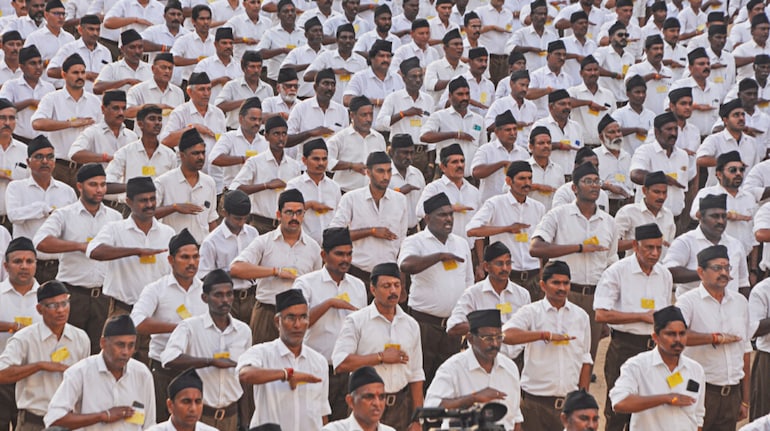
The relationship between the Rashtriya Swayamsevak Sangh (RSS) and the Constitution of India has, for decades, been clouded by manufactured narratives, sustained political propaganda, and ideological bias. A deliberate misunderstanding has been created by critics of the organisation, questioning the RSS’s commitment to the constitutional order. This has been done through selective readings of history rather than a full engagement with facts and the actual conduct of the organisation and its members in public life.
As the nation gets ready to celebrate its 77th Republic Day on 26 January 2026, it would be appropriate to look at the RSS’s engagement with India’s constitutional democracy on the basis of facts rather than prejudice.
Sarsanghchalak on the Constitution
In his annual speech on Vijayadashami in 2024, the RSS Sarsanghchalak, Mohan Bhagwat, categorically spoke about commitment to the Constitution of India. Addressing a huge gathering of swayamsevaks (RSS volunteers) and other prominent members of society at Nagpur on 12 October 2024, he said: “When we live together, some duties and disciplines of our behaviour towards each other are also formed. Law and the Constitution too are a social discipline. Philosophical foundations and rules are made so that all people in society live together harmoniously, keep progressing, and do not disintegrate. We, the people of Bharat, have given ourselves this commitment to the Constitution. Keeping in mind the meaning of this sentence of the Preamble, everyone has to discharge the duties given by the Constitution and the law properly. We should follow this system in all matters, big or small.”
He added: “Rules and regulations should be followed both in letter and spirit. To ensure that this is done properly, especially the knowledge of four aspects of our Constitution — the Preamble, the guiding principles, fundamental duties, and fundamental rights — should be made known to the general public. The discipline of mutual conduct passed on by the family; piety, cordiality, and decency in mutual behaviour; devotion towards the motherland and affinity towards society in social behaviour, along with flawless observance of law and the Constitution — all these together form the personal and national character.”
Protecting the Constitution
The biggest threat to the Indian Constitution after independence emerged in 1975, when the Indira Gandhi–led Congress government at the Centre imposed the Emergency. It was the RSS-led underground movement that contributed to the restoration of democracy in the country. At least 87 RSS workers sacrificed their lives fighting against the Emergency (a list with names and details is available in The People vs Emergency: A Saga of Struggle by P. G. Sahasrabuddhe and Manikchandra Vajpayee). More than one lakh RSS volunteers were imprisoned for opposing the Emergency. Prime Minister Narendra Modi, who was an RSS pracharak (full-time worker) at the time, also played an important role in this underground movement.
While the Indian media was crushed by censorship during the Emergency, the international media highlighted the role of the RSS in the movement seeking to restore democracy and protect the Constitution. The Economist wrote on 24 January 1976, in an article titled ‘Yes, There Is an Underground’: “In formal terms, the underground is an alliance of four opposition parties: the Jana Sangh (the RSS’s political wing), the Socialist Party, the breakaway fraction of the Congress Party, and the Lok Dal. The shock troops of the movement come largely from the Jana Sangh and its affiliate, the RSS, which claim a combined membership of 10 million (of whom 80,000, including 6,000 full-time party workers, are in prison).”
The Economist later wrote again on 12 December 1976: “The underground campaign against Mrs Gandhi claims to be the only non-left-wing revolutionary force in the world, disavowing both bloodshed and class struggle. The ground troops of this operation (the underground movement) consist of tens of thousands of cadres who are organised to the village level into four-man cells. Most of them are RSS regulars, though more and more new young recruits are coming in. The other underground parties which started out as partners in the underground have effectively abandoned the field to the Jana Sangh and the RSS.”
RSS and Ambedkar
While the Congress consistently opposed Dr B. R. Ambedkar, the key architect of the Indian Constitution, it was the RSS that stood by him. Dattopant Thengadi, an RSS ideologue and full-time worker, worked closely with Dr Ambedkar. He also authored a definitive biography of Babasaheb titled Dr Ambedkar aur Samajik Kranti ki Yatra. The book is based on Thengadi’s personal experiences and interactions with Ambedkar.
As a young pracharak of the RSS, Thengadi was such a trusted associate of Ambedkar that he was appointed Secretary of the Scheduled Caste Federation when Ambedkar was its chairman. Thengadi also served as Ambedkar’s election agent during the by-election for the Bhandara constituency in 1956.
“The RSS workers worked day and night for Babasaheb (Ambedkar) on the directions of Guruji (the second RSS chief, M. S. Golwalkar) … Though Babasaheb lost this election, when he analysed the poll results, he realised that the votes he polled were much more than the total number of Scheduled Caste votes there. A large number of upper-caste voters had also voted for him. He was quite content with this outcome,” wrote Thengadi in the book.
In fact, when Ambedkar visited an RSS training camp at Pune in 1939, the RSS founder and its first Sarsanghchalak Dr Keshav Baliram Hedgewar had arranged his lecture on ‘Dalit problem and emancipation of Dalits,’ recounted Mohan Bhagwat while speaking at a book release function in 2015.
Earlier RSSFACTS columns can be read here.
(Arun Anand has authored two books on the RSS. His X handle is @ArunAnandLive.)
Views are personal, and do not represent the stance of this publication.
Discover the latest Business News, Sensex, and Nifty updates. Obtain Personal Finance insights, tax queries, and expert opinions on Moneycontrol or download the Moneycontrol App to stay updated!
Find the best of Al News in one place, specially curated for you every weekend.
Stay on top of the latest tech trends and biggest startup news.