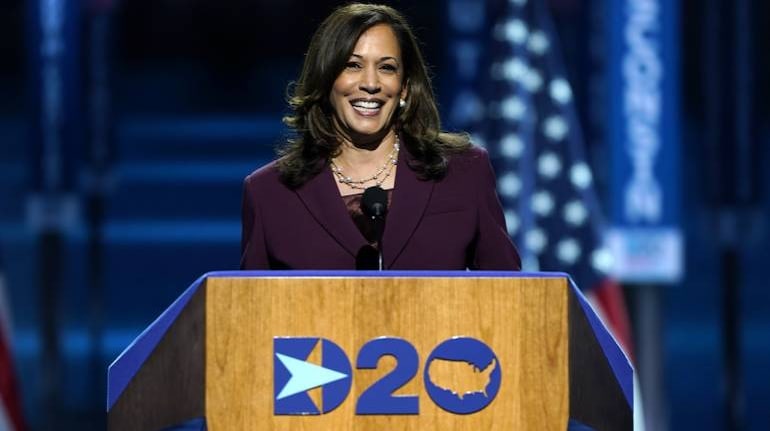
Today, August 17, the Democratic National Convention in Milwaukee, in Wisconsin, United States, will kick off. At the end of the three-day event Joe Biden will be announced as the Democratic Party’s Presidential candidate for the elections in November.
Biden’s decision to nominate California Senator and his one-time presidential rival, Kamala Harris, as his vice-presidential running mate has added a sense of excitement to an otherwise dull campaign. What is disconcerting is the way Harris’ nomination has engendered a vacuous debate in India about the future of India-US ties, and what she brings to the table, if at all anything.
For a nation that proclaims to be a self-confident and rising power, this discussion around Harris has revealed a fundamental weakness — a weakness that always views India as a nation that will be shaped by the actions of others, as opposed to one which has the ability to shape the behaviour of others. Tom-tomming Harris’ India lineage does justice neither to India’s own aspirations, nor to Harris who has never been shy of identifying herself first and foremost as Black — “I'm black, and I'm proud of being black. I was born black. I will die black,” she said in a March 2019 interview.
At the end of the day, Harris has emerged a formidable American politician playing by the rules of American politics, and all she should be expected to do is to take care of American interests. What we in India should have been doing is to assess her on her foreign policy track record, not her Indian connection. Harris does not have much of a track record on foreign policy which makes it difficult to predict future positions from her past performance, and national security is not her strong suit.
It can safely be assumed that Biden with his long record on foreign policy and national security will be in the driver’s seat. He has indicated that his administration will stand with New Delhi in confronting the threats it faces and has called for strengthening the ‘bond’ between India and the US. In an attempt to woo the Indian American community, his campaign has underlined that his administration will reform the H-1B visa system and work towards eliminating the country-quota for green cards. On the other hand, US President Donald Trump has claimed that he has more support from Indian-origin voters than Harris.
This is happening because the Indian American community has become adept at using its influence to further its agenda. More importantly, irrespective of the parties, New Delhi has become a valuable partner for Washington.
Harris’s past record on India-related issues suggests that she has taken positions on some issues which went against official Indian policies. After the abrogation of Article 370, she is quoted as saying: “We have to remind the Kashmiri people that they are not alone in the world. We are keeping track on the situation. There is a need to intervene if the situation demands.” She was also critical of External Affairs Minister S Jaishankar’s decision not to attend a meeting of the House Foreign Affairs Committee.
Neither Harris’ statements nor her Indian lineage should concern us. What should concern us is how we in India have not been able to come to terms with our nation’s rise. We want to shape global outcomes, but don’t allow for the possibility that India today has the ability to influence the behaviour of others.
America’s foreign policy agenda will be shaped by the fundamental realities shaping the US in the 21st century. When it comes to India-US ties, personalities have tended to become peripheral. Former US President Barack Obama had come to office with a standard set of narrative about India, from non-proliferation to Kashmir. On all such issues he wanted to challenge New Delhi. By the time he left office, he had been converted and was one of India’s greatest friends. Trump had also come to office after a campaign in which India, along with China, was a constant target and was willing to be transactional. Yet after four years, India-US relations have not only grown, they have been able to come off much better than America’s ties with some of its closest allies.
If the Biden-Harris ticket wins in November, India-US ties will be shaped not by Harris being half-Indian or by her previous statements on Kashmir, but by the structural realties that confront Washington and New Delhi in the Indo-Pacific and beyond. Everything else is just a distraction.
Harsh V Pant is director, Studies, at Observer Research Foundation, New Delhi and professor of international relations, King’s College London. Views are personal.
Discover the latest Business News, Sensex, and Nifty updates. Obtain Personal Finance insights, tax queries, and expert opinions on Moneycontrol or download the Moneycontrol App to stay updated!
Find the best of Al News in one place, specially curated for you every weekend.
Stay on top of the latest tech trends and biggest startup news.