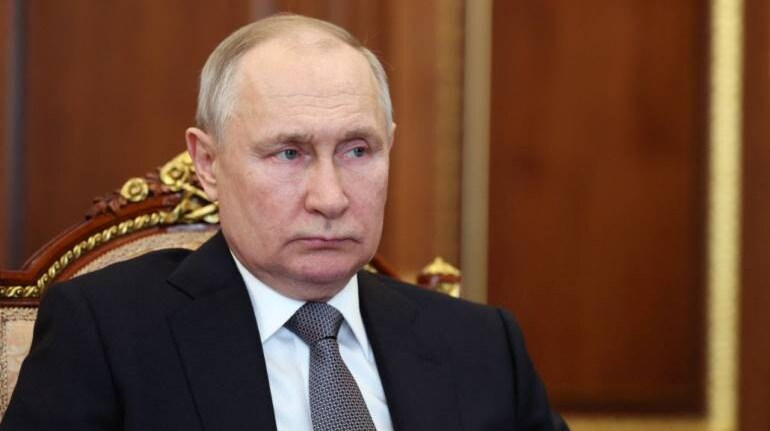
How should the West respond to Russian President Vladimir Putin’s
announcement last week that he’s begun moving nuclear weapons into Belarus, within striking distance of Ukraine?
So far, the US and its allies have reacted warily, hoping to avoid escalation. Their caution is understandable. Yet failing to respond to such a provocation is likely only to embolden Russia — and hence to make the conflict all the more difficult to resolve.
Putin’s nuclear gamesmanship is meant to instill fear and pressure the NATO alliance into withdrawing support for Ukraine. The nuclear-tipped Iskander ballistic missiles at issue have an estimated range of 500 kilometers (311 miles), four times farther than Belarus’s existing arsenal of conventional missiles. Russia has said a number of Belarusian Sukhoi Su-25 jets will be adapted to carry nuclear warheads, most likely stationed at the Lida air base near the border with Lithuania. That would put not only a huge chunk of Ukraine but also several NATO allies within reach.
As alarming as that sounds, simply positioning nukes closer to Ukraine won’t help Russia much on the battlefield. Depending on the weather, Russian forces could be caught in any fallout if the weapons were detonated. It would invite major retaliation, galvanise global opposition to Putin, and almost certainly cost Russia the financial lifelines that China and India have so far been extending. Launching the weapons against NATO countries would make even less sense, given their strategic nuclear arsenals and superior conventional capabilities.
Given those realities, the West should avoid tit-for-tat actions that could needlessly increase nuclear risks — such as repositioning its own nuclear weapons. Moving those weapons in range of Belarus-based missiles would only make them sitting targets and would do little to strengthen deterrence, while heightening the potential for miscalculation.
So what should be done instead?
First, it’s important to show that Putin’s nuclear blackmail won’t succeed. The US and its allies should redouble military and economic support for Ukraine, and in particular bolster its overstretched air and missile defenses.
Next, NATO should emphasise that any use of nuclear weapons will be met with an overwhelming military response, whether it’s delivered by conventional or non-conventional means. China and India should also remind Putin of the costs of any rash action, which both have an overriding interest in avoiding. At the same time, NATO leaders need to reiterate the alliance’s respect for Russia’s sovereignty within internationally recognised borders. Refuting Putin’s false claims that NATO is the aggressor in this conflict might help discourage some Russian commanders from carrying out reckless orders.
Finally, Putin’s provocations are a reminder of longstanding gaps in NATO’s own capabilities. In particular, the alliance needs to upgrade its air and missile defenses. Existing capabilities are fragmented and insufficient, more designed to counter a rogue Iranian missile launch than attacks against major European targets from multiple delivery systems. The answer is not just increased capacity but better integration. To counter today’s sophisticated missile threats and enhance the credibility of its deterrent, NATO needs a range of systems that work together and are interoperable across the alliance.
Russia’s de facto colonisation of Belarus, a longtime vassal state run by strongman Alexander Lukashenko, has been a Putin project for years. Russia’s push to move tactical nukes there introduces new risks and uncertainties that extend beyond Ukraine. Only prompt and resolute action by NATO can meet the challenge.
The Editors are members of the Bloomberg Opinion editorial board. Views are personal and do not represent the stand of this publication.
Credit: Bloomberg
Discover the latest Business News, Sensex, and Nifty updates. Obtain Personal Finance insights, tax queries, and expert opinions on Moneycontrol or download the Moneycontrol App to stay updated!
Find the best of Al News in one place, specially curated for you every weekend.
Stay on top of the latest tech trends and biggest startup news.